The Study of Translating District Names in Loei Province into Chinese Using the 3R Framework
Keywords:
Chinese language, Translation, Loei province, 3R frameworkAbstract
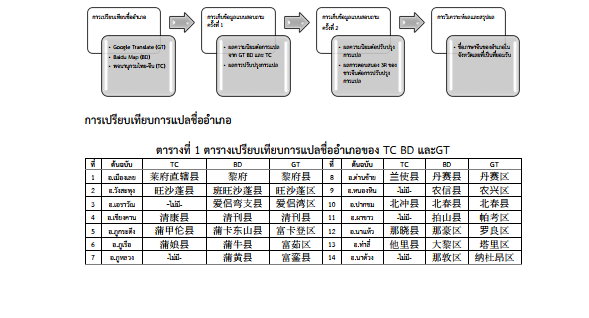
Loei Province comprises 14 districts, with district names serving as fundamental references for the locations of government offices and tourist attractions. Accurate and standardized translation of these names is essential for effective communication with Chinese speakers. This study aims to: 1) compare district name translations from various sources; 2) evaluate the acceptability of these translations among Chinese speakers using the 3R framework (Reaction, Response, and Repercussion); and 3) propose appropriate and accepted Chinese translations of district names in Loei Province. A mixed-methods approach was employed, involving comparative analysis and questionnaire-based data collection, with both qualitative and quantitative data analysis. The results revealed that: 1) district name translations varied across sources, especially in the choice of Chinese characters used for transliteration of names such as Loei, Phu, Na, Duang, and Kradueng; 2) Chinese respondents showed the highest preference for translations generated by translation programs; and 3) based on the 3R framework, the revised translations received an overall acceptability rating of 74%, considered high. In detail, 3.1) Reaction—the initial response—scored 87%, indicating a generally positive attitude; 3.2) Response—deeper engagement—scored 48%, suggesting that respondents did not seek further clarification or revision; and 3.3) Repercussion—perceived benefits—also scored 87%, as the translations were seen as helpful. Based on these results, the study proposes a set of standardized, culturally appropriate Chinese translations for the district names of Loei Province, which may serve as a reference for improving the translation of geographic names and other location-based terms in cross-cultural contexts.
Downloads
References
Chesterman, A. (2016). The memes of translation: The spread of ideas in translation theory (Revised ed.). John Benjamins Publishing Company.
García, O., & Lin, A. M. Y. (2016). Translanguaging in bilingual education. In O. García, A. M. Y. Lin, & S. May (Eds.), Bilingual and multilingual education (pp. 1-18). Springer.
Krittopakarnkit, K. (2020). Translating Thai horror film titles into Chinese: Strategies and analysis. Rajabhat Journal of Science, Humanities and Social Sciences, 21(2), 354-373.
Liu, X. (2019). A study on the transliteration and localization of loanwords. Foreign Language Research, (2), 112-117.
Liu, X. (2023). A Reception Study on the Transliteration in Genshin Impact: Evidence from a Questionnaire Survey (Master's thesis). China Foreign Affairs University, Beijing, China.
Ministry of Tourism and Sports. (2025). Tourism news. Retrieved May 7, 2025, from www.mots.go.th/news/category/411.
Nilubol, K., Saengpakdeejit, R., Botmart, V., Phalapree, D., Kaenin Sisamouth, W., Maneekanon, O., & Muangkote Mungkhunsan, C. (2023). Translanguaging in English language teaching: A perspective of bilingual education. Journal of Humanities and Social Sciences Loei Rajabhat University, 4(1), 1–12.
Numthong, K. (2011). Thai-Chinese translation textbook (2nd ed.). Kasetsart University, Faculty of Humanities, Confucius Institute.
Office of the Royal Society. (2011). Royal Institute dictionary. Retrieved September 14, 2024, from dictionary.orst.go.th.
Toury, G. (1995). Descriptive translation studies – and beyond. Amsterdam: John Benjamins Publishing.
Xiao, S. (Ed.). (1990). Thai-Chinese Dictionary. Beijing: The Commercial Press.
Xiao, S., & Gong, Y. (Eds.). (2019). Modern Thai-Chinese Dictionary. Nanning: Guangxi Education Publishing House.
The Central People's Government of the People's Republic of China. (2009, April 17). China's administrative divisions—Grassroots administrative units below the county level. Retrieved from https://www.gov.cn/test/2009-04/17/content_1288055.htm