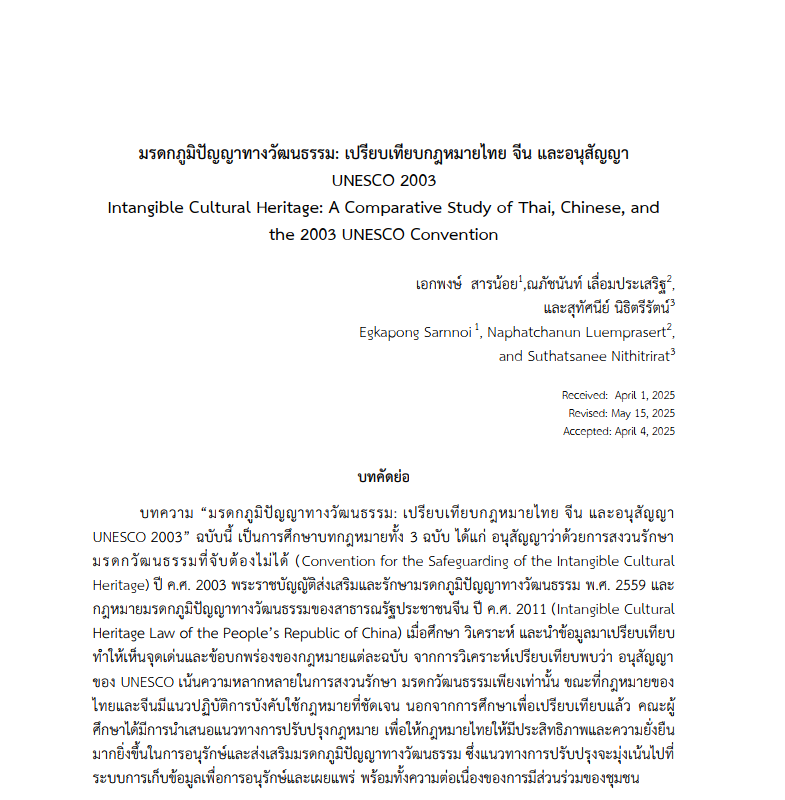
Intangible Cultural Heritage in the Legal Context: A Comparison between the 2003 UNESCO Convention, Thai Law and Chinese Law
Keywords:
Intangible Cultural Heritage, Preservation, TransmissionAbstract
The article titled "Intangible Cultural Heritage in the Legal Context: A Comparison between the 2003 UNESCO Convention, Thai Law and Chinese Law" presents a study of three legal frameworks: Convention for the Safeguarding of the Intangible Cultural Heritage (2003), the Act on the Promotion and Preservation of Intangible Cultural Heritage (2016) of Thailand, and the Intangible Cultural Heritage Law of the People's Republic of China (2011). Through examination, analysis, and comparative data, this study highlights the strengths and weaknesses of each legal framework. The comparative analysis reveals that the UNESCO Convention emphasizes the diversity of safeguarding intangible cultural heritage, while the laws of Thailand and China provide clear enforcement practices. In addition to the comparative study, the research team presents recommendations for improving the legal frameworks of Thailand and China to enhance their effectiveness and sustainability in the preservation and promotion of intangible cultural heritage. These improvement strategies focus on developing systems for data collection related to preservation and dissemination, alongside ensuring the ongoing participation of communities.
Downloads
References
กระทรวงวัฒนธรรม. (2562). นโยบายรัฐมนตรีว่าการกระทรวงวัฒนธรรม. สืบค้นเมื่อวันที่ 19 ตุลาคม 2567 จาก http://www.culture.go.th/off_secretary/ewt_dl_link.php?nid=642
กรมส่งเสริมวัฒนธรรม. (2559). พระราชบัญญัติส่งเสริมและรักษามรดกภูมิปัญญาทางวัฒนธรรม พ.ศ. 2559 และอนุสัญญาว่าด้วยการสงวนรักษามรดกวัฒนธรรมที่จับต้องไม่ได้ ค.ศ. ๒๐๐๓. สืบค้นจาก http://book.culture.go.th/newbook/ich/ich2559.pdf
ธัญญกานต์ บุษบรรณ (2565). มาตรการทางกฎหมายในการปกป้องและส่งเสริมมรดกภูมิปัญญาทาง
วัฒนธรรม. มหาวิทยาลัยธรรมศาสตร์.
เปรม ถาวรประภาสวัสดิ์. (2559). พระราชบัญญัติส่งเสริมและรักษามรดกภูมิปัญญาทางวัฒนธรรม
พ.ศ. 2559: การรักษามรดกทางวัฒนธรรมที่จับต้องไม้ได้. [ออนไลน์].
สืบค้นเมื่อวันที่ 25 ตุลาคม 2566, จาก: https://old.parliament.go.th/ewtadmin/
ewt/parliament_parcy/ewt_dl_link.php?nid=54975&filename=house2558_2
ลิขิต ฮุนตระกูล (2495). ประวัติการสัมพันธ์ระหว่างชาติไทยและชาติจีนแต่ยุคโบราณจนถึงสมัยชาติไทยได้มาตั้งกรุงสุโขทัยเป็นราชธานีแห่งประเทศไทย. โรงพิมพ์ไทยพิทยา.
สถานเอกอัครราชทูต ณ กรุงปักกิ่ง (2568). ความสัมพันธ์ไทย – จีน. [ออนไลน์]. สืบค้นเมื่อวันที่ 20 พฤษภาคม 2568, จาก: https://thaiembbeij.org/th/republic-of-china/thai-relations-china/?utm_source=chatgpt.com
สุวรรณา สังข์สุกใส. (2547). วัฒนธรรมไทย-จีน. กรุงเทพฯ: สำนักพิมพ์แห่งจุฬาลงกรณ์มหาวิทยาลัย.
วนิดา อินทรอํานวย. (2560). พ.ร.บ. ส่งเสริมและรักษามรดกภูมิปัญญาทางวัฒนธรรม. [ออนไลน์].
สืบค้นเมื่อ วันที่ 18 ตุลาคม 2567, จาก: https://cdc.parliament.go.th/ewtadmin/
ewt/elaw_parcy/ewt_dl_link.php?nid=1761
Blake, J. (2009). UNESCO’s 2003 Convention on Intangible Cultural Heritage: The Implications of Community Involvement in ‘Safeguarding’. (p. 45-58). สืบค้นเมื่อวันที่ 19 ตุลาคม 2567 จาก https://www.taylorfrancis.com/chapters/edit/10.4324/978020
-8/unesco-2003-convention-intangible-cultural-heritage-implications-community-involvement-safeguarding-janet-blake
Chen, Y. (2015). Cultural Relics Protection in China: Development and Challenges. Journal of Chinese Cultural Studies, 12(3), 45-58.
Etzkowitz and Leydesdorff. (1995, 2000). The Triple Helix: University–industry–government
innovation in action. สืบค้นเมื่อวันที่ 21 ตุลาคม 2567 จาก
Lenzerini, F. (2011). Intangible Cultural Heritage: The Living Culture of Peoples. European
Journal of International Law, 101-120. สืบค้นเมื่อวันที่ 18 ตุลาคม 2567 จาก https://shorturl.asia/X3TZD
Rong Chai & Hao Li. (2019). A Study on Legislation for Protection of Cultural Relics in China: Origin, Content and Model. สืบค้นเมื่อวันที่ 19 ตุลาคม 2567 จาก
Sun Nuo Zhu Ma & Badaruddin Bin Mohame. (2023). Heritage Tourism an Cultural Identity in China: Challenges and Opportunities for Development. สืบค้นเมื่อวันที่ 19 ตุลาคม 2567 จาก https://www.researchgate.net/publication/372300363_Heritage_Tourism_
and_Cultural_Identity_in_China_Challenges_and_Opportunities_for_Development
The Supreme People’s Court of the People’s Republic of China. (2015). Law of the People’s Republic of China on Protection of Cultural Relics. สืบค้นเมื่อวันที่ 20 ตุลาคม 2567 จาก http://www.npc.gov.cn/zgrdw/englishnpc/Law/200712/13/content_1384
htm
UNESCO. (2003). Convention for the Safeguarding of the Intangible Cultural Heritage.
สืบค้นเมื่อวันที่ 18 ตุลาคม 2567 จาก https://english.court.gov.cn/2015-07/17/c_761516_3.htmhttps://ich.unesco.org/doc/src/15164-EN.pdf