A Study of the Relationship between English Speaking Skills and Communication Problems among Front Desk Staff in Room Check-out and Payment Situations: A Case Study of Loei Palace Hotel, Loei Province
Keywords:
Relationship, English-speaking skills, Front desk staff, Communication problemsAbstract
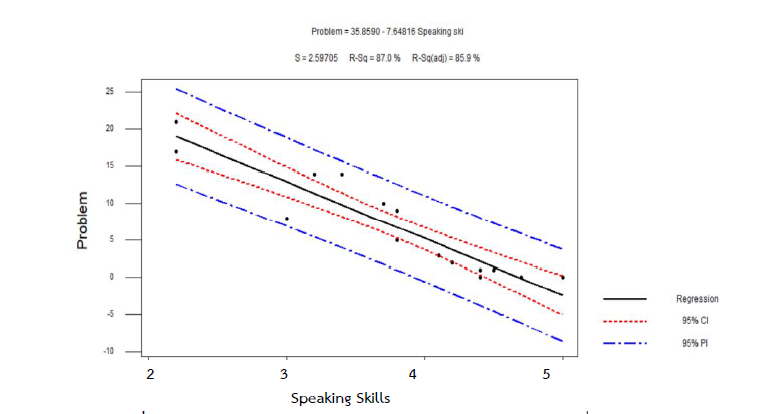
This quantitative research focused on five front desk staff members at Loei Palace Hotel, Loei Province, comprising both English major graduates and non-English major graduates. The participants were selected through Purposive Population. The objectives were 1) to examine the relationship between the English-speaking skills of the front desk staff and the persistent problems in English communication and 2) to investigate the impact of their speaking skills on the existing communication problems during check-out and payment situations. The research instruments consisted of 1) English-speaking skills evaluation questionnaire, 2) an English-speaking skills evaluation rubric for specialists, and 3) an English-speaking skills assessment report from the specialists. The data were analyzed by using relation. The research findings revealed that 1) there was a statistically significant negative relation (r = -0.920 and p = 0.001) between the English-speaking skills of the front desk staff and the persistent English communication speaking problems, and 2) speaking skills were the primary factor affecting persistent English-speaking skill problems (slope = -7.65, and r2(adj)= 85.9%, and p = 0.000) at the significance level of α = .05.
Downloads
References
กระทรวงการท่องเที่ยวและกีฬา. (2566). สถิตินักท่องเที่ยวชาวต่างชาติที่เดินทางเข้าประเทศไทยปี 2566. สืบค้นวันที่ 19 เมษายน 2568, จาก https://mots.go.th/news/category/55
กนต์ธร อรุณไชย. (2563). การศึกษาปัญหาการใช้ภาษาอังกฤษของพนักงานต้อนรับส่วนหน้า กรณีศึกษา: โรงแรมแห่งหนึ่งในย่านสุทธิสาร จังหวัดกรุงเทพมหานคร. บัณฑิตวิทยาลัย มหาวิทยาลัยกรุงเทพ.กรุงเทพฯ.
จารุพร ตั้งพัฒนกิจ. (2563). อิทธิพลของปัจจัยที่ส่งผลต่อการพูดสื่อสารภาษาอังกฤษโดยมีแรงจูงใจเป็นตัวแปร คั่นกลางและความวิตกกังวลเป็นตัวแปรกำกับ. วารสารบริหารธุรกิจและศิลปศาสตร์ ราชมงคลล้านนา, 8(2), 111-126.
แจ่มจันทร์ บุญโญปกรณ์. (2565). การพัฒนาทักษะการสื่อสารภาษาอังกฤษของผู้ประกอบการการท่องเที่ยวเพื่อยกระดับการให้บริการการท่องเที่ยวบนชีวิตวิถีใหม่ด้วยแอปพลิเคชันบนโทรศัพท์มือถือ. Journal of Liberal Art of Rajamangala University of Technology Suvarnabhumi, 4(2), 402-414.
ฐานเศรษฐกิจ. (2568). ต่างชาติเที่ยวไทยเฉียด 24 ล้านคนแล้ว เปิด 5 ชาติเข้าไทยสูงสุด. สืบค้นวันที่ 1 ตุลาคม 2568, จาก https://shorturl.asia/o8pcP
ทิศนา แขมมณี. (2556). ศาสตร์การสอน: องค์ความรู้เพื่อการจัดกระบวนการเรียนรู้ที่มีประสิทธิภาพ. (พิมพ์ครั้งที่ 17). กรุงเทพมหานคร: สำนักพิมพ์จุฬาลงกรณ์มหาวิทยาลัย.
ศรีจิตรา นวรัตนาภรณ์. (2568). การศึกษาความคงทนในทักษะการพูดสื่อสารภาษาอังกฤษพนักงานต้อนรับส่วนหน้าของโรงแรมเลยพาเลซ จังหวัดเลย โดยการใช้ชุดสื่อการเรียนรู้ด้วยตนเอง. มหาวิทยาลัยราชภัฏเลย.
Aini, N., Rahman, A., & Ong, M. (2024). Exploring the role of Artificial Intelligence in enhancing communication competence among hospitality employees. Tourism and Hospitality Management Perspectives, 56, 100363. https://doi.org/10.1016/j.thmp.2024.100363
Atkinson, R. C., & Shiffrin, R. M. (1971). The control of short-term memory. Scientific American, 224(2), 82–90.
Boz, H. & Koc, E. (2019). Development of hospitality and tourism employees’ emotional intelligence through developing their emotion recognition abilities. Journal of Hospitality Marketing & Management, 29(2), 121-138.
Brown, H. D. (2007). Principles of Language Learning and Teaching (5th ed.). New York: Longman.
Fachria, Y. M., Amalia, M., Susi, I., Rizki, A., & Ratna, R. (2025). Hospitality English: Essential Phrases for Hotel and Tourism Professionals. IJERE Journal, 4(1), 211-224.
Koc, E. (2018). Service failures and recovery in hospitality and tourism: a review of literature and recommendations for future research. Journal of Hospitality Marketing & Management,1-24.
Maharaj, M., Pawar, S., & Rani, M. (2025). A study on Impact of travel agency services on customer satisfaction. International Journal of Engineering, Business and Management (IJEBM), 9(2), 10-16.
Ng, Y. L. & Liu, C. H. (2025). Cultivating adaptability and competency through enhancing hotel employability skills and language communication abilities. Journal of Hospitality and Tourism Management, 15-29.
Talwar, S., Dhir, A., Kaur, P., & Mäntymäki, M. (2020). Why do people purchase from online travel agencies (OTAs)? A consumption values perspective. Journal of Hospitality Marketing & Management, 29(4), 1-11.
Tsai, C. M., Huang, Y. F. & Lou, K. R. (2025). The Effects of Service Quality, Brand Loyalty, and Customer Satisfaction on Repurchase Intention. An Empirical Case Study of Online Travel Agents in Taiwan. Asia Pacific Viewpoint, 66 (1), 73-84.
Zhao, Z. (2025). Understanding the Role of Personalized Learning Pathways in Enhancing Academic Confidence among ESL Students in Overseas Study Contexts. Journal of Education and Educational Research, 13(2), 24-25.