
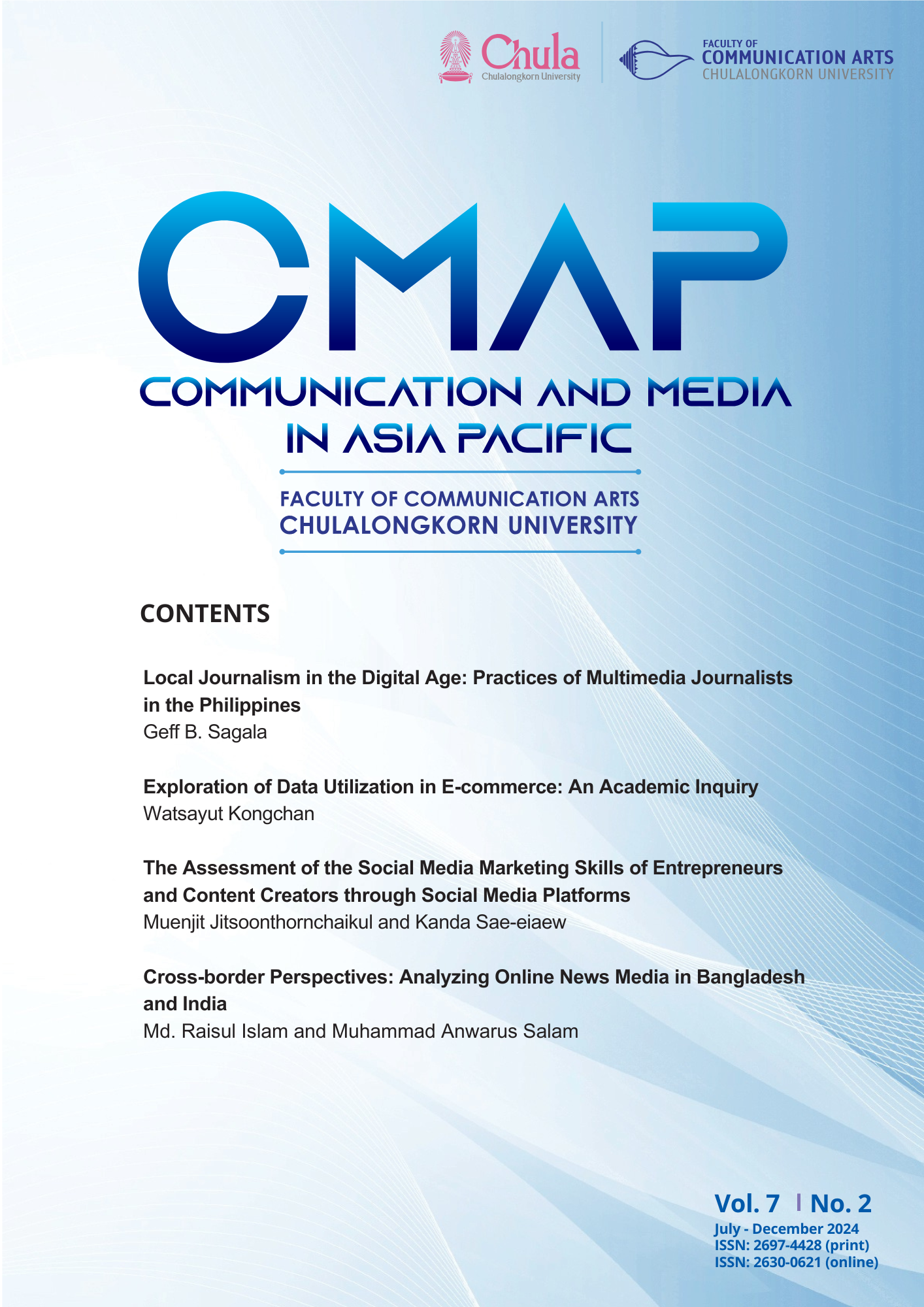
Local Journalism in the Digital Age: Practices of Multimedia Journalists in the Philippines
Article Sidebar
Main Article Content
Abstract
In today’s digital age, journalism has evolved to fit in with the social reality to where it belongs. This raises the question of how journalists are now writing stories in the age of new media. It is crucial to explore the current practices of contemporary journalists as they catch up with the developments in the new media landscape. Through this qualitative-narrative inquiry study design, media practitioners and educators can situate local journalism in the digital age. Nine local journalists took part in an extensive interview that led to a discussion of their journalistic practices in the new media, and the development of a framework for digital news writing. The findings showed that the emergence of new media has caused a change in how news is produced. Technology changed the process of gathering, writing, and publishing news stories. This study concluded that staying relevant, battling misinformation, defending the truth, and being devoted to the people are the biggest challenges for multimedia journalists. It is therefore recommended that multimedia journalists should become better at using technology, polish their social media skills, and learn photojournalism and mobile journalism.
Article Details
References
Aguilar, Jr, F. V., Mendoza, M. P., & Candelaria, A. L. K. (2014). Keeping the state at bay: The killing of journalists in the Philippines, 1998-2012. Critical Asian Studies, 46(4), 649-677. https://doi.org/10.1080/14672715.2014.960719
Al Nahed, S., & Hammond, P. (2018). Framing war and conflict: Introduction to the special issue. Media, War & Conflict, 11(4), 365-368. https://doi.org/10.1177/1750635218798992
Ardèvol-Abreu, A. (2015). Framing theory in communication research. Origins, development and current situation in Spain. Revista Latina de Comunicación Social, 70, 423-450.
Balod, H. S. S., & Hameleers, M. (2021). Fighting for truth? The role perceptions of Filipino journalists in an era of mis-and disinformation. Journalism, 22(9), 2368-2385. https://doi.org/10.1177/1464884919865109
Bartholomé, G., Lecheler, S., & de Vreese, C. (2015). Manufacturing conflict? How journalists intervene in the conflict frame building process. The International Journal of Press/Politics, 20(4), 438-457.
Bennett, W. L., & Pfetsch, B. (2018). Rethinking political communication in a time of disrupted public spheres. Journal of communication, 68(2), 243-253. https://doi.org/10.1093/joc/jqx017
Blake, J. S. (2019). News in a digital age: Comparing the presentation of news information over time and across media platforms. Rand Corporation.
Brüggemann, M. (2014). Between frame setting and frame sending: How journalists contribute to news frames. Communication Theory, 24(1), 61-82.
Burns, L. S., & Matthews, B. J. (2018). Understanding journalism. Sage.
Dawadi, S. (2021). Thematic analysis approach: A step-by-step guide for ELT research practitioners. Journal of NELTA, 25(1-2), 62-71.
Deinla, I. B., Mendoza, G. A. S., Ballar, K. J., & Yap, J. K. (2022). The link between fake news susceptibility and political polarization of the youth in the Philippines. Asian Journal of Political Science, 30(2), 160-181. https://doi.org/10.1080/02185377.2022.2117713
Deuze, M. (2019). What journalism is (not). Social media+Society, 5(3), 2056305119857202.
Eberwein, T., Fengler, S., & Karmasin, M. (Eds.). (2019). Media accountability in the era of post-truth politics: European challenges and perspectives. Routledge.
Falasca, K. (2014). Political news journalism: Mediatization across three news reporting contexts. European Journal of Communication, 29(5), 583-597. https:// doi.org/10.1177/0267323114538853
Fernandez, A. C. T., & Devaraj, M. (2019, June). Computing the linguistic-based cues of fake news in the Philippines towards its detection. In Proceedings of the 9th International Conference on Web Intelligence, Mining and Semantics (pp. 1-9). https://doi.org/10.1145/ 3326467.3326490
García-Orosa, B., López-García, X., & Vázquez-Herrero, J. (2020). Journalism in digital native media: Beyond technological determinism. Media and Communication, 8(2), 5-15.
Geçer, E., & Mahinay, K. J. (2018). Framing The 'War on Drugs' In the Philippines. Akademik Incelemeler Dergisi, 13(1), 199-226.
Guo, L., & McCombs, M. (Eds.). (2015). The power of information networks: New directions for agenda setting. Routledge.
Hall, S. (2019). The determinations of news photographs (1973). In Crime and media (pp. 123-134). Routledge.
Hamilton, J. (2016). Democracy’s detectives: The economics of investigative journalism. Harvard University Press. https://doi.org/10.4159/9780674973572
Hernandez, R. K., & Rue, J. (2015). The principles of multimedia journalism: Packaging digital news. Routledge.
Herr, O. (2020). New tactics to close down speech: The news editor at Rappler speaks to Index about legal threats against the media outlet’s CEO, Maria Ressa, plus a report on Index’s recent work. Index on Censorship, 49(3), 97-100. https://doi.org/10.1177/0306422020958292
Hong, S., & Nadler, D. (2015, May). Social media and political voices of organized interest groups: a descriptive analysis. In Proceedings of the 16th annual international conference on digital government research (pp. 210-216).
Horbyk, R., Löfgren, I., Prymachenko, Y., & Soriano, C. (2021). Fake news as meta-mimesis: imitative genres and storytelling in the Philippines, Brazil, Russia and Ukraine.
Jones, J. M. (2018). US media trust continues to recover from 2016 low. Gallup.
Karlsson, M., Clerwall, C., & Nord, L. (2017). Do not stand corrected: Transparency and users’ attitudes to inaccurate news and corrections in online journalism. Journalism & Mass Communication Quarterly, 94(1), 148-167. https://doi.org/10.1177/1077699016654680
Kim, A., & Dennis, A. R. (2019). Says who? The effects of presentation format and source rating on fake news in social media. MIS Quarterly, 43(3), 1025-1039. https://dx.doi.org/10.2139/ssrn.2987866
Knobel, B. (2018). The watchdog still barks: How accountability reporting evolved for the digital age. Fordham University Press.
Ladera, R. A. B., & Lebrilla, R. V. C. (2012). Factors that Influence Broadcast Media Agenda Setting in Iloilo City. Bachelor in Broadcasting Undergraduate Thesis, West Visayas State University, Iloilo City.
Lazer, D. M., Baum, M. A., Benkler, Y., Berinsky, A. J., Greenhill, K. M., Menczer, F., ... & Zittrain, J. L. (2018). The science of fake news. Science, 359(6380), 1094-1096. https://doi.org/10.1126/science.aao2998
Lopezosa, C., Codina, L., Fernández-Planells, A., & Freixa, P. (2023). Journalistic innovation: How new formats of digital journalism are perceived in the academic literature. Journalism, 24(4), 821-838. https://doi.org/10.1177/14648849211033434
Maniou, T. A., Stark, A., & Touwen, C. J. (2020). Journalism training beyond journalism schools. Journalism & Mass Communication Educator, 75(1), 33-39. https://doi.org/10.1177/1077695820904979
Mensing, D. (2010). Rethinking [again] the future of journalism education. Journalism Studies, 11(4), 511-523.
Miller, S. (2019). Citizen journalism. In H. Ornebring (Ed.), Oxford Research Encyclopedia of Communication. Oxford University Press. https://doi.org/10.1093/acrefore/9780190228613.013.786
Mitchell, W. J.T. (2013). There are no visual media. In: N. Mirzoeff (Ed.), The visual culture reader (3rd ed., pp. 7-14). Routledge.
Nagaynay, C., & Lee, J. (2020). Place branding and urban regeneration as dialectical processes in local development planning: A case study on the Western Visayas, Philippines. Sustainability, 12(1), 369. https://doi.org/10.3390/su12010369
Nelson, J. L., & Lei, R. F. (2018). The effect of digital platforms on news audience behavior. Digital journalism, 6(5), 619-633. https://doi.org/10.1080/21670811.2017.1394202
Newman, N., Fletcher, R., Levy, D. A. L., & Nielsen, R. K. (2016). Reuters institute digital news report 2016. Reuters Institute for the Study of Journalism.
Ong, J. C., & Tapsell, R. (2022). Demystifying disinformation shadow economies: fake news work models in Indonesia and the Philippines. Asian Journal of Communication, 32(3), 251-267. https://doi.org/10.1080/01292986.2021.1971270
Opiniano, J., Daquipil, R. A., & Romarate, P. I. (2021). Reflective practice in the newswork of Filipino journalists: A grounded theory study. Journal of Applied Journalism & Media Studies, 10(3), 315-335. https://doi.org/10.1386/ajms_00031_1
Opperhuizen, A. E., Schouten, K., & Klijn, E. H. (2019). Framing a conflict! How media report on earthquake risks caused by gas drilling: a longitudinal analysis using machine learning techniques of media reporting on gas drilling from 1990 to 2015. Journalism Studies, 20(5), 714-734.
Prager, A., & Hameleers, M. (2021). Disseminating information or advocating peace? Journalists’ role perceptions in the face of conflict. Journalism, 22(2), 395-413. https://doi.org/10.1177/1464884918791788
Puente, B. (2020). Muzzling the media: The perils of the critical press in the Philippines. Media Asia, 47(1-2), 81-82. https://doi.org/10.1080/01296612.2020.1818172
Ragragio, J. L. D. (2021). Strongman, patronage and fake news: Anti-human rights discourses and populism in the Philippines. Journal of Language and Politics, 20(6), 852-872. https://doi.org/10.1075/jlp.20039.rag
Salaverrí Aliaga, R. (2019). Digital journalism: 25 years of research. Review article. Profesional De La información, 28(1). https://doi.org/10.3145/epi.2019.ene.01
Salvosa II, F. F., & Esguerra, C. V. (2022). Raportowanie w „nowej rzeczywistości”. Jak pandemia Covid-19 wpłynęła na praktykę dziennikarską na Filipinach. Fides, Ratio Et Patria. Studia Toruńskie, 17, 290–306. https://doi.org/10.56583/frp.2262
Schuck, A. R., Vliegenthart, R., & De Vreese, C. H. (2016). Who's afraid of conflict? The mobilizing effect of conflict framing in campaign news. British Journal of Political Science, 46(1), 177-194.
Shin, J., Jian, L., Driscoll, K., & Bar, F. (2018) The diffusion of misinformation on social media: Temporal pattern, message, and source. Computers in Human Behavior 83, 278–287. https://doi.org/10.1016/j.chb.2018.02.008
Silverman, D. (Ed.). (2020). Qualitative research. Sage.
Smaniotto, A. (2020). Facts, News and Public Opinion: Robert Ezra Park and the Democratic Challenge of Modern Journalism [Doctoral dissertation]. https://www.theses.fr/2020EHES0184
Tandoc, Jr, E. C., Hellmueller, L., & Vos, T. P. (2013). Mind the gap: Between journalistic role conception and role enactment. Journalism Practice, 7(5), 539-554. https://doi.org/10.1080/17512786.2012.726503
Tandoc, E. C. (2020). Watching over the watchdogs: The problems that Filipino journalists face. In What journalists are owed (pp. 101-116). Routledge.
Tandoc, E. C., Sagun, K. K., & Alvarez, K. P. (2023). The digitization of harassment: Women journalists’ experiences with online harassment in the Philippines. Journalism Practice, 1-16. https://doi.org/10.1080/17512786.2021.1981774
Tuquero, L. (2022). 51% of Filipinos find it difficult to spot fake news on media - SWS. Rappler. https://www.rappler.com/nation/sws-survey-fake-news-december-2021/
Umali, M. S. (2013). The dialogical processes of vernacular mediation: new media and the Karay-a ethnic group of the Philippines [Doctoral dissertation].
Van Dalen, A., De Vreese, C. H., & Albæk, E. (2012). Different roles, different content? A four-country comparison of the role conceptions and reporting style of political journalists. Journalism, 13(7), 903-922.
Vargo, C. J., Guo, L., & Amazeen, M. A. (2018). The agenda-setting power of fake news: A big data analysis of the online media landscape from 2014 to 2016. New Media & Society, 20(5), 2028-2049. https://doi.org/10.1177/1461444817712086
Vos, T. P. (2019). Journalism as institution. In H. Ornebring (Ed.), Oxford Research Encyclopedia of Communication. Oxford University Press. https://doi.org/10.1093/acrefore/9780190228613.013.825
Vos, T. P., Eichholz, M., & Karaliova, T. (2019). Audiences and journalistic capital: Roles of journalism. Journalism Studies, 20(7), 1009-1027. https://doi.org/10.1080/1461670X.2018.1477551
Wilson, S. M., & Anagnostopoulos, D. (2021). Methodological guidance paper: The craft of conducting a qualitative review. Review of Educational Research, 91(5), 651-670. https://doi.org/10.3102/00346543211012755
Yang, Y., & Su, Y. (2020). Public voice via social media: Role in cooperative governance during public health emergency. International Journal of Environmental Research and Public Health, 17(18), 6840. https://doi.org/10.3390/ijerph17186840
