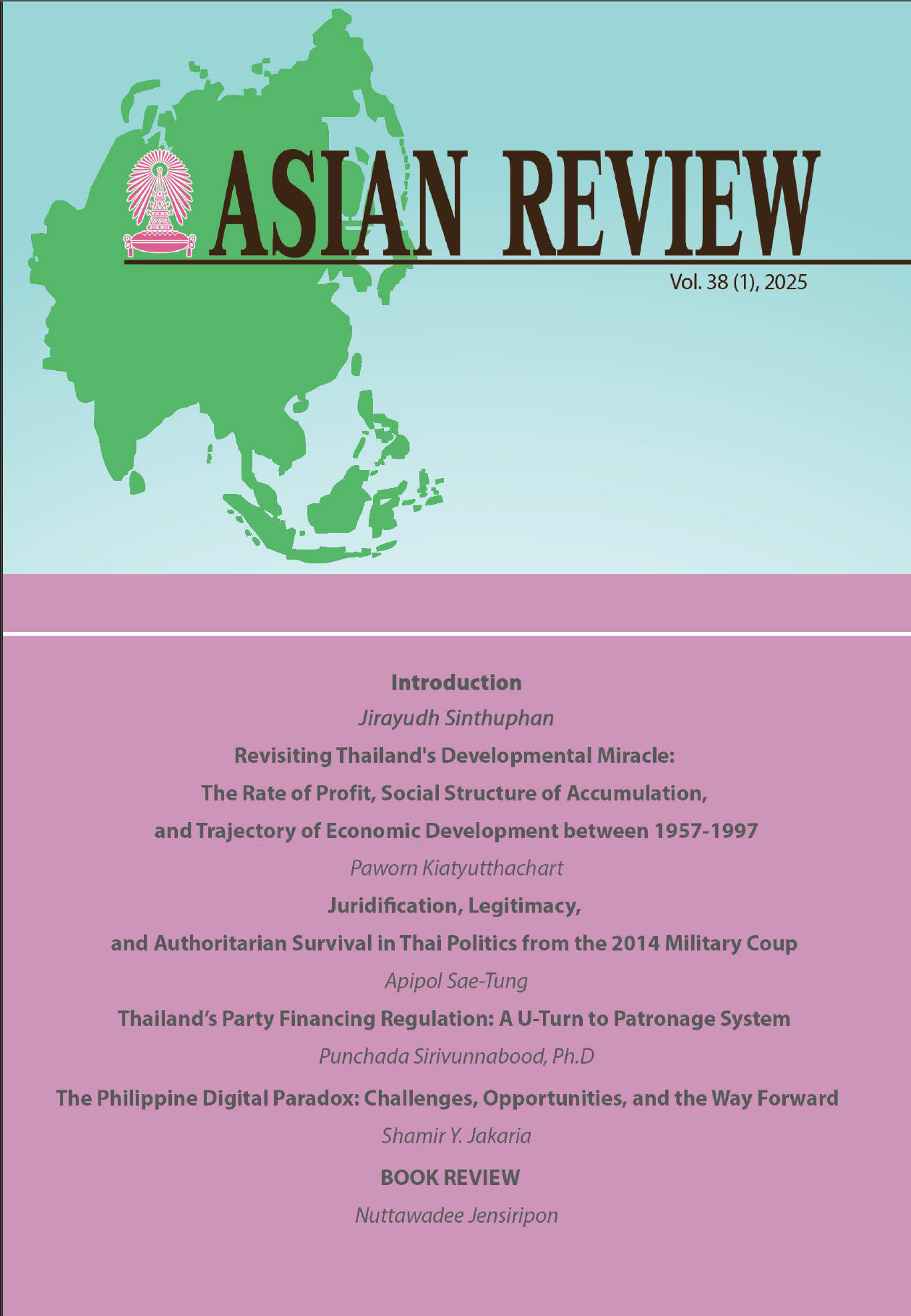
Juridification, Legitimacy, and Authoritarian Survival in Thai Politics from the 2014 Military Coup
DOI:
https://doi.org/10.14456/arv.2025.2Keywords:
Juridification, Authoritarian Survival, Legality, LegitimacyAbstract
This article explores the conditions under which authoritarian regimes resort to juridification as a strategy for political survival. It examines why authoritarian governments rely on legal mechanisms despite possessing coercive power. Through an analysis of Thailand’s 2014 military coup and its aftermath, the study argues that juridification—defined here as the expansion of legal control into political domains—is triggered when regimes suffer from low political legitimacy. Drawing on the concepts of legality, legitimacy, and authoritarian adaptation, the article demonstrates how the military-led government in Thailand institutionalised its power through the 2017 Constitution and the National Strategy, both designed to entrench the regime’s status quo under a legal framework. Rather than reinforcing democratic norms, juridification in this context functioned to consolidate authoritarian rule under the guise of legality. The findings contribute to understanding how authoritarian regimes strategically employ legal instruments to enhance durability and claim legitimacy.
References
Beetham, David. 2013. The Legitimation of Power. Basingstoke: Palgrave Macmillan.
Blichner, L.C., and A. Molander. 2008. "Mapping Juridification." European Law Journal 14 (1): 36–54.
Coicaud, Jean-Marc. 2002. Legitimacy and Politics: A Contribution to the Study of Political Right and Political Responsibility. Translated by David Ames Curtis. Cambridge: Cambridge University Press.
Cotterrell, Roger. 1995. Law's Community: Legal Theory in Sociological Perspective. Oxford: Oxford University Press.
Dixon, Rosalind, and David Landau. 2019. "Abusive Judicial Review: Courts against Democracy." UC Davis Law Review 53: 1313–1378.
Dogan, Mattei. 1992. "Conceptions of Legitimacy." In Encyclopedia of Government and Politics, edited by Mary Hawkesworth and Maurice Kogan. London: Routledge.
Dressel, Björn, ed. 2012. The Judicialization of Politics in Asia. Routledge Law in Asia 12. Milton Park, Abingdon, Oxon; New York, NY: Routledge.
Dressel, Björn, and Khemthong Tonsakulrungruang. 2018. "Coloured Judgements? The Work of the Thai Constitutional Court, 1998–2016." Journal of Contemporary Asia 49 (1): 1–23. https://doi.org/10.1080/00472336.2018.1479879.
Ferejohn, John. 2002. "Judicializing Politics, Politicizing Law." Law and Contemporary Problems 65 (3): 41–68. https://doi.org/10.2307/1192402.
Göbel, Christian. 2010. "Authoritarian Consolidation." European Political Science 10: 176–190.
Haberkorn, Tyrell. 2018. "Dictatorship, Monarchy, and Freedom of Expression in Thailand." The Journal of Asian Studies 77 (4): 935–943. https://doi.org/10.1017/S0021911818002528.
Hirschl, Ran. 2004. "The Political Origins of the New Constitutionalism." Indiana Journal of Global Legal Studies 11 (1): 71–108.
Hirschl, Ran. 2011. "The Judicialization of Politics." In The Oxford Handbook of Political Science, edited by Robert Goodin. Oxford: Oxford University Press.
Kitirianglarp, Kengkij, and Kevin Hewison. 2011. "'Thai-Style Democracy': The Royalist Struggle for Thailand's Politics." In Saying the Unsayable, edited by Soren Ivarsson and Lotte Isager. Copenhagen S, Denmark: NIAS.
Maerz, Seraphine F. 2020. "The Many Faces of Authoritarian Persistence: A Set-Theory Perspective on the Survival Strategies of Authoritarian Regimes." Government and Opposition 55 (1): 64–87. https://doi.org/10.1017/gov.2018.17.
Magnussen, Anne-Mette, and Anna Banasiak. 2013. "Juridification: Disrupting the Relationship between Law and Politics?" European Law Journal 19 (3): 325–339.
Mérieau, Eugénie. 2016. "Thailand’s Deep State, Royal Power and the Constitutional Court (1997–2015)." Journal of Contemporary Asia 46 (3): 445–466. https://doi.org/10.1080/00472336.2016.1151917.
Nathan, Andrew J. 2020. "The Puzzle of Authoritarian Legitimacy." Journal of Democracy 31 (1): 158–168. https://doi.org/10.1353/jod.2020.0013.
Office of the Council of State. 2015. Constitution of the Kingdom of Thailand (Interim), B.E. 2557 Amendment (No.1), B.E. 2558 (2015).
Office of the Council of State. 2017. Constitution of the Kingdom of Thailand.
The Royal Office. 2019. The King's Message. Online: https://www.royaloffice.th/wp-content/uploads/2019/03/relate243371-1-1.pdf
Pathmanand, Ukrist. 2008. "A Different Coup d'État?" Journal of Contemporary Asia 38 (1): 124–142. https://doi.org/10.1080/00472330701651994.
Phongpaichit, Pasuk, and Chris Baker. 2008. "Thaksin's Populism." Journal of Contemporary Asia 38 (1): 62–83. https://doi.org/10.1080/00472330701651960.
Prasirtsuk, Kitti. 2015. "Thailand in 2014: Another Coup, a Different Coup?" Asian Survey 55 (1): 200–206.
Royal Thai Government. 2014. Royal Command to Appoint the Prime Minister. Online: https://ratchakitcha.soc.go.th/documents/2017226.pdf
Royal Thai Government. 2017. National Strategies Preparation Act B.E. 2560 (2017). Online: https://ratchakitcha.soc.go.th/documents/2112624.pdf
Royal Thai Government. 2019. The Election Commission Requests the Constitutional Court to Consider and Issue an Order to Dissolve the Thai Raksa Chart Party. Online: https://ratchakitcha.soc.go.th/documents/17075924.pdf
Royal Thai Government. 2020. The Election Commission Requests the Constitutional Court to Consider and Issue an Order to Dissolve the Future Forward Party. Online: https://ratchakitcha.soc.go.th/documents/17125066.pdf
Royal Thai Government. 2024. The Election Commission Requests the Constitutional Court to Consider and Issue an Order to Dissolve the Move Forward Party. Online: https://ratchakitcha.soc.go.th/documents/41319.pdf
Schmitt, Carl. 2004. Legality and Legitimacy. Durham, NC: Duke University Press.
Sieder, Rachel. 2020. "The Juridification of Politics." In The Oxford Handbook of Law and Anthropology, edited by Marie-Claire Foblets, Mark Goodale, Maria Sapignoli, and Olaf Zenker. Oxford: Oxford University Press. Online: Oxford Handbooks Online.
Simpser, Alberto, and Tom Ginsburg. 2014. "Introduction: Constitutions in Authoritarian Regimes." In Constitutions in Authoritarian Regimes, edited by Alberto Simpser and Tom Ginsburg. New York: Cambridge University Press.
Slater, Dan. 2010. Ordering Power: Contentious Politics and Authoritarian Leviathans in Southeast Asia. New York: Cambridge University Press.
Turner, Mark M. 1990. "Authoritarian Rule and the Dilemma of Legitimacy: The Case of President Marcos of the Philippines." The Pacific Review 3 (4): 349–362. https://doi.org/10.1080/09512749008718886.
Vallinder, Torbjörn. 1994. "The Judicialization of Politics. A World-Wide Phenomenon: Introduction." International Political Science Review / Revue Internationale de Science Politique 15 (2): 91–99.
Winichakul, Thongchai. 2016. Thailand's Hyper-royalism: Its Past Success and Present Predicament. Trends in Southeast Asia 7. Singapore: ISEAS Publishing.
Downloads
Published
How to Cite
Issue
Section
License
Copyright (c) 2025 Instiute of Asian Studies, Chulalongkorn University

This work is licensed under a Creative Commons Attribution-NonCommercial-NoDerivatives 4.0 International License.
Published articles are under the copyright of the Instiute of Asian Studies, Chulalongkorn University. Partially or totally publication of an article elsewhere is possible only after the consent from the editors.