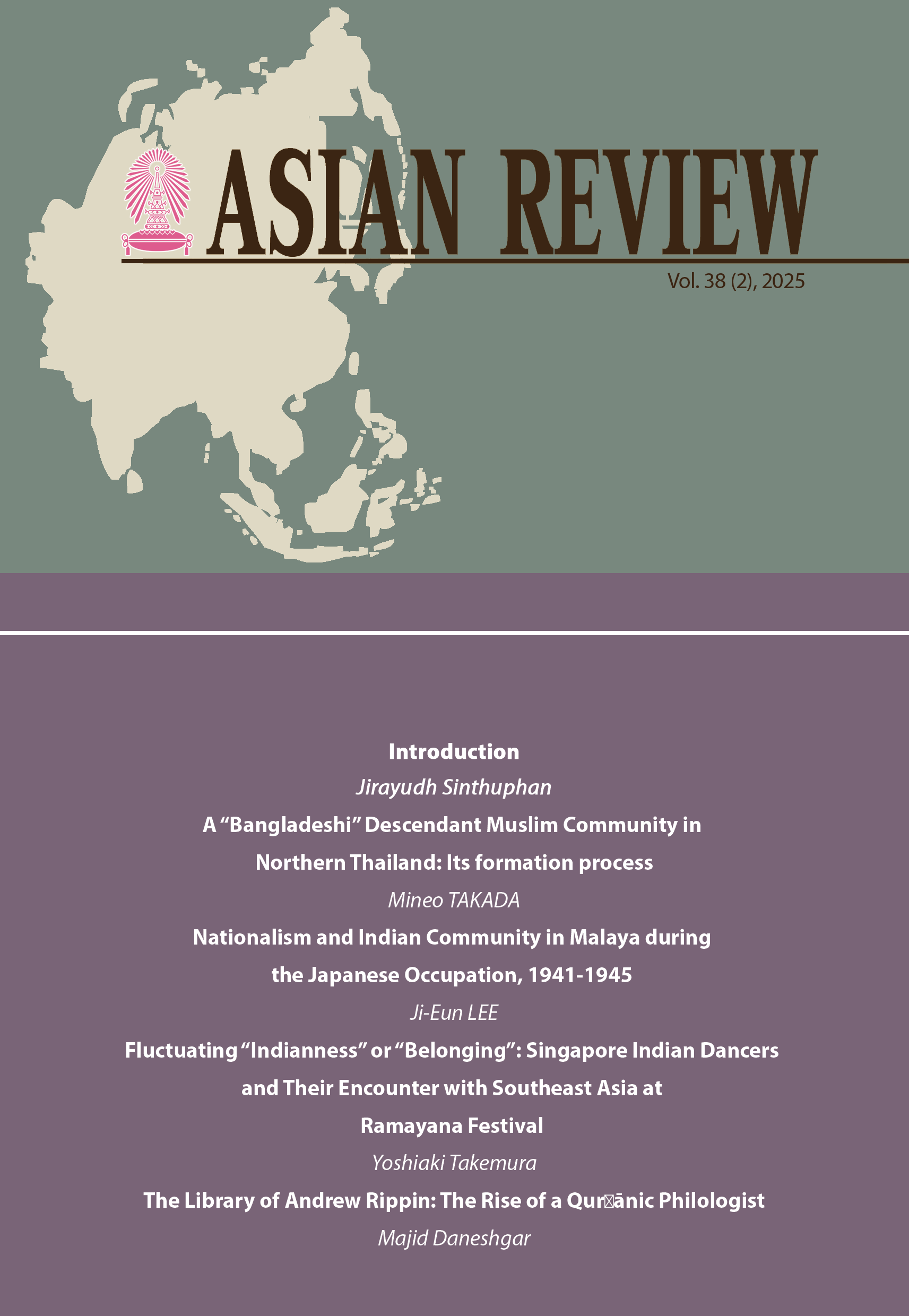
A “Bangladeshi” Descendant Muslim Community in Northern Thailand
Its formation process
DOI:
https://doi.org/10.14456/arv.2025.6Keywords:
Muslims, Bangladesh, Bengal, migration, British colonial era, community formation, northern ThailandAbstract
Thailand is a majority Buddhist country. However, there is a Muslim population in some parts of the country. One such community is a so-called "Indian" Muslim community in northern Thailand. In fact, they originally came from East Bengal, now Bangladesh, not India. A large community of such Bangladeshi descendants can be found in Chiang Mai and other groups of them live in some smaller towns in northern Thailand.
This paper discusses the migration processes, routes, and settlement processes of a group in northern Thailand. When the author started researching them, they declared themselves "Bangladee" (Thai pronunciation of Bangladesh), but they added that they did not know where their ancestors came from, only knowing place names like Chittagong or Noakhali. This paper will focus on an examination of their settlement processes and community formation. It will also emphasize the importance of the land route connection between South Asia and Southeast Asia.
References
Bajnid, Omar Farouk. 1999. “The Muslims in Thailand: A Review”, Southeast Asian Studies (Kyoto Univ.), 37-2, pp.210-234.
Bowie, Katherine A. 1988. Peasant Perspectives on the Political Economy of the Northern Thai Kingdom of Chiang Mai in the Nineteenth Century: Imprecations for the understanding of the peasant political expression, Vol.1, Dissertation, Department of Anthropology, The University of Chicago, Illinois.
Choudhury, M.M. Emran. 2004. মীরসরাইর ইতিহাস (Mirsarai-r Itihas, History of Mirsarai), Author’s Private Edition, Dhaka. (in Bangla/Bengali)
Gehan, Wijeyewardene. 1985. “Great City on the River Ping: Some Anthropological and Historical Perspectives on Chiangmai”, Political Science Review, (Chiang Mai University), Vol.6, pp. 86-112.
Gilquin, Michel. 2005. The Muslims of Thailand, IRASEC and Silkworm Books, Bangkok (translated by Michael Smithies from original French edition published in 2002).
Hussain, Z. 1982. The silent minority: Indians in Thailand. Bangkok: Chulalongkorn University.
Kakizaki, Ichiro. 2000. Tai Keizai to Tetsudou (Thai Economy and Railway): 1885–1935, Nihon-Keizai Hyoron Co., Tokyo. (in Japanese)
Mani, A. 1993. "Indians in Thailand", Kernial Singh SANDHU and A. MANI eds., Indian Communities in Southeast Asia, Institute of Southeast Asian Studies, Singapore, pp.910-927.
Ongsakul, Sarassawadee. 2005. History of Lanna, translated by Chitraporn Tanratanakul, Silkworm Books, Chiang Mai.
Otomo, Nao. 2011. “Tai kokusekihou-no ichibu-kaisei: Tai kokusekihou-no hensen to mukokusekisha mondai” Gaikoku-no Rippou, 249, pp.111-121 ("Partial Revision of the Thai Nationality Law: Its transition and the problem of the stateless person", The legislation of the foreign countries). (In Japanese)
Penth, Hans. 2004. A Brief History of Lān Nā: Northern Thailand from the past to present, Silkworm Books, Chiang Mai.
Pongsawat, Pitch. 2007. Border Partial Citizenship, Border Towns, and Thai–Myanmar Cross-Border Development: Case Studies at the Thai Border Towns, Ph.D. thesis, City and Regional Planning, the University of California, Berkley.
Saowanee, Jitmuad. 2009. “Tai-Muslim Shakai no Iso- rekishi to genjou (Aspects of the Society of the Thai Muslims – history and present situation, translated from Thai by TAKAOKA Masanobu)”, in HAYASHI Yukio ed., ‘Kyoiki’ no Jissen Shukyo- Tairikubu Tounan-ajia Chiiki to Shuko no Topoloji (Religions in Practice in ‘Borderlands’: Mainland Southeast Asia and the topology of religion), Kyoto University Press, pp. 677–728. (in Japanese)
Sato, Hiroshi. 1995. Tai no Indojin Shakai: Tounan ajia to Indo no Deai (Indian Society in Thailand: Southeast Asia meets India), Institute of Developing Economies, Chiba. (in Japanese)
Schomburgk, Robert H. 1863. “A visit to Xiengmai, the principal city of the Laos or Shan States”, The Journal of Asiatic Society of Bengal, 32, pp. 387–399.
Suthep, Soonthornpasuch. 2013. Islamic Identity In Chiang Mai City: A historical and structural composition of two communities, Center for Ethnic Studies and Development, Faculty of Social Sciences, Chiang Mai University. (Originally, Unpublished dissertation, 1977, same title, Department of Anthropology, University of California, Berkley)
Takada, Mineo. 2018. “Burma as ‘Corridor’: A case of South Asian descendants’ community in Northern Thailand”, Shudo Hogaku (Shudo Law Review), 40-2, pp. 113–133. (The original version of this paper was presented at “International Conference on Burma/Myanmar Studies, ‘Burma/Myanmar in Transition: Connectivity, Changes and Challenges’”, 24–26 July 2015, Chiang Mai University. (http://www.burmalibrary.org/docs21/Takada-Mineo-2015-Burma_as_Corridor-en.pdf)
Wang, Liulan. 2011. Ekkyou wo Ikiru Un’nan kei Muslim: Kita Tai ni okeru Kyosei to network (Yunnanese Muslims living in the Border Transgression: Symbiosis and networks in northern Thailand), Showa-do Publishing Co., Kyoto. (in Japanese)
Downloads
Published
How to Cite
Issue
Section
License
Copyright (c) 2025 Instiute of Asian Studies, Chulalongkorn University

This work is licensed under a Creative Commons Attribution-NonCommercial-NoDerivatives 4.0 International License.
Published articles are under the copyright of the Instiute of Asian Studies, Chulalongkorn University. Partially or totally publication of an article elsewhere is possible only after the consent from the editors.