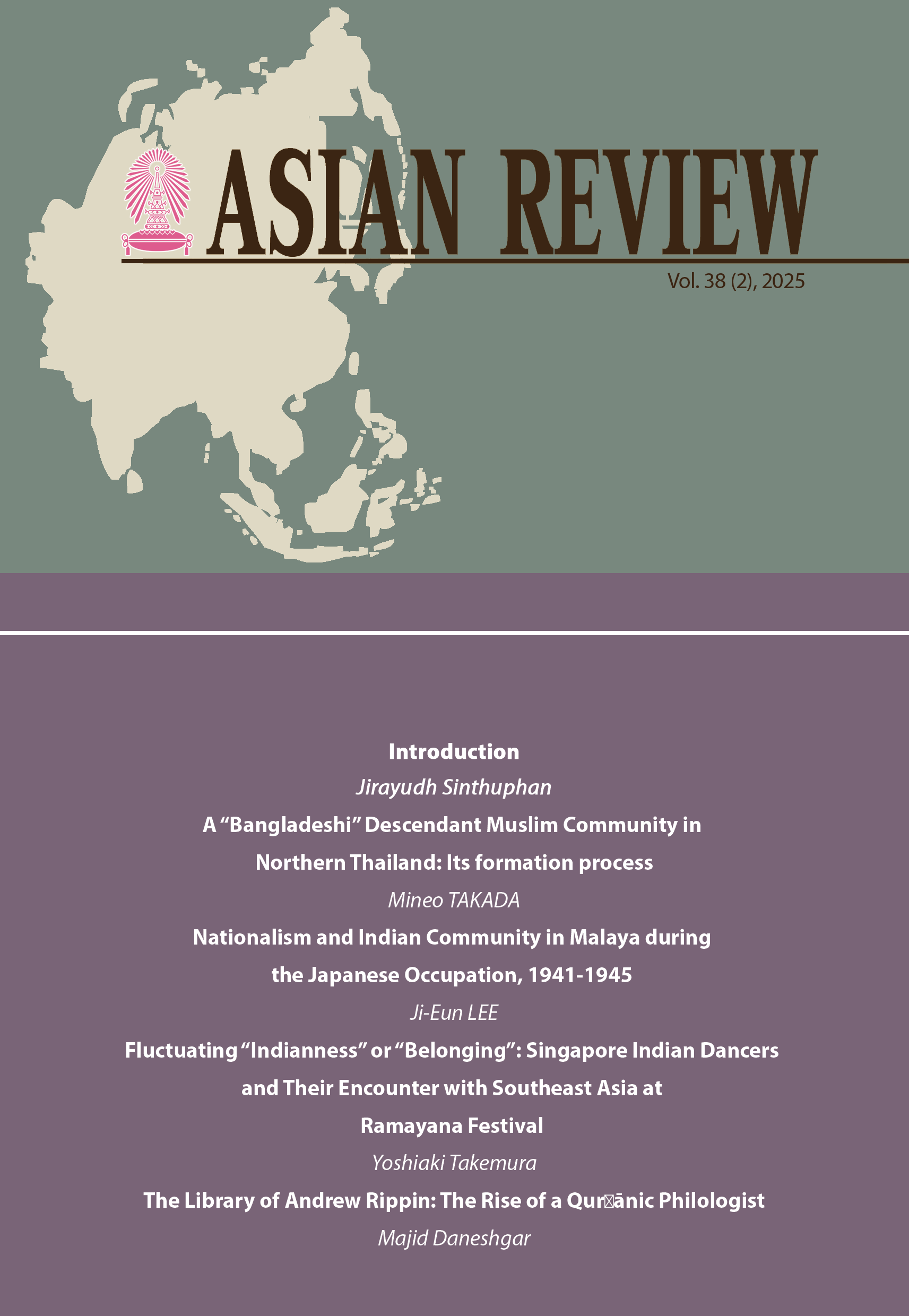
Nationalism and Indian Community in Malaya during the Japanese Occupation, 1941-1945
DOI:
https://doi.org/10.14456/arv.2025.7Keywords:
Indian Nationalism, Indian Independence League, Indian National Army, Subhas Chandra Bose, MalayaAbstract
This study examines the transformation of the Indian community in Malaya during the Japanese occupation (1941–45), with a focus on the rise of nationalist consciousness and collective identity. Through the formation and activities of the Indian Independence League (IIL) and the Indian National Army (INA), the Indian community experienced significant organizational and ideological changes. Under Subhas Chandra Bose’s leadership, civilian participation and support for the INA increased dramatically, fostering a sense of unity and purpose. Comparative analysis highlights the differing wartime experiences of Malaya’s major ethnic groups: while Malays benefited from Japanese policies, the Chinese faced harsh repression, leading to intensified interethnic tensions. The findings suggest that the Indian community’s collective wartime experiences fostered political unity and national identity, contributing to both the anti-colonial movement and the post-war restructuring of Malaya’s multi-ethnic society.
References
Primary Sources
Government of Bengal (Home) Defence Branch. 1997. “File No. W/356/43.” In Towards Freedom: Documents on the Movement for Independence in India 1943–1944, Part III, edited by P. S. Gupta, 2714–2720. Delhi: Oxford University Press, Indian Council of Historical Research.
Government of India. 1997. “File No. 2/4/43-Home Poll (I).” In Towards Freedom: Documents on the Movement for Independence in India 1943–1944, Part III, edited by P. S. Gupta, 2685–2710. Delhi: Oxford University Press, Indian Council of Historical Research.
Government of India. 2004. “File No. 601/7378/H.S. India Office Library.” In Indian National Army—A Documentary Study vol. II, edited by T. R. Sareen, 321–325. New Delhi: Gyan Publishing House.
Indian Independence League. 2004. “Implementation of the Recommendations of the IIL Conference, Syonan, 8 May 2603 (1943).” In Indian National Army—A Documentary Study vol. II, edited by T. R. Sareen, 105–106. New Delhi: Gyan Publishing House.
Indian Independence League Headquarters. 2007. “Circular, Syonan, 13 July 2603 (1943).” In Chalo Delhi Writings and Speeches 1943–1945, edited by Sisir K. Bose and Sugata Bose, 60–63. New Delhi: Permanent Black.
Indian Independence League Headquarters (Department of Training). 2007. “Circular, Syonan, 13 July 2603 (1943).” In Chalo Delhi Writings and Speeches 1943–1945, edited by Sisir K. Bose and Sugata Bose, 60–63. New Delhi: Permanent Black.
Indian Independence League Headquarters (Department of Recruitment). 2007. “Circular, Syonan, 23 July 2603 (1943).” In Chalo Delhi Writings and Speeches 1943–1945, edited by Sisir K. Bose and Sugata Bose, 63–67. New Delhi: Permanent Black.
Indian Prisoners of War. 1959. “The Prisoners’ Letter, 1 January 1942.” In The Springing Tiger—A Study of a Revolution, by Hugh Toye, 204–207. Delhi: Jaico Publishing House.
Officer of Strategic Service, Research and Analysis Branch. 2004. “R & A No. 1595: Indian Minorities in South and East Asia—The Background of the Indian Independence Movement, 8 September 1944.” In Indian National Army—A Documentary Study vol. III, edited by T. R. Sareen, 193–225. New Delhi: Gyan Publishing House.
War Office. 2004a. “File No. 208/833. Public Record Office.” In Indian National Army—A Documentary Study vol. I, edited by T. R. Sareen, 372–408. New Delhi: Gyan Publishing House.
War Office. 2004b. “File No. 208/818. Public Record Office.” In Indian National Army—A Documentary Study vol. II, edited by T. R. Sareen, 209–213. New Delhi: Gyan Publishing House.
War Office. 2004c. “File No. 208/808. Public Record Office.” In Indian National Army—A Documentary Study vol. IV, edited by T. R. Sareen, 69–84. New Delhi: Gyan Publishing House.
Secondary Sources
Akashi, Yoji. 1970. “Japanese Policy towards the Malayan Chinese 1941–1945.” Journal of Southeast Asian Studies 1 (2): 61–89.
Anderson, Perry. 2015. The Indian Ideology. Gurgaon: Three Essays Collective.
Arasaratnam, Sannappah. 1970. Indians in Malaysia and Singapore. Bombay and Kuala Lumpur: Oxford University Press.
Bandyopadhyay, Sekhar. 2015. From Plassey to Partition and After. Hyderabad: Orient BlackSwan.
Bose, Sisir K., Alexander Werth, and S. A. Ayer, eds. 1973. A Beacon Across Asia: A Biography of Subhas Chandra Bose. New Delhi: Orient Longman.
Bose, Sugata. 2011. His Majesty’s Opponent: Subhas Chandra Bose and India’s Struggle Against Empire. Cambridge: Belknap Press of Harvard University Press.
Chandra, Bipan. 2010. History of Modern India. Hyderabad: Orient BlackSwan.
Chandra, Bipan, Mridula Mukherjee, Aditya Mukherjee, K. N. Panikkar, and Sucheta Mahajan. 1989. India’s Struggle for Independence. New Delhi: Penguin Books.
Hashim, Wan. 1983. Race Relations in Malaysia. Kuala Lumpur: Heinemann Educational Books (Asia).
Cheah, Boon Kheng. 2002. “Japanese Army Policy toward the Chinese and Malay-Chinese Relations in Wartime Malaya.” In Southeast Asian Minorities in the Wartime Japanese Empire, edited by Paul H. Kratoska, 97–110. London: RoutledgeCurzon.
Kratoska, Paul. 1998. The Japanese Occupation of Malaya, 1941–1945. London: C. Hurst & Co.
Mookerjee, Girija K. 1975. Subhas Chandra Bose. New Delhi: Publications Division, Government of India.
Mukherjee, Daya. 1997. Subhas Chandra Bose, Accelerator of India’s Independence. New Delhi: Gyan Publishing House.
Mani, A., and P. Ramasamy. 2006. “Subhas Chandra Bose and the Indian National Army: A Southeast Asian Perspective.” Paper presented at the Seminar on “The Forgotten Army in a World War: Subhas Bose’s INA and Asia’s Independence.”
Netaji Center, ed. 1992. Netaji Subhas Chandra Bose: A Malaysian Perspective. Kuala Lumpur: Netaji Center.
Ramasamy, P. 2000. “Indian War Memory in Malaysia.” In War and Memory in Malaysia and Singapore, edited by Patricia Lim Pui Huen and Diana Wong, 90–105. Singapore: Institute of Southeast Asian Studies.
Sandhu, Kernial Singh. 1962. “Communalism: The Primary Threat to the Malayan Unity.” The Asian Survey 2 (6): 32–37.
Sandhu, Kernial Singh. 1969. Indians in Malaya: Some Aspects of Their Immigration and Settlement 1786–1957. Cambridge: Cambridge University Press.
Sandhu, Kernial Singh. 1993. “The Coming of the Indians to Malaysia.” In Indian Communities in Southeast Asia, edited by K. S. Sandhu and A. Mani, 151–89. Singapore: Times Academic Press.
Sarkar, Sumit. 1983. Modern India 1885–1947. New Delhi: Macmillan.
Thompson, Virginia. 2001. “British Malaya.” In South Asia Colonial History Vol. IV, edited by Paul H. Kratoska, 89–99. London: Routledge.
Toye, Hugh. 1984. “The First Indian National Army, 1941–42.” Journal of Southeast Asian Studies 15 (2): 365–81.
Downloads
Published
How to Cite
Issue
Section
License
Copyright (c) 2025 Instiute of Asian Studies, Chulalongkorn University

This work is licensed under a Creative Commons Attribution-NonCommercial-NoDerivatives 4.0 International License.
Published articles are under the copyright of the Instiute of Asian Studies, Chulalongkorn University. Partially or totally publication of an article elsewhere is possible only after the consent from the editors.