
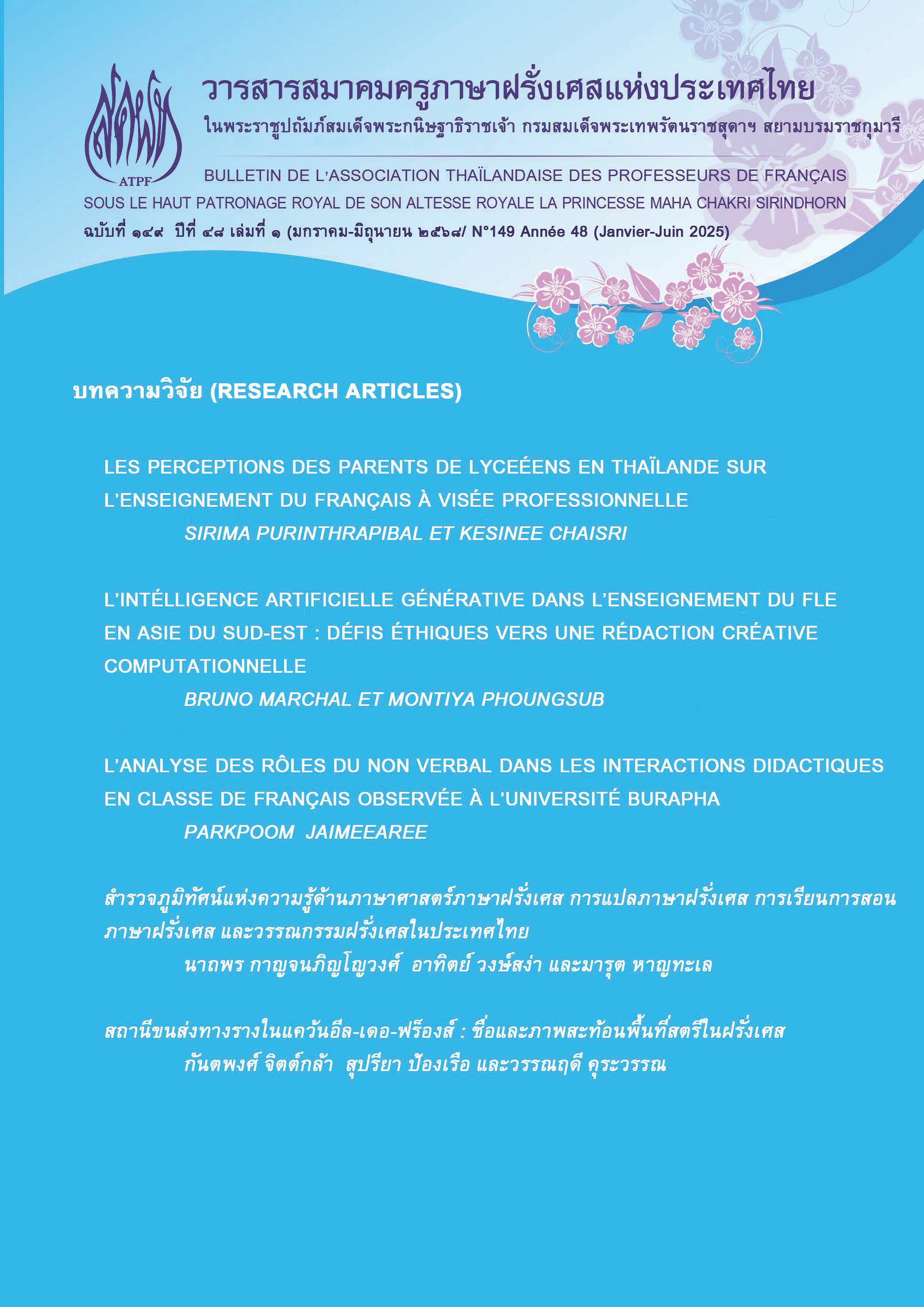
Parent’s Perceptions of Thai Secondary School Students regarding French Language Learning for Professional Purposes
Article Sidebar
Main Article Content
Abstract
This study aims to explore Thai parents’ perceptions regarding the teaching of French for Specific Purposes (FSP) to high school students. Data were collected from 363 parents of high school French learners across the four regions of Thailand, resulting in a response rate of 94.29%. A mixed-methods approach, integrating both quantitative and qualitative data (through questionnaires and interviews), was employed to gain a multidimensional perspective. Results reveal that most parents have not participated in discussions or shared their opinions on French and FSP teaching in schools (73.55%). They also have not been involved in implementing French and FOS teaching activities (74.10%). However, the majority believe that FSP education at the high school level aligns well with current global changes (80.72%) and that FSP activities in high schools are based on active learning methods (79.34%). In terms of parental efforts to support their children’s French and FSP learning, over half (58.13%) enrolled their children in private courses. Additionally, parents acknowledge that FSP education is beneficial for their children’s future ( = 3.67, SD. = 1.09), particularly in enhancing job prospects (
= 3.66, SD. = 1.09) by potentially increasing future job opportunities, higher earnings (
= 3.66, SD. = 1.09), and broadening their children’s professional outlook (
= 3.66, SD. = 1.09).
Downloads
Article Details
References
Ardharn, S. (2024). Exploring Issues and Difficulties in French Teaching and Learning Based on Action-Oriented Approach in Upper Northern Secondary Schools. Chiang Mai University Journal of Humanities, 25(1), 48–80.
Bandura, A. (1977). Social Learning Theory. Prentice Hall.
Bairstow, D. et Lavaur, J. (2017). Sous-titrage, compréhension de films et acquisition de vocabulaire | Subtitling, comprehension of films and acquisition of vocabulary. Psychologie Française, 62(3), 249-261. https://doi.org/10.1016/j.psfr.2015.05.001
Bartram, B. (2006). An Examination of Perceptions of Parental Influence on Attitudes to Language Learning. Educational Research, 48(2), 211–221.
Bel, D. (2018). L’enseignement du / en français en Asie de l’est et du sud-est. Observatoire de la langue française (OIF). http://observatoire.francophonie.org/wp-content/uploads/2018/11/Etude-Apprentissage-francais-Asie-SE-D-Bel.pdf
Birulés-Muntané, J. et Soto-Faraco, S. (2016). Watching Subtitled Films Can Help Learning Foreign Languages. PLoS ONE, 11(6). https://doi.org/10.1371/journal.pone.0158409
Bowlby, J. (1969). Attachment and Loss: Attachment. Basic Books.
Boussif, I. et SánchEz Auñón, E. (2021). Cinema as a Didactic Tool in the Secondary School Foreign Language Classroom: French. Porta Linguarum, 35, 129-147. DOI: https://doi.org/10.30827/portalin.v0i35.15460
Bouchet, L. (2012). L’enseignement du français sur objectifs spécifiques à un public débutant. Évaluation d’une formation FOS adaptée. Mémoire de Master en Sciences du langage, Université Grenoble Stendhal Grenoble 3. Récupéré sur https://dumas.ccsd.cnrs.fr/dumas-00709356
Conseil de l’Europe. (2001). Cadre européen commun de référence pour les langues. Didier.
Dejamornchai, S. (2021a). Teaching Strategies for Active Learning of the Foreign Language. Thammasat Printing House.
Dejamornchai, S. (2021b). French Language Learning Management: Reflections, Directions and Challenges. Thammasat Printing House.
Dejamornchai, S. et Dansawat, C. (2010). Besoins des diplômés de français et des caractéristiques souhaitables pour les entreprises francophones en Thaïlande. Bulletin de l’ATPF, 33(120), 4-20.
Dupont, L. (2019). Profil des familles et réussite scolaire en langues étrangères. Journal de l’Éducation, 15(2), 34-47.
Ebrahimi, Y. et Bazaee, P. (2016). The Effect of Watching English Movies with Standard Subtitles on EFL Learners’ Content and Vocabulary Comprehension. Journal of Applied Linguistics and Language Research, 3, 284-295.
Eison, J. et Bonwell, C. (1991). Active Learning: Creating Excitement in the Classroom. Washington. School of Education and Human Development, George Washington University. files.eric.ed.gov/fulltext/ED336049.pdf
Epstein, J. L. (2011). School, Family, and Community Partnerships: Preparing Educators and Improving Schools. Westview Press.
France Alumni Thaïlande (2024). Pourquoi travailler votre français. Récupéré sur https://www.francealumni.fr/fr/poste/thailande/magazine/langue-francaise/pourquoi-travailler-votre-francais-2616
Glickman, C. D. et Gordon, S. P. (2008). Supervising Today’s Schools: Changing, Improving, and Rejuvenating. Allyn & Bacon.
Gandolfi, F., Kwaffo, M. Th., McAndrews, R. Sacco, S.J. et Stein-Smith, K. (2021). French Language and Francophone Culture in Sub-Saharan Africa –Interdisciplinary Reflections on Multilingualism and French Language Education. International Journal of Humanities and Social Science. 11(10). DOI:10.30845/ijhss.v11n10p5
Harris, Q. et Goodall, J. (2008). Do parents know they matter? Engaging all parents in learning. Educational Research, 50(3), 277- 289.
DOI:10.1080/00131880802309424 ISSN 0013-1881
Hoibian, S. et Millot, Ch. (2018). Aider les jeunes à mieux identifier leurs gouts et motivations personnelles : Un levier pour améliorer l’orientation. Cnesco.
Hoover-Dempsey, K.V. et Jones, K.P. (1997). Parental Role Construction and Parental Involvement in Children’s Education. Communication présentée au AERA annual meeting of the American Educational Research Association, Chicago, avril. https://www.erudit.org/fr/revues/rse/2004-v30-n2-rse1025/012675ar/
Jaoul-Grammare, M. et Nakhili, N. (2010). Quels facteurs influencent les poursuites d’études dans l’enseignement supérieur ?. Net.Doc.68
Karadag, C. (2009). L’exploitation des films français dans l’enseignement des compétences orales en FLE. Çukurova Üniversitesi Eğitim Fakültesi Dergisi, 3(37), 122-128. http://egitim.cu.edu.tr/efdergi
Karami, A. (2019). Implementing Audio-Visual Materials (Videos), as an Incidental Vocabulary Learning Strategy, in Second/Foreign Language Learners’ Vocabulary Development: A Current Review of the Most Recent Research. I-manager’s Journal on English Language Teaching, 9(2), 60-69. https://files.eric.ed.gov/fulltext/EJ1220725.pdf
Karlik, M. (2023). Exploring the Impact of Culture on Language Learning: How Understanding Cultural Context and Values can Deepen Language Acquisition. International Journal of Language, Linguistics, Literature and Culture, 2(5). https://doi.org/10.59009/ijlllc.2023.0035
Kraiperm, T. (2021). L’enseignement du FLE à l’université en Thaïlande : de l’évaluation des besoins à l’élaboration d’un cursus. RSU International Research Conference 2021 Proceeding. https://rsucon.rsu.ac.th/proceeding/18
Lareau, A. (2011). Unequal Childhoods: Class, Race, and Family Life. University of California Press.
Meepukham, P. (2011). Participation for Student’s Guardian of the School Management
in Bantonratdumrongvit School the Sakonnakhon Primary Educational Service Area Office 1. North University.
Purinthrapibal, S. (2017). Motivation in Learning French of Secondary Schools Students in Fourteen Southern Provinces of Thailand. Journal of Humanities and Social Sciences, 25(48), 205-229.
Purinthrapibal, S. (2019a). Les représentations de la langue française chez les étudiants de licence de français à l’Université Prince de Songkla, Campus de Pattani. Bulletin de l’ATPF, 42(138), 1-21.
Purinthrapibal, S. (2019b). Besoins et tendances de l’apprentissage du français chez
les apprenants des écoles secondaires dans les quatorze provinces du Sud
de la Thaïlande. Bulletin de l’ATPF, 39(131), 32-47.
Purinthrapibal, S. et Chaisri, K. (2022). Utilisation des méthodes et techniques d’apprentissage actif dans l’enseignement du français dans les écoles secondaires du Sud de la Thaïlande. Bulletin de l’ATPF, 45(143), 50-72.
Purinthrapibal, S. et Chaisri, K. (2024). Problems of Active Learning Implementation for French Language Teaching and Learning in Secondary Schools in the South of Thailand. Suranaree Journal of Social Sciences, 18(1), 1-21.
https://www.researchgate.net/publication/365951493
Roslim, N., Azizul, A.F., Nimehchisalem, N. et Tew Abdullah, M.H. (2021). Exploring Movies for Language Teaching and Learning at the Tertiary Level. Asian Journal of University Education (AJUE), 17(3), 271-280.
Sadiku, A. (2017). The impact of subtitled movies on vocabulary development. International Journal of Business and Technology. 6(1).
Doi:10.33107/ijbte.2017.6.1.04
Sittisak, S. (2011). Parents’ Participation in Vocational Schools Administration: A Case Study of Pasicharoen and Bangkokyai Districts. Master Thesis, National Institute of Development Administration.
https://repository.nida.ac.th/items/78aaf65a-d248-46e7-8bd7-71508a9ec4de
Songsai, J. (2018). Participation in Educational Management of Anuban Khehabangplee under Smuthprakarn Primary Educational Service Area Office. SSRU Journal of Public Administration, 1(2), 13-25.
Stevanovic, B. et Mosconi, N. (2007). La représentation des métiers chez les adolescent(es) scolarisé(es) au collège et au lycée « Du mouvement mais pas de changement ». Travail et Emploi, 109, 69-80.
Tamis-LeMonda, K. S. et Rodriguez, E.T. (2009). Parents’ role in fostering young children’s learning and language development. Encyclopedia on Early Childhood Development, 1-10.
https://www.child-encyclopedia.com/pdf/expert/language-development-and-literacy /according-experts/parents-role-fostering-young-childrens-learning
Thammason, N. et Rungrojsuwan, S. (2017). Tutorial Study: The Consumption of Signs
among Thai Students. MFU Connexion, 6(2), 127-159.
Utami, A. Y. (2022). The Role of Parental Involment in Student Academic Outcomes. Journal of Education Review Provision, 2(1), 17-21.
Yamane, T. (1973). Statistics: An Introductory Analysis. Harper & Row.
