
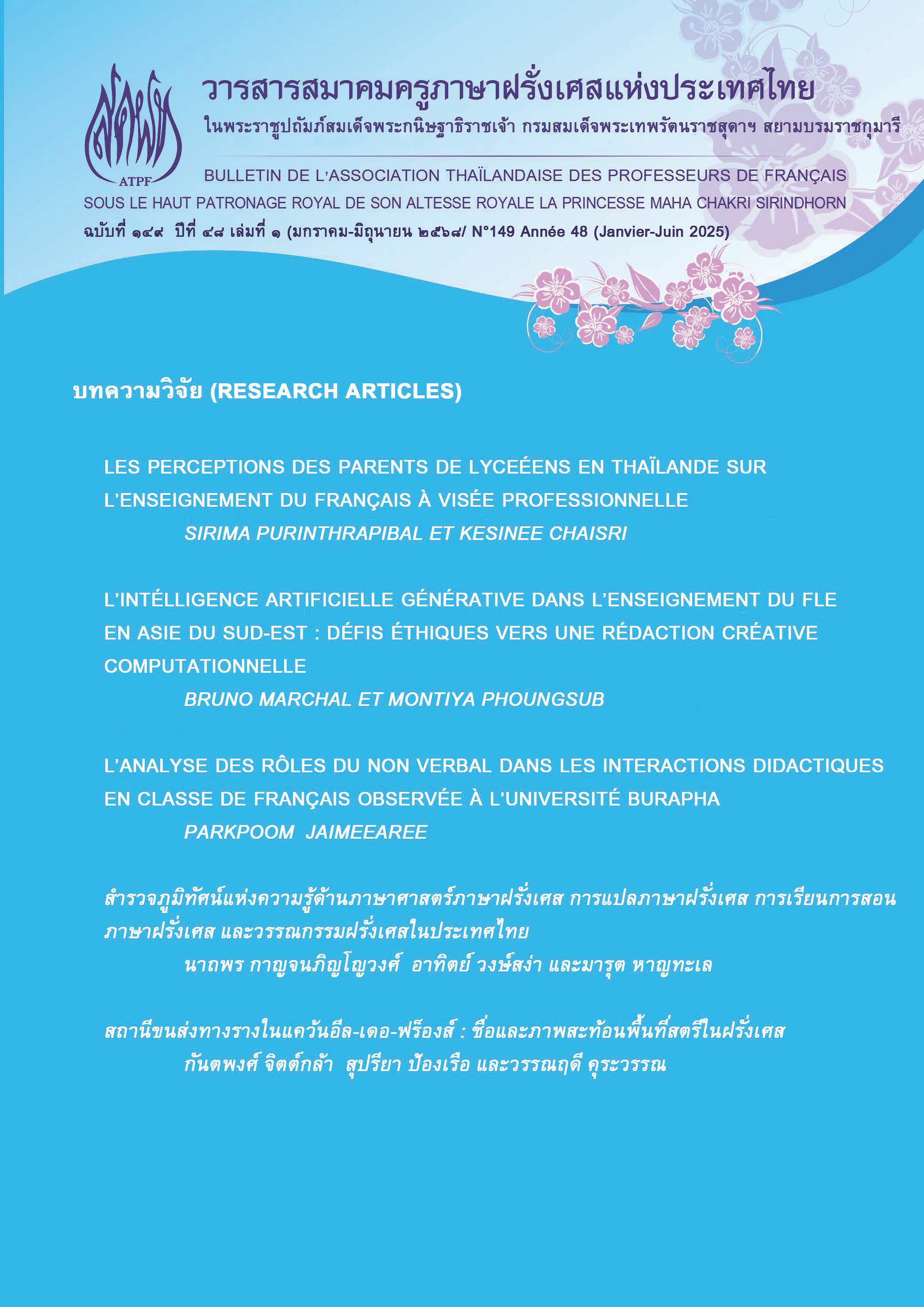
L’analyse des rôles du non verbal dans les interactions didactiques en classe de français observée à l’Université Burapha
Article Sidebar
Main Article Content
บทคัดย่อ
La classe de langue est un lieu ordinaire dans lequel les échanges interactifs entre enseignant et apprenants se produisent sous forme de verbal et de non verbal. La phrase <<On ne peut pas parler sans bouger>> témoigne que le verbal est inséparable du non verbal qui constitue un ingrédient non négligeable dans l’analyse des interactions communicatives en milieu naturel et en milieu institutionnel. Le non verbal joue un rôle essentiel dans l’enseignement/apprentissage de langue. Dans ce travail de recherche, deux types du non verbal sont observés : le non verbal de la part de l’enseignant et celui de la part des apprenants. Chacun a ses propres rôles plus ou moins différents. En effet, le professeur a recours au regard, au sourire et à la pause afin de vérifier la compréhension des apprenants et notamment de faire dérouler la classe. Du côté du non verbal de la part des apprenants, lorsqu’ils éprouvent des difficultés, ils rient, sourient, froncent les sourcils et hochent la tête. Ces réactions dites silencieuses indiquent leur inquiétude essentiellement liée à l’incompréhension du contenu d’enseignement.
Downloads
Article Details
เอกสารอ้างอิง
Bergson, H. (1940). Le rire. Presses Universitaires de France.
Cicurel, F. (2002). La classe de langue, un lieu ordinaire, une interaction complexe. AILE, 16, 145-163.
Dabène, L. et al. (1990). Variations et rituels en classe de langue. Hatier.
Foerster, C. (1984). Le rire : aspect non verbal dans l’interaction. Le français dans le monde, 183, 35-38.
Kerbrat-Orecchioni, C. (1996). La conversation. Seuil.
Kerbrat-Orecchioni, C. (1998). L’implicite. Armand Colin.
Le Robert. (2000). Le Petit Robert de la langue française. Dictionnaires Le Robert.
Traverso, V. (1999). L’analyse des conversations. Nathan.
Vion, R. (1992). La communication verbale, Analyse des interactions. Hachette.
