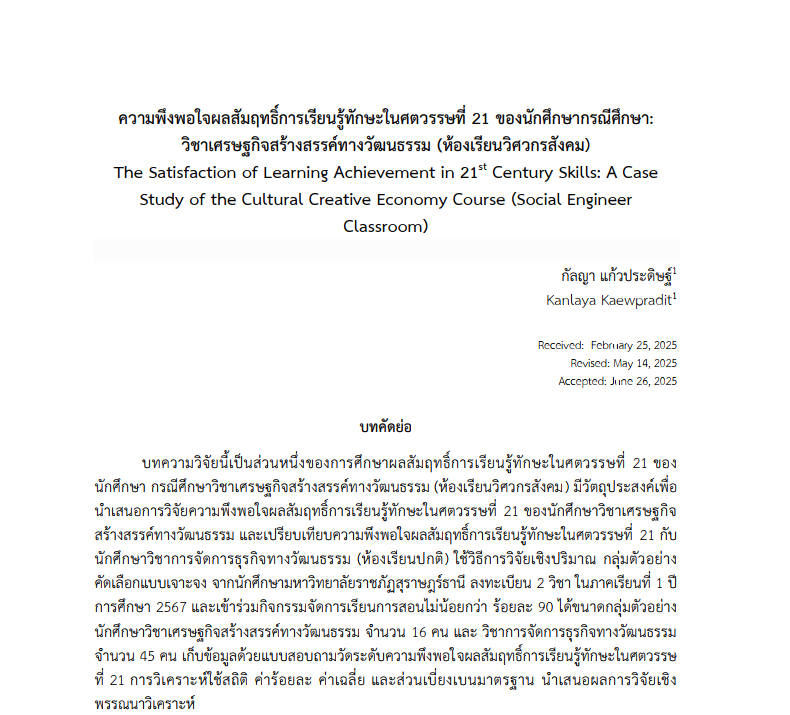
The Satisfaction of Learning Achievement in 21st Century Skills: A Case Study of the Cultural Creative Economy Course (Social Engineer Classroom)
Keywords:
Learning Achievement, Learning Skills in 21st Century, Social Engineering, Classroom, SatisfactionAbstract
The research article was part of a study on the students’ learning achievements in 21st-century skills. The case study focused on students in the Cultural Creative Economy (Social Engineer Classroom) and sought to compare their satisfaction with the acquisition of 21st-century skills to those in the Cultural Business Management (Regular Classroom). The quantitative research methods was used, with a purposive sampling of students enrolled in two subjects in the first semester of the 2024 academic year who participated in at least 90% of the teaching activities. The sample size included 16 students from the class of Cultural Creative Economy and 45 students from the class of Cultural Business Management. The questionnaire was used to collect the data to measure the satisfaction with the learning achievement in 21st-century skills. Statistical analysis included percentage, mean, and standard deviation, with results presented in a descriptive manner.
The result showed that the overall satisfaction with the learning achievement in 21st-century skills of students in the Cultural Creative Economy was at the highest level, with an average (=4.38, S.D.=0.12). The satisfaction with the learning achievement in 21st-century skills across all five skills was at the highest level in every aspect. The average for learning and innovation skills was at the highest level (
=4.44, S.D.=0.04), followed by life and career skills with an average (
=4.39, S.D.=0.13). The least satisfaction was in information, media, and technology skills with the average (
=4.30, S.D.=0.72). Moreover, the satisfaction with the learning achievement in 21st-century skills of students in Cultural Creative Economy was higher than that of the students in Cultural Business Management.
Downloads
References
กัมปนาท คูศิริรัตน์ และนุชรัตน์ นุชประยูร. (2559). ผลการจัดกิจกรรมการเรียนรู้ผ่านเครือข่ายสังคมออนไลน์รายวิชาสถิติวิจัยสำหรับการดำรงชีวิตและการทำงานที่มีต่อผลสัมฤทธิ์ทางการเรียนและทักษะการรู้สารสนเทศของนักศึกษาระดับปริญญาตรีในศตวรรษที่ 21. วารสารบัณฑิตศึกษามหาวิทยาลัยราชภัฏวไลยอลงกรณ์ ในพระบรมราชูปถัมถ์, 12(2), 1-11.
เจริญพงษ์ ชมภูนุช. (2564). การวิจัยเรื่องปัจจัยที่ส่งผลต่อทักษะการเรียนรู้ในศตวรรษที่ 21 ด้านการคิดอย่างมีวิจารณญาณและการแก้ปัญหาของนักเรียนระดับมัธยมศึกษาตอนปลายแผนการเรียน วิทยาศาสตร์-คณิตศาสตร์. วารสารครุศาสตร์ คณะครุศาสตร์ มหาวิทยาลัยราชภัฏกำแพงเพชร, 6(2), 39–45.
ชลธิชา หอมฟุ้ง และสมพร ร่วมสุข. (2559). การสอนคติชนวิทยากับการพัฒนาทักษะในศตวรรษที่ 21 ของผู้เรียนและการเสริมสร้างความภูมิใจในภูมิปัญญาไทย. วารสารมนุษยศาสตร์ สังคมศาสตร์ และศิลปะ มหาวิทยาลัยศิลปากร, 9(2), 1–15.
ดาราวรรณ รองเมือง. (2562). การศึกษาบรรยากาศการเรียนรู้ ความพึงพอใจต่อการจัดการเรียนรู้ในศตวรรษที่ 21 และผลสัมฤทธิ์ทางการเรียนรู้ของนักศึกษาหลักสูตรพยาบาลศาสตรบัณฑิต. วารสารเครือข่ายวิทยาลัยพยาบาลและการสาธารณสุขภาพใต้, 6(1), 167–177.
ประภาส เกตุแก้ว. (2546). ความพึงพอใจของผู้ใช้บริการที่มีต่อการให้บริการของฝ่ายทะเบียนรถสำนักงานเขตขนส่งจังหวัดประจวบคีรีขันธ์. กรุงเทพฯ: มหาวิทยาลัยศรีนครินทรวิโรฒ.
พวงรัตน์ ทวีรัตน์. (2530). การสร้างและพัฒนาแบบทดสอบผลสัมฤทธิ์. กรุงเทพฯ: มหาวิทยาลัยศรีนครินทร์วิโรฒประสานมิตร.
ไพศาล หวังพานิช. (2523). การวัดผลการศึกษา. กรุงเทพฯ: มหาวิทยาลัยศรีนครินทรวิโรฒ ประสานมิตร.
ราชบัณฑิตยสถาน. (2542). พจนานุกรมฉบับราชบัณฑิตยสถาน พ.ศ. 2542. กรุงเทพฯ: อักษรเจริญทัศน์.
วิจารณ์ พาณิช. (2556). วิถีสร้างการเรียนรู้ศิษย์ในศตวรรษที่ 21. กรุงเทพฯ: มูลนิธิสดศรี-สฤษดิ์วงศ์.
สุคนธ์ สินธพานนท์. (2558). ครูยุคใหม่กับการจัดการเรียนรู้สู่การศึกษา 4.0. กรุงเทพฯ: ห้างหุ้นส่วนจำกัด 9119 เทคนิคพริ้นติ้ง.
สุธน วงค์แดง ภาณุมาส เศรษฐจันทร และวีระพงษ์ สิงห์ครุธ. (2561). การพัฒนาหลักสูตรฝึกอบรมเพื่อเสริมสร้างทักษะการเรียนรู้ในศตวรรษที่ 21 สำหรับนักศึกษาครูมหาวิทยาลัยราชภัฏกลุ่มรัตนโกสินทร์. วารสารวิชาการและวิจัยสังคมศาสตร์, 13(1), 75–89.
สุสัณหา ยิ้มแย้ม และคณะ. (2558). การพัฒนาการจัดการเรียนรู้แบบผสมผสานเพื่อพัฒนาทักษะการเรียนรู้ในศตวรรษที่ 21. วารสารพยาบาลมหาวิทยาลัยเชียงใหม่, 42(พิเศษ)