Creative Drawing Skill Development through Activity-Based Learning for Digital Art Students.
Keywords:
Creative Line Drawing, Digital Art, Art Skills, Experiential LearningAbstract
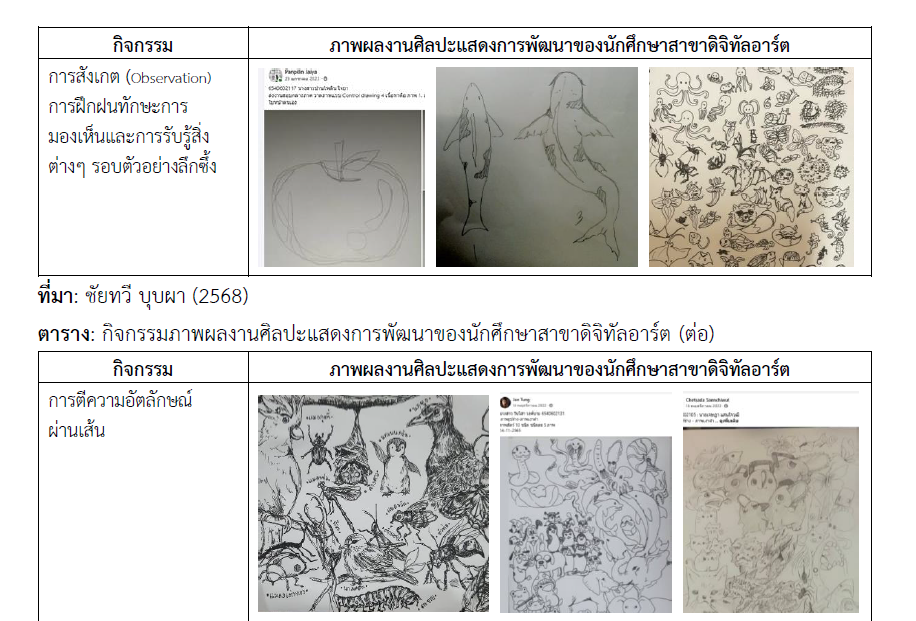
This research aimed to investigate the following: Methods for promoting the development of creative works among Digital Art students in the Creative Drawing course; The results of creative skill development in the Creative Drawing course; and Student satisfaction with learning in the Creative Drawing course. The sample group consisted of 17 Digital Art students enrolled in the Creative Drawing course during the research semester. The study was conducted over a period of 10 weeks. The research instruments included a creative learning activity plan, a creative drawing skill assessment form, an art portfolio evaluation form, pre-test and post-test, and a satisfaction questionnaire. The research findings revealed that the promotional method was the implementation of creative drawing learning activities designed based on the concepts of learning focused on observation, interpretation of identity through lines, use of diverse techniques, and critical reflection. These activities significantly developed creative drawing skills and enhanced the artistic creativity of Digital Art students. The development results indicated that the learning activities significantly impacted creative thinking (p < 0.05), especially in the aspects of originality, fluency, and flexibility of thought. Students' artwork demonstrated clear development in the unique use of lines to convey concepts, creativity, and composition that effectively communicates emotions. Overall student satisfaction was at the "Highest" level (overall mean = 4.57), with the highest satisfaction specifically in the areas of the instructor and the learning outcomes. These findings align with the concepts and research results of several academics who support the role of active and creative learning in developing essential skills for the 21st century.
Downloads
References
กรมวิชาการ. (2544). ความรู้เกี่ยวกับสื่อมัลติมีเดียเพื่อการศึกษา. กรุงเทพฯ: ศูนย์พัฒนาหนังสือกรมวิชาการ กระทรวงศึกษาธิการ.
คำปา, มุกดารัศ. (2562). การพัฒนาการสร้างสรรค์ชิ้นงานทางทัศนศิลป์ โดยการจัดกิจกรรมการเรียนรู้แบบค้นพบ สำหรับนักเรียนระดับชั้นมัธยมศึกษาตอนต้น [วิทยานิพนธ์ปริญญาศึกษาศาสตรมหาบัณฑิต, มหาวิทยาลัยธุรกิจบัณฑิตย์].
ผลณัชชา มหปุญญานนท์. (2551). การวัดและประเมินผลการเรียนรู้. สำนักพิมพ์มหาวิทยาลัยรามคำแหง.
วัลไพจิตร, ธัญพิชชา. (2566). การพัฒนาความคิดสร้างสรรค์และทักษะการนำเสนอโดยใช้การเรียนรู้แบบสร้างสรรค์เป็นฐานร่วมกับกระดาน MOODBOARDS สำหรับนักเรียนชั้นมัธยมศึกษาปีที่ 2 [วิทยานิพนธ์ปริญญาศึกษาศาสตรมหาบัณฑิต, มหาวิทยาลัยธุรกิจบัณฑิตย์].
วิจิตสถิตรัตน์, อธิพัชร์. (2565). การพัฒนาทักษะการสร้างสรรค์ผลงานทัศนศิลป์ 2 มิติ สำหรับครูศิลปะระดับประถมศึกษา ผ่านการเรียนรู้แบบเชิงรุก. วารสารศิลปกรรมศาสตร์ มหาวิทยาลัยขอนแก่น, 18(3), 47-60.
Aboalgasm, A. S., & Ward, R. (2014). Evaluating the Use of Digital Art Tools for Drawing to Enhance Artistic Ability and Improve Digital Skill among Junior School Students.
Ariaji, R., et al. (2021). Learning Materials Based on Digital Art Student Creativity in Universitas Muhammadiyah Tapanuli Selatan.
Deci, E. L., & Ryan, R. M. (1985). Intrinsic motivation and self-determination in human behavior. Plenum.
Eisner, E. W. (2002). The arts and the creation of mind. Yale University Press.
Gaitskell, C. D. (1957). Children and their art. Harcourt, Brace & World.
Kolb, D. A. (1984). Experiential learning: Experience as the source of learning and development. Prentice-Hall.
Lowenfeld, V., & Brittain, W. L. (1987). Creative and mental growth (8th ed.). Macmillan.Robinson, K. (2011). Out of our minds: Learning to be creative. Capstone.
Runco, M. A., & Acar, S. (2012). Divergent thinking as an indicator of creative potential. Creativity Research Journal, 24(1), 1-10.
Torrance, E. P. (1966). Torrance tests of creative thinking: Norms-technical manual. Personnel Press.
Torrance, E. P. (1974). Torrance tests of creative thinking: Norms-technical manual. Ginn.
Winner, E., & Hetland, L. (2008). Art for our Sake School Arts Classes Matter More than Ever- But Not for the Reasons You Think. Arts Education Policy Review, 69(5), 29-37.