The Impact on People’s Rights and Freedoms in Communication Through Computer Networks
Keywords:
Freedom of Communication, Computer Systems, Principle of ProportionalityAbstract
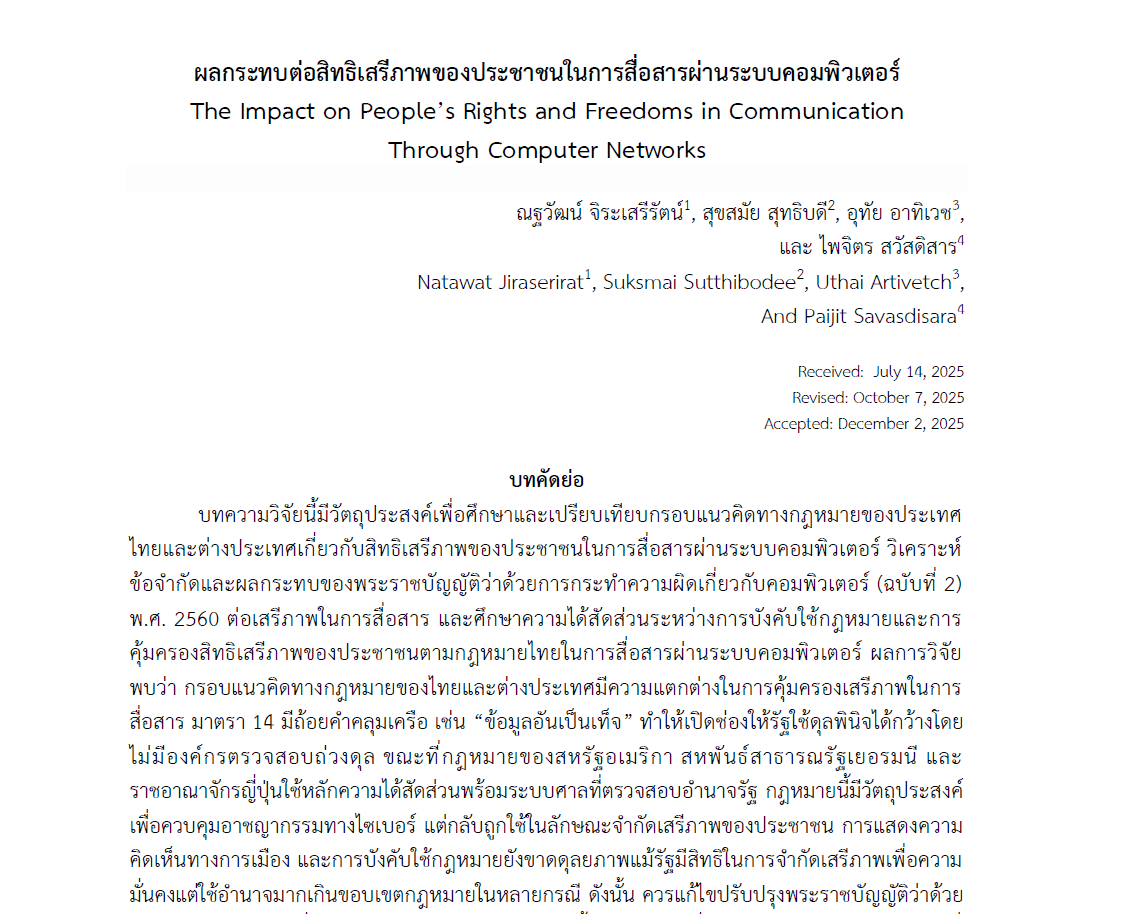
This research aims to study and compare the legal frameworks of Thailand and other countries regarding the freedom of people in communicating via computer systems, analyze the limitations and impacts of the Computer-Related Crime Act (No. 2) B.E. 2560 on freedom of communication, and study the proportionality between the enforcement of the law and the protection of the freedom of people under Thai law regarding communication via computer systems. The research results show that the legal frameworks of Thailand and other countries differ in protecting freedom of communication. Section 14 contains ambiguous words such as “false information”, which leaves the state with wide discretion without a check and balance body. Meanwhile, the laws of the United States, the Federal Republic of Germany, and the Kingdom of Japan use the principle of proportionality with a court system that checks the state’s power. This law aims to control cybercrime, but it is used to limit people’s freedom of expression, political expression, and law enforcement lacks balance. Although the state has the right to limit freedom for security, it has used its power beyond the scope of the law in many cases. Therefore, the Computer-Related Crime Act should be amended to be clearer, especially regarding the scope of officials’ powers, and to stipulate that access to people’s data must be authorized by the court in order to reduce the risk of violating people’s privacy rights. Consider using alternative measures instead of criminal punishment, fines, or probation. For cases of non-serious offenses against state security and to strengthen the mechanism for checking and balancing law enforcement to determine whether there is a violation of people's rights and freedoms.
Downloads
References
คันธิรา ฉายาวงศ์. (2568). เสรีภาพสื่อกับกฎหมายดิจิทัล: ความท้าทายของผู้ประกอบวิชาชีพสื่อกับการปรับตัวในอนาคต. วารสารศาสตร์, 18(1), 99-150.
บรรเจิด สิงคะเนติ. (2558). หลักพื้นฐานเกี่ยวกับสิทธิเสรีภาพและศักดิ์ศรีความเป็นมนุษย์. กรุงเทพฯ: วิญญูชน.
วรเจตน์ ภาคีรัตน์. (2543). เงื่อนไขการตรากฎหมายจำกัดสิทธิและเสรีภาพของประชาชน: “มาตร” ในการควบคุมตรวจสอบความชอบด้วยรัฐธรรมนูญของกฎหมาย. วารสารนิติศาสตร์ มหาวิทยาลัยธรรมศาสตร์, 30(2), 184-194.
วีระ โลจายะ. (2539). เอกสารการสอนชุดกฎหมายมหาชนเรื่องสิทธิเสรีภาพของประชาชน. กรุงเทพฯ :สำนักพิมพ์ชวนพิมพ์.
ศิลป์ฟ้า ตันศราวุธ และโทบี้ เมนเดล. (2553). บทวิเคราะห์พระราชบัญญัติว่าด้วยการกระทำความผิดเกี่ยวกับคอมพิวเตอร์ 2550. ศูนย์กฎหมายและประชาธิปไตย (Centre for Law and Democracy) องค์การสาธารณประโยชน์นานาชาติด้านสิทธิมนุษยชนในประเทศแคนาดา.
สมยศ เชื้อไทย. (2553). คำอธิบายหลักรัฐธรรมนูญทั่วไป. กรุงเทพฯ: เรือนแก้วการพิมพ์.
สาวตรี สุขศรี, ศิริพล กุศลศิลป์วุฒิ และอรพิณ ยิ่งยงพัฒนา. (2555). ผลกระทบจากพระราชบัญญัติว่าด้วยการกระทำความผิดเกี่ยวกับคอมพิวเตอร์ พ.ศ. 2550 และนโยบายของรัฐกับสิทธิเสรีภาพในการแสดงความคิดเห็น. โครงการอินเทอร์เน็ตเพื่อกฎหมายประชาชน.
เอกบุญ วงศ์สวัสดิ์กุล. (2553). หลักนิติรัฐ หลักนิติธรรม. กรุงเทพฯ :มหาวิทยาลัยธรรมศาสตร์.
Chen, L. (2017). Freedom of Speech and the Principle of Proportionality. Journal of Constitutional Law, 45(3), 120-135.
Chester Tan. (2022). Free speech and public order in Singapore. Asian Journal of Comparative Law, 17(1), 88-105.
Freedom House. (2022). Freedom on the Net 2022-Indonesia. Retrieved from https://freedomhouse.org
Human Right Watch. (2016). Thailand: Cyber Crime Act Tightens Internet Control. Retrieved from https://www.hrw.org/news/2016/12/21/thailand-cyber-crime-act-tightens-internet-control
Justia. (1969). Brandenburg v. Ohio, 395 U.S. 444 (1969). Retrieved from https://supreme. justia.com/cases/federal/us/395/444/
Palatino, M. (2012). Malaysia’s new internet law. Retrieved from https://thediplomat.com/ 2012/08/guilty-until-proven-innocent-malaysias-new-internet-law/
Reang, P. (2014). Freedom of expression and right to information in Asian countries: A regional analysis of challenges, treats and opportunities. London: Internews Europe.
Smith, J. (2018). Human rights and the rule of law: A comparative analysis. Oxford University Press.
Smith, J., & Johnson, A. (2020). Principles of state discretion: A legal and political perspective. Journal of Political Science, 15(2), 123-145.