The Problem on Properties Holding of Alien in Thailand
Keywords:
Right over leasehold asset, Immovable properties holding, AlienAbstract
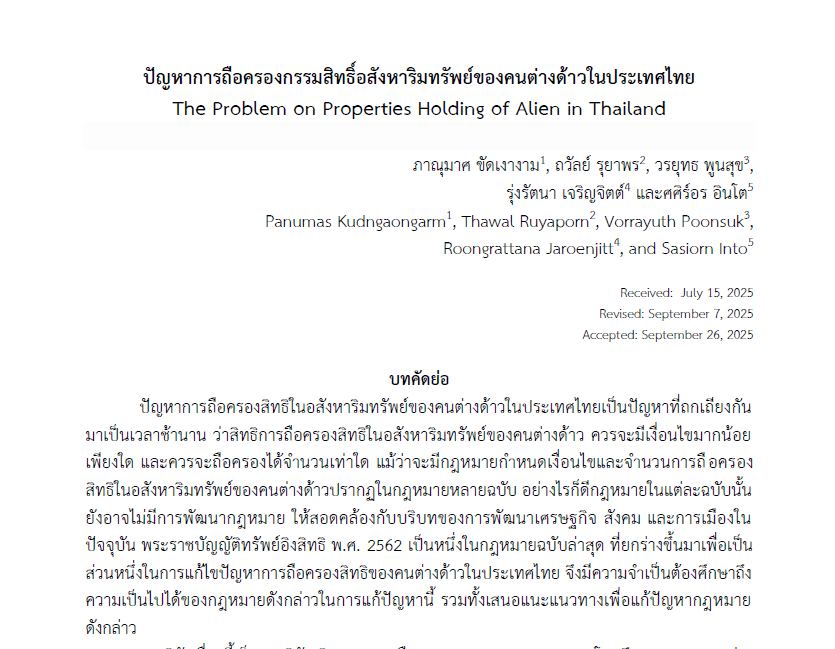
The problems on immovable properties holding by aliens in Thailand have been discussed since immemorial time. These problems are the conditions of holding and the quantity of immovable properties should be held by the aliens. Even though, those questions have already been provided in several laws and regulations. However, those laws and regulations have not been revised to compatible with the need of aliens who would like to be the owners of immovable properties in Thailand. While, presently, Thai laws and regulations have not been developed to serve economic, social and politic development. Until the latest law, named “the Right Over Leasehold Asset Act B. E. 2562” is issued to be the choice of solving the problems on immovable properties holding by aliens in Thailand. There for, it is necessity to study the possibilities of this Act to solve these problems and to find out the appropriated measures and the recommendations to those problems.
This research is documentary research, based on drafted laws and regulations, acts, texts, articles, relevant research works, judicial decisions, electronic information and foreign laws related to this topic for comparison of Thai laws.
The research found that the Right Over Leasehold Asset Act B. E. 2562 may not applicable to the need of foreign investors and the one who would like to be the owner of immovable properties in Thailand. For what’s ever reasons, this law is not appropriate enough to the need of those foreign investors and aliens. In summary, this research has the recommendations are as follows: 1) Thailand still be one target that alien groups would like to hold immovable properties. 2) Those target alien groups are Russian Federation and People’s Republic of China. 3) For the immovable properties holding of aliens, in case of ownership, they should pay the tax of the income receive from the differences cost of the properties holding after they distribute those properties. 4) In case of social problems, the Government should create the mutual understanding of local people to accept and understanding of Human rights regime on the rights and freedom of movement and settlement. 5) The effect of value change of immovable properties in case of increasing of demand by aliens, the Government should allow immovable properties holding by aliens only the high price of properties. This is to avoid the effect which may reflect to the higher price of immovable properties and effect to the middle and lower classes of domestic people. 6) The Government should improve or gathering the law concerning immovable properties holding by aliens which are hidden in several laws and regulations to be registered in a single law particularly for the holding of alien in immovable properties in Thailand. This is to serve the understanding of both Thai officials and aliens who would like to hold the immovable properties in Thailand.
Downloads
References
บรรณานุกรม
รัฐธรรมนูญแห่งราชอาณาจักรไทย พ.ศ. 2560, พระราชบัญญัติธนาคารพาณิชย์ พ.ศ. 2505, ประมวลกฎหมายที่ดิน พ.ศ. 2497 (และพระราชบัญญัติแก้ไขเพิ่มเติมประมวลกฎหมายที่ดิน (ฉบับที่ 8) พ.ศ. 2542), พระราชบัญญัติประกอบกิจการปิโตรเลียม พ.ศ. 2514, พระราชบัญญัติส่งเสริมการลงทุน พ.ศ. 2520, พระราชบัญญัติอาคารชุด พ.ศ. 2522, พระราชบัญญัติการนิคมอุตสาหกรรมแห่งประเทศไทย พ.ศ. 2522,พระราชบัญญัติประกันชีวิต พ.ศ. 2535, พระราชบัญญัติประกันวินาศภัย พ.ศ. 2535, พระราชบัญญัติประกอบธุรกิจของคนต่างด้าว พ.ศ. 2542, พระราชบัญญัติการเช่าอสังหาริมทรัพย์เพื่อพาณิชยกรรมและอุตสาหกรรม พ.ศ. 2542, พระราชบัญญัติทรัพย์อิงสิทธิ พ.ศ. 2562.
หนังสือ/บทความ/งานวิจัย/วิทยานิพนธ์ และงานวิจัยที่เกี่ยวข้อง
กรมที่ดิน. หลักเกณฑ์การถือครองอสังหาริมทรัพย์ของคนต่างด้าวในประเทศสมาชิกอาเซียน 10 ประเทศ. การเตรียมความพร้อมเข้าสู่ประชาคมอาเซียนปี 2558 จัดทำโดยกรมที่ดินกระทรวงมหาดไทย, ข้อมูลจากกระทรวงการต่างประเทศ ณ วันที่ 24 มิถุนายน 2557.
ฐากูร จุลินทร. การถือครองที่ดินของคนต่างด้าว เอกสาร ข่าวสารงานวิจัยและพัฒนา ปีที่ 13 ฉบับที่ 139
มีนาคม 2557, 18-19.
โสภณ พรโชคชัย. ต่างชาติกับที่ดินไทย: ไม่ให้ซื้อ. โพสต์ทูเดย์ 28 กุมภาพันธ์ 2550 หน้า A13 มีนาคม 2550: 63-64.
ณัฐวิน อัศวภูวดล. มาตรการทางกฎหมายในการห้ามถือกรรมสิทธิ์อสังหาริมทรัพย์ของบุคคลต่างด้าว ในประเทศไทย Problem In Hand Holding Proprietor of the Foreigners in Thailand. วารสารวิทยาลัยนครราชสีมา, Vol.10, No.2, July-December 2016.
สุชาติ มสันต์. ปัญหาทางกฎหมายเกี่ยวกับการจดทะเบียนก่อตั้งทรัพย์อิงสิทธิ. นักศึกษาปริญญาโทหลักสูตรนิติศาสตรมหาบัณฑิต สาขาวิทยบริการเฉลิมพระเกียรติ จังหวัดตรัง คณะนิติศาสตร์ มหาวิทยาลัย
รามคำแหง (บทความเรียบเรียงจากการศึกษาอิสระเรื่องปัญหาทางกฎหมายเกี่ยวกับการจดทะเบียนก่อตั้งทรัพย์อิงสิทธิ), หน้า 1-6.
ฯลฯ
เอกสารทางอิเล็กทรอนิกส์
กรมที่ดินหวั่น AEC ดันทุนนอกทะลัก ชงแก้ ‘นอมินี’ ต่างชาติไล่ฮุบ ตั้งเขตเศรษฐกิจพิเศษเช่ายาว 50 ปี. สืบค้นเมื่อ 6 เมษายน 2567, http://thaipublica.org/2012/department-of-lands-aec/
ศิริพร สัจจานนท์ และคณะ. โครงการศึกษาสภาพปัญหาการถือครองอสังหาริมทรัพย์ของคนต่างด้าวระยะที่ 2 (2552). สืบค้นเมื่อ 6 เมษายน 2567, http://landforum.trf.or/09-02.pdf
กรมที่ดิน การจดทะเบียน. สืบค้นเมื่อ 6 เมษายน 2567, http://www.dol.go.th/registry/DocLib3/handbook10.pdf
โกสินทร์ เตชะดิลก. ทรัพย์อิงสิทธิ ทรัพย์สินชนิดใหม่ของไทย. สืบค้นเมื่อ 6 เมษายน 2567,
คมสันต์ เพชรน้อย. ปัญหากฎหมายเกี่ยวกับทรัพย์อิงสิทธิ ตามพระราชบัญญัติทรัพย์อิงสิทธิ พ.ศ. 2562.
สืบค้นเมื่อ 6 เมษายน 2567, http://www.lawgrad.ru.ac.th
ฯลฯ
Jara Samuel Tura. “Comparative Analysis on Ownership of Immovable Property by Foreigners and Its Implication of FDI: the case of Ethiopia and Kenya’s Land Policy”. Hawassa University Journal of Law (HUJL), Volume 6, July 2022, pp. 153-176.
Dalibor Krstinic, Jovana Vasiljkovic, Ana Langovic Milicevic. “Regulation on Foreign Ownership of Agricultural Land in the Republic of Serbia”. Economics of Agriculture, Year 67, No. 2020, Belgrade, pp. 553-567.
Dmytro Fedchyshyn, Iryna Ignatenko. “Protection of land ownership of foreigners in Ukraine”.
Journal Tribune, Volume 8, Special Issue, October 2018, pp. 27-38.
Mark Shapiro. “The Dormant Commerce Clause: A Limit on Alien Land Laws”. Brooklyn Journal of International Law, Volume 20, Issue 1, Symposium: Intellectual Property and Comparative Law: Changing Views in the European Community and the United States of America, pp. 217-235.
ฯลฯ