Legal Measures for Setting Fees in the Community Management of Electronic Waste and Equipment
Keywords:
E-waste, Fees, Environmental Law, Local Administrative Organizations, Extended Producer Responsibility (EPR)Abstract
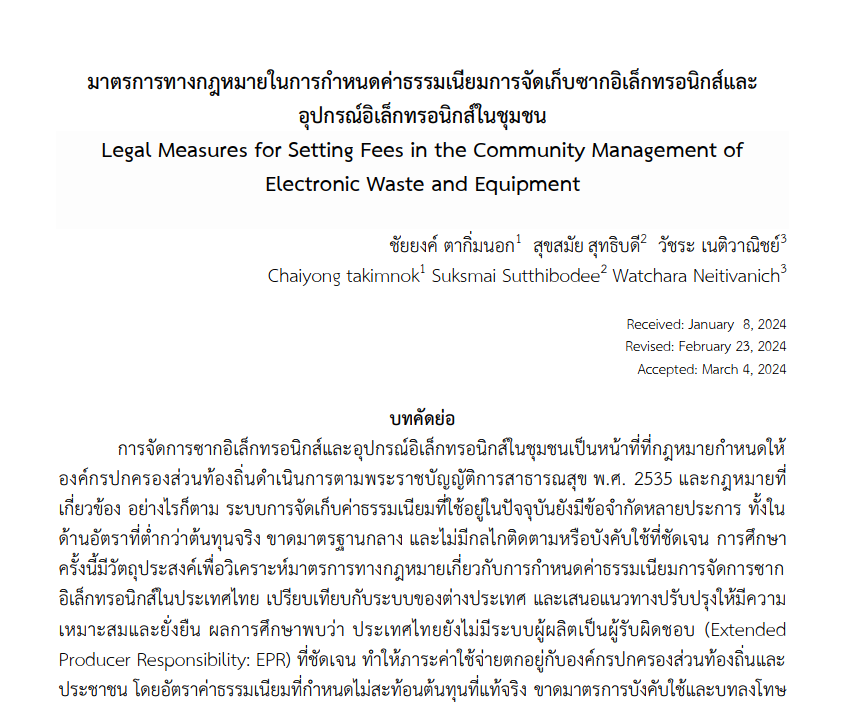
The management of electronic waste (e-waste) and electronic equipment in communities is a statutory duty assigned to local administrative organizations under the Public Health Act B.E. 2535 (1992) and related legislation. However, the current fee collection system faces several limitations, including rates lower than the actual management costs, the absence of standardized national criteria, and the lack of clear monitoring and enforcement mechanisms. This study aims to analyze the legal measures governing fee determination for e-waste management in Thailand, compare them with systems in other countries, and propose suitable and sustainable improvements. The findings reveal that Thailand does not have a clear Extended Producer Responsibility (EPR) system, resulting in the financial burden falling on local authorities and the public. The prescribed fee rates do not reflect actual costs, there is a lack of effective enforcement measures and penalties, and no comprehensive monitoring and evaluation system is in place. In contrast, jurisdictions such as the European Union, Japan, the Republic of Korea, the Federal Republic of Germany, and the Republic of China (Taiwan) have adopted EPR principles alongside the establishment of centralized management organizations, integrated tracking systems, and fee structures based on the type and quantity of e-waste, which collectively enhance the sustainability of waste management systems. Therefore, it is recommended that Thailand revise its legal framework to mandate producer responsibility for e-waste management costs, establish an effective monitoring and evaluation system, set fee rates that reflect actual costs with periodic adjustments, develop recycling infrastructure, promote multi-sector collaboration, and create economic incentives to ensure a sustainable e-waste management system that aligns with international standards.
Downloads
References
กรมควบคุมมลพิษ. (2565). รายงานสถานการณ์การจัดการขยะมูลฝอยและของเสียอันตรายจากชุมชนของประเทศไทย ปี 2565. กระทรวงทรัพยากรธรรมชาติและสิ่งแวดล้อม.
กระทรวงมหาดไทย. (2562). ระเบียบกระทรวงมหาดไทยว่าด้วยค่าใช้จ่ายเพื่อการช่วยเหลือประชาชนตามอำนาจหน้าที่ขององค์กรปกครองส่วนท้องถิ่น พ.ศ. 2562. โรงพิมพ์คุรุสภาลาดพร้าว.
สำนักงานคณะกรรมการกฎหมายแห่งชาติ. (2563). การกระจายอำนาจและการจัดการขยะมูลฝอยขององค์กรปกครองส่วนท้องถิ่น. สำนักเลขาธิการวุฒิสภา.
อนุรักษ์ พันธุเมธา. (2553). ทฤษฎีภาษีอากรและการคลังสาธารณะ. สำนักพิมพ์มหาวิทยาลัยเกษตรศาสตร์.
ปิยะมิตร ณ นคร. (2552). หลักการผู้ก่อมลพิษเป็นผู้จ่ายในการจัดการสิ่งแวดล้อม. สำนักพิมพ์มหาวิทยาลัยมหิดล.
สมศักดิ์ กิตติเกษม. (2559). ความเป็นอิสระทางการคลังขององค์กรปกครองส่วนท้องถิ่น. สำนักพิมพ์มหาวิทยาลัยสงขลานครินทร์.
Environmental Protection Administration, Taiwan. (2001). Waste Disposal Act of the Republic of China (Taiwan). Taipei: Government of the Republic of China (Taiwan).
European Commission. (2012). Directive 2012/19/EU on Waste Electrical and Electronic Equipment (WEEE). Official Journal of the European Union.
Kunz, N. C., Mayers, K., & Van Wassenhove, L. N. (2018). Stakeholder views on extended producer responsibility and the German WEEE system. Journal of Industrial Ecology, 22(4), 834–845.
Ministry of Economy, Trade and Industry (METI). (2001). Home Appliance Recycling Law (Law No. 97 of 1998). Tokyo: Government of Japan.
Ministry of Environment, Republic of Korea. (2008). Act on the Resource Circulation of Electrical and Electronic Equipment and Vehicles. Seoul: Government of the Republic of Korea
Terazono, A., Murakami, S., Abe, N., Inanc, B., Moriguchi, Y., Sakai, S. I., ... & Hirakawa, T. (2006). Current status and research on e-waste issues in Asia. Journal of Material Cycles and Waste Management, 8(1), 1-12.
Sander, K., Schilling, S., Tojo, N., van Rossem, C., Vernon, J., & George, C. (2007). The Producer Responsibility Principle of the WEEE Directive. European Commission DG Environment.
Environmental Protection Administration Taiwan. (2001). Waste Disposal Act. EPA Taiwan
Ministry of Environment Korea. (2008). Act for Resource Recycling of Electrical and Electronic Equipment and Vehicles. MOE Korea.