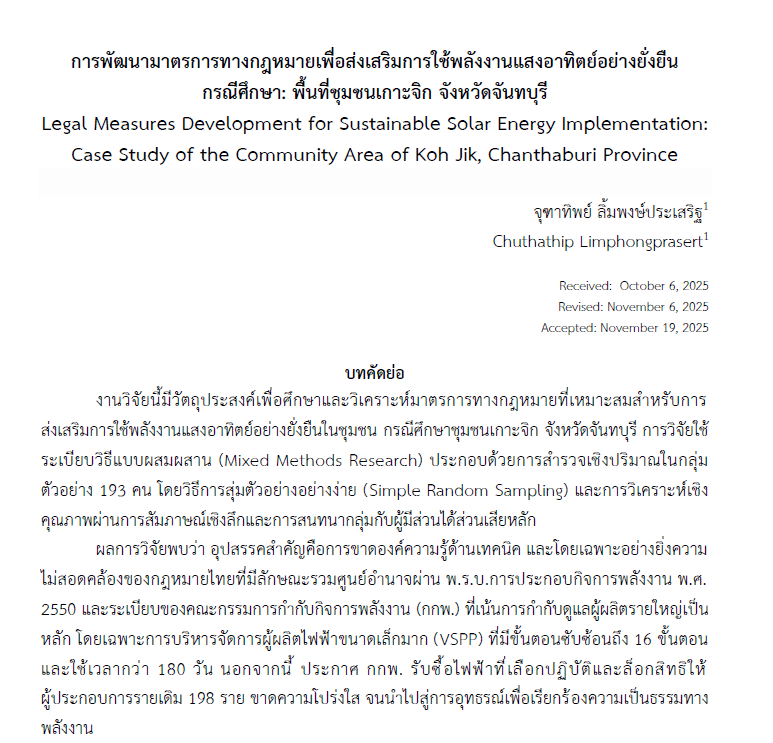
Legal Measures Development for Sustainable Solar Energy Implementation: Case Study of the Community Area of Koh Jik, Chanthaburi Province
Keywords:
Community Energy Law, Solar Energy, Sustainability, Energy Justice, Public ParticipationAbstract
This research aims to study and analyze appropriate legal measures for promoting the sustainable use of solar energy at the community level, using Koh Jik Community, Chanthaburi Province, a remote area with high energy potential but facing structural obstacles, as a case study. A Mixed Methods approach was used, involving a quantitative survey of 193 samples and qualitative analysis through in-depth interviews and focus group discussions with stakeholders.
The findings indicate that despite high social readiness and clear benefits in energy cost reduction, scaling up is hindered by three main obstacles: 1) High upfront costs and lack of easily accessible soft loan mechanisms; 2) Lack of technical knowledge for long-term maintenance; and 3) Inconsistent Thai laws, which are centralized, focusing on large operators, leading to complex permitting processes and a lack of legal status for "Community Energy" to produce and sell surplus electricity.
In-depth analysis under the Holistic Participatory Energy Model (HPEM) and energy justice principles suggests that the clarity of legal procedures and institutional trust are crucial factors influencing installation decisions. The research proposes prompt legal reform to recognize the status and rights of "Grassroots Prosumers", implementing stable financial incentives (Tiered FiT/Net Metering), simplifying permitting to a notification regime, and establishing a performance tracking index (Solar Legal Acceptance Index: SLAI) to ensure laws adapt to actual community data. These proposals aim to reduce energy inequality and create long-term sustainability.
Downloads
References
กระทรวงพลังงาน. (2561). แผนพัฒนาพลังงานทดแทนและพลังงานทางเลือก (AEDP 2018).
กระทรวงพลังงาน. (2565). แผนพัฒนากำลังผลิตไฟฟ้าของประเทศไทย พ.ศ. 2565–2580 (PDP 2022–2037). กรุงเทพฯ: สำนักงานนโยบายและแผนพลังงาน.
กระทรวงมหาดไทย. (2537). พระราชบัญญัติสภาตำบลและองค์การบริหารส่วนตำบล พ.ศ. 2537.
กระทรวงมหาดไทย. (2542). พระราชบัญญัติกำหนดแผนและขั้นตอนการกระจายอำนาจให้แก่องค์กรปกครองส่วนท้องถิ่น พ.ศ. 2542.
กรมพัฒนาพลังงานทดแทนและอนุรักษ์พลังงาน. (2564). แนวทางการส่งเสริมพลังงานหมุนเวียนระดับชุมชน. กรุงเทพฯ: กระทรวงพลังงาน.
กรมพัฒนาพลังงานทดแทนและอนุรักษ์พลังงาน. (2566). รายงานพลังงานหมุนเวียนประเทศไทย 2565.
รัฐธรรมนูญแห่งราชอาณาจักรไทย พุทธศักราช 2560.
สำนักงานคณะกรรมการกำกับกิจการพลังงาน. (2550). พระราชบัญญัติการประกอบกิจการพลังงาน พ.ศ. 2550.
สำนักงานนโยบายและแผนพลังงาน (สนพ.). (2566). รายงานสถานการณ์พลังงานประเทศไทย 2566.
สำนักงานสถิติแห่งชาติ. (2565). สถิติพลังงานทดแทนและพลังงานแสงอาทิตย์ประเทศไทย. กรุงเทพฯ: กระทรวงดิจิทัลเพื่อเศรษฐกิจและสังคม.
ฯลฯ
หนังสือ/บทความ/งานวิจัย/วิทยานิพนธ์ และงานวิจัยที่เกี่ยวข้อง
กิตติศักดิ์ พงษ์เล็ก. (2564). การส่งเสริมพลังงานหมุนเวียนในระดับท้องถิ่นของประเทศไทย: มิติทางกฎหมายและนโยบาย. วารสารนิติศาสตร์ มหาวิทยาลัยธรรมศาสตร์, 50(3), 45–78.
ชาณิกา ปัญจพุทธานนท์ และ รัตพงษ์ สอนสุภาพ. (2559). ปัญหาและอุปสรรคของการพัฒนาพลังงานไฟฟ้าจากแสงอาทิตย์ในประเทศไทย. วารสารวิจัยและพัฒนา วไลยอลงกรณ์ ในพระบรมราชูปถัมภ์ สาขามนุษยศาสตร์และสังคมศาสตร์, 11(3), 63–87.
ชุติมา อยู่ดี และ เสถียรภาพ นาหลวง. (2562). มาตรการทางกฎหมายเพื่อส่งเสริมการผลิตและใช้ไฟฟ้าจากพลังงานแสงอาทิตย์. วารสารวิชาการแพรวากาฬสินธุ์ มหาวิทยาลัยกาฬสินธุ์, 6(1), 1–15.
ธนเดช อุดมสุข. (2565). The Role of Local Administrative Organizations in Renewable Energy Development. วารสารการบริหารท้องถิ่น, 18(4), 77–99.
ธีรพล ศิริพงศ์. (2562). แนวทางการใช้กฎหมายเพื่อขับเคลื่อนพลังงานสะอาดในประเทศไทย. วารสารนโยบายสาธารณะและการพัฒนา, 8(1), 1–22.
พรรณราย วัฒนสุข. (2563). การบริหารจัดการพลังงานทดแทนโดยชุมชน: กรณีศึกษาโซลาร์วิลเลจ. วารสารรัฐศาสตร์และสังคมศาสตร์, 16(2), 112–130.
สุปัน, ส. (2562). การจัดการพลังงานชุมชนอย่างยั่งยืน: กรณีศึกษาชุมชนนาเหลือง อำเภอเวียงสา จังหวัดน่าน. วารสารพัฒนาสังคม, 21(2), 45–63.
ฯลฯ
เอกสารทางอิเล็กทรอนิกส์
พงษ์ศักดิ์ อยู่มั่น, และคณะ. (2558). โครงการแนวทางการบริหารจัดการพลังงานทางเลือกชุมชนแบบมีส่วนร่วม: กรณีศึกษา บ้านห้วยมง อำเภอเมืองปาน จังหวัดลําปาง (รายงานวิจัยฉบับสมบูรณ์). มหาวิทยาลัยราชภัฏลําปาง. สืบค้นเมื่อ 20 ตุลาคม 2568, https://elibrary.tsri.or.th/fullP/RDG56A0023/RDG56A0023V08/RDG56A0023V08_full.pdf
กรมพัฒนาพลังงานทดแทนและอนุรักษ์พลังงาน. (2565). รายงานดุลยภาพพลังงานของประเทศไทย พ.ศ. 2565. กรุงเทพฯ: กระทรวงพลังงาน. สืบค้นเมื่อ 20 ตุลาคม 2568, https://www.dede.go.th/uploads/2565_for_web_e39e0dd571.pdf
เสริมสุข บัวเจริญ และคณะ. (2558). โครงการ “การพัฒนาพลังงานทดแทนอย่างมีส่วนร่วมและยั่งยืนของหมู่บ้านตามโครงการพัฒนาเพื่อความมั่นคงพื้นที่ชายแดนตามแนวทางพระราชทาน จังหวัดแม่ฮ่องสอน” (รายงานฉบับสมบูรณ์). สืบค้นเมื่อ 20 ตุลาคม 2568, https://elibrary.tsri.or.th/fullP/RDG55A0029/RDG55A0029_full.pdf
GSB Research. (2563). โรงไฟฟ้าชุมชนเพื่อเศรษฐกิจฐานราก. สืบค้นเมื่อ 25 ตุลาคม 2568, https://www.gsb.or.th/gsbresearch/wp-content/uploads/2020/07/GR_hotissue_PowerPlant_6_63_inter_detail.pdf
สำนักงานคณะกรรมการสุขภาพแห่งชาติ. (2568, 25 มิ.ย.). พัฒนานโยบายสาธารณะ ผลักดัน อปท. สนับสนุน ‘ชุมชน’ ใช้ไฟฟ้า … สืบค้นเมื่อ 25 ตุลาคม 2568, https://www.nationalhealth.or.th/NHCO/100
ฯลฯ
Arnstein, S. R. (1969). A ladder of citizen participation. Journal of the American Institute of Planners, 35(4), 216–224.
Clean Energy Council (Australia). (2021). Community Solar Guide. Melbourne: Clean Energy Council.
Creswell, J. W. (2014). Research design: Qualitative, quantitative, and mixed methods approaches (4th ed.). Sage.
Davis, F. D. (1989). Perceived usefulness, perceived ease of use, and user acceptance of information technology. MIS Quarterly, 13(3), 319–340.
European Parliament and Council. (2018). Directive (EU) 2018/2001 on the promotion of the use of energy from renewable sources. Official Journal of the European Union, L 328/82.
International Energy Agency (IEA). (2022). Renewables 2022: Global Status Report. Paris: IEA.
International Renewable Energy Agency (IRENA). (2023). Renewable Energy Statistics 2023. Abu Dhabi: IRENA.
Ministry of Economy, Trade and Industry (METI, Japan). (2012). Japan’s Feed-in Tariff Scheme for Renewable Energy.
Rogers, E. M. (2003). Diffusion of Innovations (5th ed.). Free Press.
Saheb, Y. (2021). Right to energy as a human right. Energy Research & Social Science, 74, 101902.
United Nations. (2015). Transforming Our World: The 2030 Agenda for Sustainable Development.
United Nations Development Programme (UNDP). (2022). Community-Based Renewable Energy: Pathways for Sustainable Development. New York: UNDP.
World Bank. (2023). Thailand Energy Transition Report: Community Empowerment and Legal Reform. Washington, DC: World Bank Group.
World Commission on Environment and Development. (1987). Our Common Future. Oxford University Press.