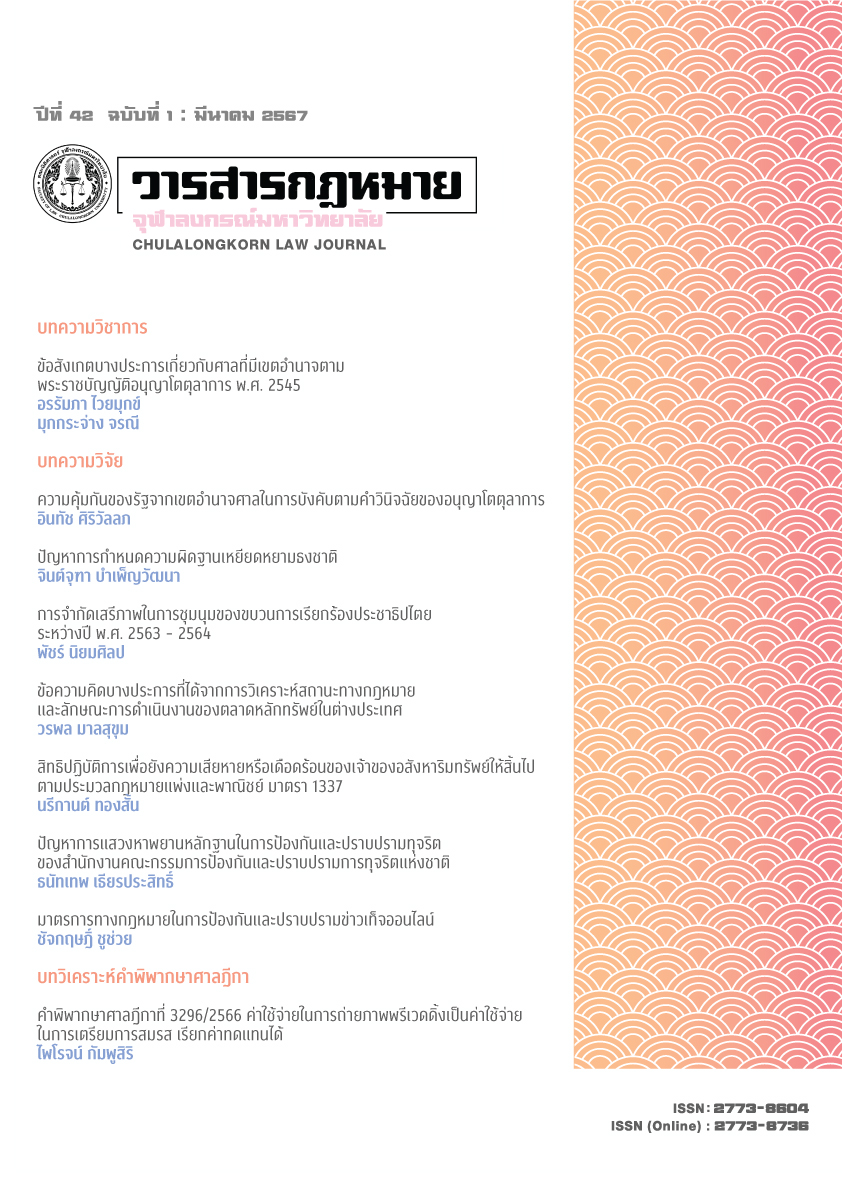
The Right of an Immovable’s Owner to Have Inconvenience or Injury Abated under the Civil and Commercial Code Section 1337
Article Sidebar
Main Article Content
Abstract
Civil and Commercial Code Section 1337 is the provision about an exclusive right relating to an action to abate immovable property to the greater injury or inconvenience of the owner. Such an act consists of several challenges facing law enforcement and interpretation. According to the study and analysis, the researcher found that Section 1337 is the provision aiming to specially protect the rights of the owner of immovable property when the owner has suffered greater injury or inconvenience caused by exercising the rights of others. Thus, applying this section does not require consideration of the principles of tort liability. Moreover, the owner of immovable property also has the right to arbitrarily abate greater injury or inconvenience to himself without applying to the court since it is the right that acts over the property of the owner of immovable property. In addition, the owner is entitled, without prejudice to any claim for compensation, to have such injury or inconvenience abated without consideration of liability in tort. Hence, suffice it to say that applying Section 1337 to immovable property is beneficial to the owner. Based on the result of the study and analysis, the researcher suggests that law enforcement authorities should consider the spirit of the law by applying Section 1337 individually and should not try to adjudicate by involving the principle of tort liability. The owner of immovable property must exercise the right to abate greater injury deliberately under the scope of rights. Regarding the right to claim compensation, the researcher suggests that calculating compensation claims in tort following Section 438 should be considered as well.
Article Details

This work is licensed under a Creative Commons Attribution-NonCommercial-NoDerivatives 4.0 International License.
The copyright in this website and the material on this website (including without limitation the text, computer code, artwork, photographs, images, music, audio material, video material and audio-visual material on this website) is owned by Chulalongkorn University Law Journal and its licensors.
1. Chulalongkorn University Law Journal grants to you a worldwide non-exclusive royalty-free revocable license to:
- view this website and the material on this website on a computer or mobile device via a web browser;
- copy and store this website and the material on this website in your web browser cache memory; and
- print pages from this website for your use.
- All articles published by Chulalongkorn University Law Journal are licensed under the Creative Commons Attribution 4.0 International License. This permits anyone to copy, redistribute, remix, transmit and adapt the work provided the original work and source is appropriately cited.
2. Chulalongkorn University Law Journal does not grant you any other rights in relation to this website or the material on this website. In other words, all other rights are reserved. For the avoidance of doubt, you must not adapt, edit, change, transform, publish, republish, distribute, redistribute, broadcast, rebroadcast or show or play in public this website or the material on this website (in any form or media) without appropriately and conspicuously citing the original work and source or Chulalongkorn University Law Journal prior written permission.
3. You may request permission to use the copyright materials on this website by writing to journal@law.chula.ac.th.
4. Chulalongkorn University Law Journal takes the protection of its copyright very seriously. If Chulalongkorn University Law Journal discovers that you have used its copyright materials in contravention of the license above, Chulalongkorn University Law Journal may bring legal proceedings against you seeking monetary damages and an injunction to stop you using those materials. You could also be ordered to pay legal costs.
If you become aware of any use of Chulalongkorn University Law Journal's copyright materials that contravenes or may contravene the license above or any material on the website that you believe infringes your or any other person's copyright, please report this by email to journal@law.chula.ac.th.
References
Bryan A. Garner, Black's Law Dictionary, 11th ed. (Thomsan Reuters 2019)
Jon K. Wactor, "Self-Help: A Viable Remedy for Nuisance - a Guide for the Common Man's Lawyer," Arizona Law Review 24, no. 1 (1982): 83-98.
Prosser William L, Handbook of the Law of Torts, 17th ed. (St. Paul, West Publishing Co 1941)
Ratanlal Ranchhoddas and Dhirajlal Keshavla Thakore, The law of torts, 26th ed. (LexisNexis Butterworths Wadhwa Nagpur, 2010)
คำพิพากษาศาลฎีกาที่ 1618/2512
คำพิพากษาศาลฎีกาที่ 1992/2538
คำพิพากษาศาลฎีกาที่ 3815/2540
จิ๊ด เศรษฐบุตร, หลักกฎหมายแพ่งลักษณะละเมิด, พิมพ์ครั้งที่ 8 (โครงการตำราและเอกสารประกอบการสอนคณะนิติศาสตร์ มหาวิทยาลัยธรรมศาสตร์, 2556)
จิ๊ด เศรษฐบุตร, หลักกฎหมายแพ่งลักษณะละเมิด, พิมพ์ครั้งที่ 8 (โครงการตำราและเอกสารประกอบการสอนคณะนิติศาสตร์ มหาวิทยาลัยธรรมศาสตร์, 2556)
ปรีดี เกษมทรัพย์, กฎหมายแพ่ง : หลักทั่วไป พิมพ์ครั้งที่ 5 (มหาวิทยาลัยธรรมศาสตร์, 2526)
ภัทรศักดิ์ วรรณแสง, คำอธิบายกฎหมายละเมิด, พิมพ์ครั้งที่ 9 (กรุงเทพฯ: วิญญูชน 2560)
มาตรา 438 ประมวลกฎหมายแพ่งและพาณิชย์
มานิตย์ จุมปา, คำอธิบายประมวลกฎหมายแพ่งและพาณิชย์ ว่าด้วยทรัพย์สิน, พิมพ์ครั้งที่ 8 (กรุงเทพฯ: สำนักพิมพ์แห่งจุฬาลงกรณ์มหาวิทยาลัย, 2555)
ศนันท์กรณ์ โสตถิพันธุ์, คำอธิบายลักษณะละเมิด จัดการงานนอกสั่ง ลาภมิควรได้, พิมพ์ครั้งที่ 8 (กรุงเทพฯ: วิญญูชน 2561)
ศักดา ธนิตกุล, กฎหมายกับเศรษฐศาสตร์, พิมพ์ครั้งที่ 3 (กรุงเทพฯ: นิติธรรม, 2555)
เสนีย์ ปราโมช, ม.ร.ว., ประมวลกฎหมายแพ่งและพาณิชย์ ว่าด้วยทรัพย์สิน, พิมพ์ครั้งที่ 2 (พระนคร: สำนักพิมพ์มหาวิทยาลัยธรรมศาสตร์และการเมือง, 2484)
หลวงมนูภาณวิมลศาสตร์ (ชม จามรมาน), หลักกฎหมายแพ่ง ลักษณนิวแซนซ์โดยย่อ, (มปพ. มปป.)
อานนท์ มาเม้า, กรรมสิทธิ์, พิมพ์ครั้งที่ 2 (โครงการตำราและเอกสารประกอบการสอนคณะนิติศาสตร์ มหาวิทยาลัยธรรมศาสตร์, 2562)
อำนาจ วงศ์บัณฑิต, คำอธิบายกฎหมายสิ่งแวดล้อม, พิมพ์ครั้งที่ 4 (กรุงเทพฯ: วิญญูชน, 2562)
