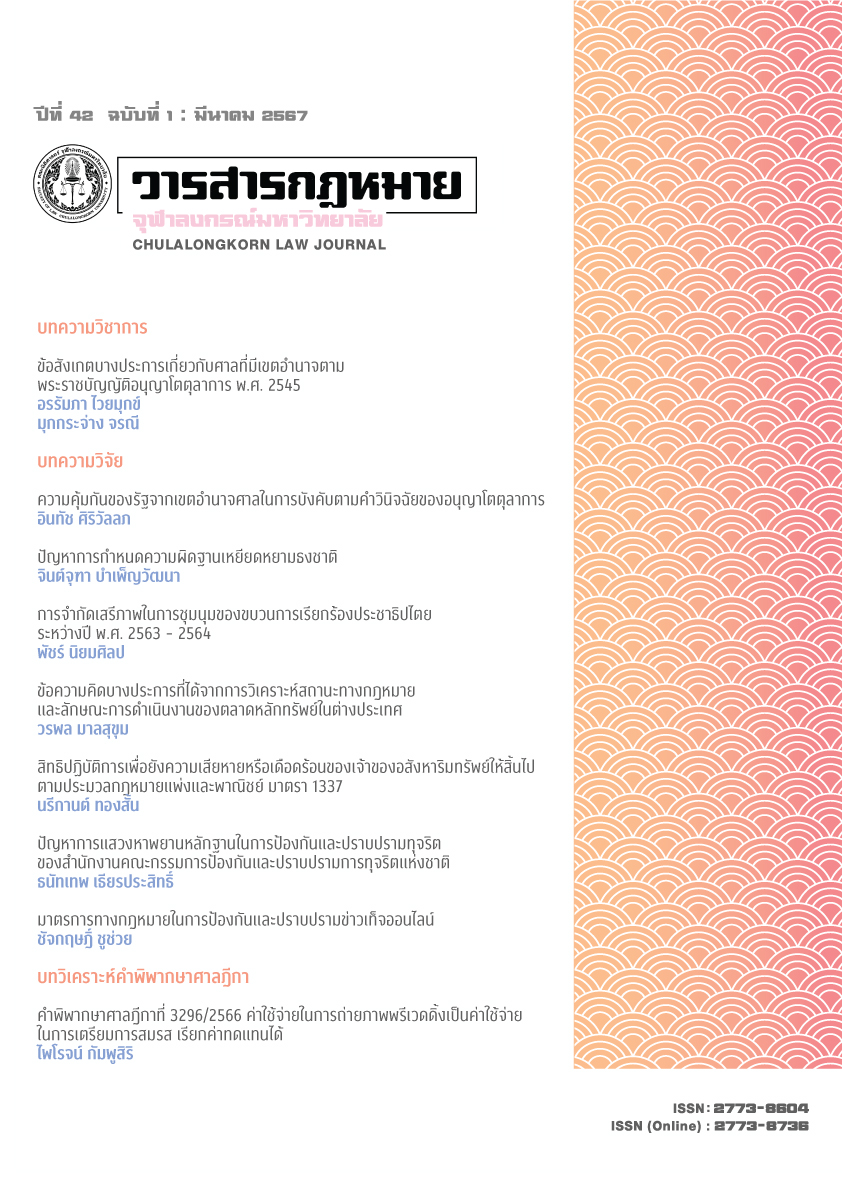
Legal Measures to Prevent and Suppress Online Fake News
Article Sidebar
Main Article Content
Abstract
The increasing problem of spreading false news online. This thesis aimed to (1) study the concepts, theories, and principles of legal measures for preventing and combating fake news, (2) study the international law: the Budapest Convention on Cybercrime and the laws related to preventing and combating fake news in Malaysia, Singapore, Philippines, China, and Germany, (3) analyze Thai laws concerning the prevention and combat of fake news in comparison to international and foreign laws, and (4) propose recommendations for improving and clarifying the laws related to preventing and combating fake news.This research is qualitative research by studying criminal measures and administrative measures to prevent and suppress online fake news, including researching both Thai and foreign language documents of edict, The study found that (1) freedom of expression and freedom of speech were protected by the constitution. However, if the exercise of these rights impacted the public order or good morals of the people or infringed on the rights or freedoms of others, the state could intervene by enacting laws that restricted these rights and freedoms. (2) in the comparative study with the laws of Malaysia, Singapore, Philippines, China, and Germany, it was found that the prevention and combating of fake news were legislated as specific laws, clear definitions were provided, the severity levels of offenses were defined, authorities was empowered to issue orders to manage fake news, and measures and penalties were established for service providers to self-regulate. (3) Thailand has no specific laws, making it an obstacle to preventing and suppressing fake news online. (4) therefore, it was advisable to amend the Act on Commission of Offences Relating to Computer B.E. 2550 (2007) by providing clear definitions and boundaries of offenses, authorizing government officers to issue the administrative order to manage fake news, and specifying administrative measures and punishments for service providers under government supervision.
Article Details

This work is licensed under a Creative Commons Attribution-NonCommercial-NoDerivatives 4.0 International License.
The copyright in this website and the material on this website (including without limitation the text, computer code, artwork, photographs, images, music, audio material, video material and audio-visual material on this website) is owned by Chulalongkorn University Law Journal and its licensors.
1. Chulalongkorn University Law Journal grants to you a worldwide non-exclusive royalty-free revocable license to:
- view this website and the material on this website on a computer or mobile device via a web browser;
- copy and store this website and the material on this website in your web browser cache memory; and
- print pages from this website for your use.
- All articles published by Chulalongkorn University Law Journal are licensed under the Creative Commons Attribution 4.0 International License. This permits anyone to copy, redistribute, remix, transmit and adapt the work provided the original work and source is appropriately cited.
2. Chulalongkorn University Law Journal does not grant you any other rights in relation to this website or the material on this website. In other words, all other rights are reserved. For the avoidance of doubt, you must not adapt, edit, change, transform, publish, republish, distribute, redistribute, broadcast, rebroadcast or show or play in public this website or the material on this website (in any form or media) without appropriately and conspicuously citing the original work and source or Chulalongkorn University Law Journal prior written permission.
3. You may request permission to use the copyright materials on this website by writing to journal@law.chula.ac.th.
4. Chulalongkorn University Law Journal takes the protection of its copyright very seriously. If Chulalongkorn University Law Journal discovers that you have used its copyright materials in contravention of the license above, Chulalongkorn University Law Journal may bring legal proceedings against you seeking monetary damages and an injunction to stop you using those materials. You could also be ordered to pay legal costs.
If you become aware of any use of Chulalongkorn University Law Journal's copyright materials that contravenes or may contravene the license above or any material on the website that you believe infringes your or any other person's copyright, please report this by email to journal@law.chula.ac.th.
References
ANTI-FAKE NEWS ACT 2018 Part II OFFENCES 4.
décision n 88-248 DC du 17 janvier 1989 et nº 89-260 DC du 28 juillet 1989
Dustin P. Calvillo a, Ryan J.B. Garcia b, Kiana Bertrand a, Tommi A. Mayers. Personality factors and self-reported political news consumption predict susceptibility to political fake news. Personality and Individual Differences. Personality and Individual Differences. Sciencedirect. 2021.
FEUERBACH (P.J.A.). Lehrbuch des gemeinen in Deustchland gultigen Peinlichen Rechts. 3d ed. Giessen 1805
LORVELLEC (S.), “Les frontières entre infraction pénale et infraction administrative en Italie”, A.P.C., 1985, nº 8.
Robert C. Post “The Social Foundations of Defamation Law: Reputation andthe Constitution”, California Law Review Vol.74, No.3 (May 1986).
Supinya Klangnarong. Mapping Digital Media Southeast Asia Roundtable. Singapore: Singapore Internet Research Centre. 2014.
กรกริช มุ่งสวัสดิ์ และญาดา กาศยปนันทน์. การกำหนดความผิดเกี่ยวกับการแสดงความคิดเห็นผ่านสื่อสังคมออนไลน์ในประการที่ก่อให้เกิดความเสียหายต่อผู้อื่น. การประชุมนําเสนอผลงานวิจัยระดับบัณฑิตศึกษามหาวิทยาลัยรังสิต, ครั้งที่ 11, 2561.
กรมการปกครอง. สำนักบริหารการทะเบียน. [ออนไลน์] แหล่งที่มา: https://stat.bora.dopa.go.th/ stat/statnew /statMONTH /statmonth/#/displayData [26 ตุลาคม 2565]
กรรณิการ์ รอดมา. ปัญหาการบังใช้กฎหมายเกี่ยวกับสื่อลามกเด็กบนอินเตอร์เน็ต. วิทยานิพนธ์ปริญญามหาบัณฑิต คณะนิติศาสตร์ สถาบันบัณฑิตพัฒนบริหารศาสตร์, 2556
กระทรวงดิจิทัลเพื่อเศรษฐกิจและสังคม, “ศูนย์ต่อต้านข่าวปลอม” [ออนไลน์] แหล่งที่มา: https://www.depa.or.th/th/article-view [10 ตุลาคม 2565]
ขจีวรรณ ยงสวาสดิ์. มาตรการทางกฎหมายว่าด้วยการกำกับควบคุมข่าวปลอม กรณีศึกษานิยามและฐานความผิด. การศึกษาค้นคว้าอิสระปริญญามหาบัณฑิต คณะนิติศาสตร์ สถาบันบัณฑิตพัฒนบริหารศาสตร์, 2562
คณาธิป ทองรวีวงศ์. กฎหมายความผิดเกี่ยวกับคอมพิวเตอร์ เล่มที่ 1, พิมพ์ครั้งที่ 1. (กรุงเทพมหานคร: นิติธรรม, 2563)
ชนน ศิลปะรัศมี. เสรีภาพในการแสดงความคิดเห็นกับการคุ้มครองชื่อเสียงของบุคคลอื่นตามแนวคาวินิจฉัยของศาลสิทธิมนุษยชนแห่งยุโรป. วิทยานิพนธ์ปริญญามหาบัณฑิต มหาวิทยาลัยธรรมศาสตร์, 2560
ชาญชัย แสวงศักดิ์. โทษทางปกครอง: กฎหมายเปรียบเทียบ. พิมพ์ครั้งที่ 1 (กรุงเทพมหานคร: วิญญูชน, 2564)
ณัฐพัฒน์ เลิศประพจน์กุล. กลไกความร่วมมือทางอาญาระหว่างประเทศภายใต้กรอบของอนุสัญญาว่าด้วยอาชญากรรมทางคอมพิวเตอร์ของสภายุโรป. วิทยานิพนธ์ปริญญามหาบัญฑิต คณะนิติศาสตร์ จุฬาลงกรณ์มหาวิทยาลัย, 2555.
ธนพฤกษ์ ชามะรัตน์. สถานภาพองค์ความรู้ของแนวคิดเครือข่ายทางสังคม. [ออนไลน์] แหล่งที่มา: http://v-reform.org/u-knowledges/ [5 ตุลาคม 2565]
นิติพล เสตถาภรณ์ และภัฏฐิญา สิริบวรพิพัฒน์. “แนวทางการจัดให้มีกฎหมายควบคุมและคุ้มครองผู้ให้และผู้ได้รับผลกระทบจากผู้ให้ข่าวสารออนไลน์” Journal of Modern Learning Development, 6(3) 2564.
พจนานุกรม ฉบับราชบัณฑิตยสถาน พ.ศ.2554 [ออนไลน์] แหล่งที่มา: https://dictionary.orst.go.th/ [9 ตุลาคม 2565]
พาณิชย์ สดสี. แนวทางการป้องกันและมาตรการควบคุมการเผยแพร่ข่าวเท็จในเฟซบุ๊ก. หลักสูตรการป้องกันราชอาณาจักรรุ่นที่ 60. ประจำปีการศึกษาพุทธศักราช 2560-2561.
พิชิต วิจิตรบุญยรักษ์. สื่อสังคมออนไลน์: สื่อแห่งอนาคต. มหาวิทยาลัยกรุงเทพ. วารสาร Executive.
มนฤทัย ลิขิตธรรมนิตย์. บทบาทของผู้ประกอบการอินเตอร์เน็ตในการกำกับดูแลเนื้อหาอินเตอร์เน็ตภายหลังการประกาศใช้ พ.ร.บ. ว่าด้วยการกระทำความผิดเกี่ยวกับคอมพิวเตอร์ พ.ศ.2550. วิทยานิพนธ์ปริญญามหาบัณฑิต คณะนิติศาสตร์ จุฬาลงกรณ์มหาวิทยาลัย, 2552
มนฤทัย ลิขิตธรรมนิตย์. บทบาทของผู้ประกอบการอินเตอร์เน็ตในการกำกับดูแลเนื้อหาอินเตอร์เน็ตภายหลังการประกาศใช้ พ.ร.บ. ว่าด้วยการกระทำความผิดเกี่ยวกับคอมพิวเตอร์ พ.ศ .2550. วิทยานิพนธ์ปริญญามหาบัณฑิต คณะนิติศาสตร์ จุฬาลงกรณ์มหาวิทยาลัย, 2552
รัฐธรรมนูญแห่งราชอาณาจักรไทย มาตรา 25
รัฐบัญญัติ ฉบับที่ 51-711 ลงวันที่ 7 มิถุนายน ค.ศ. 1951 มาตรา 7
รัฐบัญญัติ ฉบับลงวันที่ 29 กรกฎาคม ค.ศ. 1881 เกี่ยวกับเสรีภาพของสื่อมวลชน มาตรา 32 วรรคสอง และสาม
รัฐบัญญัติว่าด้วยการกระทาผิดทางปกครอง (OWiG) มาตรา 121
รัฐสภาไทย. สำนักภาษาต่างประเทศ. งานแปลข่าวอาเซียน. “กฎหมายต่อต้านข่าวปลอมของมาเลเซียมีผลใช้บังคับแล้ว” [ออนไลน์] แหล่งที่มา: https://www.parliament.go.th/ewtadmin/ewt/parliament_parcy/ewt_dl_link.php?nid=48166&filename=foreign_news. [11 มกราคม .2566]
รัตนาภรณ์ จอมมูล. มาตรการทางกฎหมายในการกำกับควบคุมข่าวปลอมทางการเมืองบนโลกไซเบอร์. วิทยานิพนธ์ปริญญามหาบัณฑิต มหาวิทยาลัยเชียงใหม่, 2564
วุฒิสภาฟิลิปปินส์ Senate of the Philippines. การประชุมวุฒิสภาครั้งที่สิบเจ็ดของสาธารณรัฐฟิลิปปินส์. [ออนไลน์] แหล่งที่มา: https://legacy.senate.gov.ph/lisdata/2624822593!.pdf [9 ตุลาคม 2565]
ศุภวัฒน์ สิงห์สุวงษ์. เกณฑ์พิจารณาในการเลือกกำหนดโทษทางปกครองแทนโทษอาญา. สำนักงานศาลปกครอง. แหล่งที่มา: https://www.krisdika.go.th/data/article77/filenew/03-1-3.pdf. [10 กรกฎาคม 2566]
ศุภวัฒน์ สิงห์สุวงษ์. เกณฑ์พิจารณาในการเลือกกำหนดโทษทางปกครองแทนโทษอาญา. สำนักงานศาลปกครอง. [ออนไลน์] แหล่งที่มา: https://www.krisdika.go.th/data/article77/filenew/03-1-3.pdf. [10 กรกฎาคม 2566]
สิทธิที่ได้รับการรับรองในกติการะหว่างประเทศว่าด้วยสิทธิพลเมืองและสิทธิของการเมือง (ICCPR) ข้อ 19 (3) (a)
สุวัฒน์ เอมสัมฤทธิ์. การแสดงความคิดเห็นด้วยอคติผ่านข่าวปลอมผ่านสังคมออนไลน์: กรณีศึกษาการเลือกตั้งประเทศไทยในปี พ.ศ.2562. การศึกษาค้นคว้าอิสระปริญญามหาบัณฑิต มหาวิทยาลัยธรรมศาสตร์, 2561.
เสรีภาพที่ได้รับการรับรองในปฏิญญาสากลว่าด้วยสิทธิมนุษยชน ข้อ 19 และกฏิการะหว่างประเทศว่าด้วยสิทธิพลเมืองและสิทธิทางการเมือง (TCCPR) ข้อ 19
