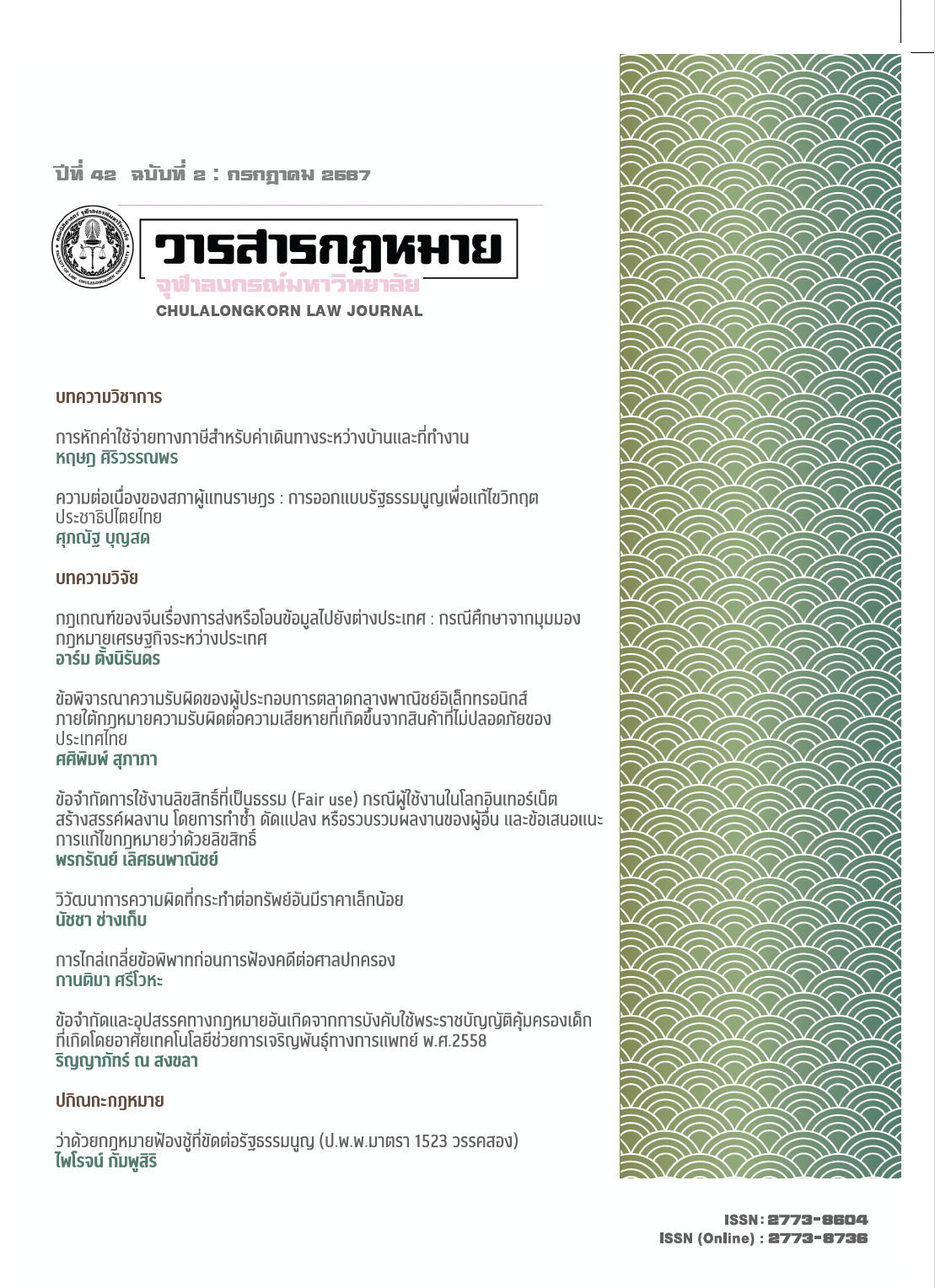
The Continuity of the House of Representatives : Designing a Constitution to Solve the Crisis of Democracy in Thailand
Article Sidebar
Main Article Content
Abstract
This academic article focuses on studying the problems related to the criteria for assuming and vacating the position of representatives in the legislature after completing their mandated term as stipulated by the constitution, particularly during the period of parliamentary dissolution. This situation often results in a prolonged vacancy in the house of representatives without any organization stepping in to ensure the continued functioning of the legislative body. The study relies on the theory of the continuity of the state to examine these issues.
The research reveals that these problems lead to significant constitutional issues, namely the lack of continuity in the execution of state duties and crises in constitutional principles during these periods. Consequently, there is a need to revise the existing criteria to ensure the smooth transition between the outgoing and incoming sets of representatives. Specifically, in cases where the incumbent representatives complete their term as mandated by the constitution, it is proposed that new elections should be conducted before the outgoing representatives vacate their positions. In the event of parliamentary dissolution, it is suggested that the outgoing representatives should continue to serve until the new representatives assume office, preventing a legislative vacuum. This approach aims to safeguard the democratic system during these critical periods, similar to the situations in the years 2006 and 2014.
Article Details

This work is licensed under a Creative Commons Attribution-NonCommercial-NoDerivatives 4.0 International License.
The copyright in this website and the material on this website (including without limitation the text, computer code, artwork, photographs, images, music, audio material, video material and audio-visual material on this website) is owned by Chulalongkorn University Law Journal and its licensors.
1. Chulalongkorn University Law Journal grants to you a worldwide non-exclusive royalty-free revocable license to:
- view this website and the material on this website on a computer or mobile device via a web browser;
- copy and store this website and the material on this website in your web browser cache memory; and
- print pages from this website for your use.
- All articles published by Chulalongkorn University Law Journal are licensed under the Creative Commons Attribution 4.0 International License. This permits anyone to copy, redistribute, remix, transmit and adapt the work provided the original work and source is appropriately cited.
2. Chulalongkorn University Law Journal does not grant you any other rights in relation to this website or the material on this website. In other words, all other rights are reserved. For the avoidance of doubt, you must not adapt, edit, change, transform, publish, republish, distribute, redistribute, broadcast, rebroadcast or show or play in public this website or the material on this website (in any form or media) without appropriately and conspicuously citing the original work and source or Chulalongkorn University Law Journal prior written permission.
3. You may request permission to use the copyright materials on this website by writing to journal@law.chula.ac.th.
4. Chulalongkorn University Law Journal takes the protection of its copyright very seriously. If Chulalongkorn University Law Journal discovers that you have used its copyright materials in contravention of the license above, Chulalongkorn University Law Journal may bring legal proceedings against you seeking monetary damages and an injunction to stop you using those materials. You could also be ordered to pay legal costs.
If you become aware of any use of Chulalongkorn University Law Journal's copyright materials that contravenes or may contravene the license above or any material on the website that you believe infringes your or any other person's copyright, please report this by email to journal@law.chula.ac.th.
References
“แถลงการณ์ คณะปฏิรูปการปกครองในระบอบประชาธิปไตยอันมีพระมหากษัตริย์ทรงเป็นประมุข,” ราชกิจจานุเบกษา เล่มที่ 123 ตอนที่ 95 ก, วันที่ 20 กันยายน 2549
“แถลงการณ์สำนักนายกรัฐมนตรี เรื่อง การยุบสภาผู้แทนราษฎรและการกำหนดวันเลือกตั้ง,” ราชกิจจานุเบกษา เล่มที่ 123 ตอนพิเศษที่ 23 ก, วันที่ 24 กุมภาพันธ์ 2549
“ประกาศคณะรักษาความสงบแห่งชาติ ฉบับที่ 1/2557 เรื่อง การควบคุมอำนาจปกครองประเทศ,” ราชกิจจานุเบกษา เล่มที่ 131 ตอนพิเศษที่ 83 ง, วันที่ 22 พฤษภาคม 2557
“พระราชกฤษฎีการยุบสภาผู้แทนราษฎร พ.ศ. 2549,” ราชกิจจานุเบกษา เล่มที่ 123 ตอนที่ 20 ก, วันที่ 24 กุมภาพันธ์ 2549
“พระราชกฤษฎีการยุบสภาผู้แทนราษฎร พ.ศ. 2556,” ราชกิจจานุเบกษา เล่มที่ 130 ตอนที่ 155 ก, วันที่ 9 ธันวาคม 2556
Alf Ross, “On the Concepts “State" and "State Organs” in Constitutional Law”, in Scandinavian Studies in Law, 5 (October 1961): 111-130.
Anthony W. Bradley and Cesare Pinelli, “Parliamentarism,” in The Oxford Handbook of Comparative Constitutional Law, eds. Michel Rosenfeld and Andras Sajo (Oxford: Oxford University Press, 2012)
Article 24 of Finland’s Constitution
Article 32 Part 4 of Denmark’s Constitution
Article 39 of The Basic Law for the Federal Republic of Germany
Article 41 of Japan’s Constitution
Article 42 of Japan’s Constitution
Article 43 of Japan’s Constitution
Article 45 of Japan’s Constitution
Article 46 of Japan’s Constitution
Article 53 of Greece’s Constitution
Article 54 of Japan’s Constitution
Article 61 of Italy’s Constitution
Article 63 and Article 67 of The Basic Law for the Federal Republic of Germany
Article 64 of Netherlands’ Constitution
Article 68 of Spain’s Constitution
Article 77 of The Basic Law for the Federal Republic of Germany
Article 78 of Cambodia’s Constitution
Chris Baker and Pasuk Phongpaichit, A History of Thailand, (Cambridge: Cambridge University Press, 2022)
Donald P. Kommers, The Constitutional Jurisprudence of the Federal Republic of Germany, (London: Duke University Press, 1989)
Economist Intelligence Unit (EIU), Democracy Index 2022: Frontline Democracy and the Battle for Ukraine, (London: The Economist Intelligence Unit Limited, 2023)
Elisabeth Zoller, Introduction to Public Law: A Comparative Study, (Leiden: Martinus Nijhoff Publishers, 2007)
Eugenie Merieau, “Thailand’s Deep State, Royal Power and the Constitutional Court (1997–2015)”, in Journal of Contemporary Asia, 46, 3 (August 2016): 455-466.
Olivier Beaud, “Conceptions of the State,” in The Oxford Handbook of Comparative Constitutional Law, eds. Michel Rosenfeld and Andras Sajo (Oxford: Oxford University Press, 2012)
Samuel Issacharoff, Fragile Democracies : Contested Power in the Era of Constitutional Courts, (New York: Cambridge University Press, 2015)
Sanford Levinson and Jack M. Balkin, “Constitutional Crises”, in University of Pennsylvania Law Review, 157, 3 (February 2009): 707-753.
Thongchai Winichakul, “Thailand’s Royal Democracy in Crisis,” in After the Coup: The National Council for Peace and Order Era and the Future of Thailand, eds. Michael J Montesano, Terence Chong, and Shu Xun Mark Heng (Singapore: ISEAS Publishing, 2019)
Werner Heun, The Constitution of Germany, (Oxford: Hart Publishing, 2011)
ฐากูร ศิริยุทธ์วัฒนา, การคัดค้านผลการเลือกตั้งโดยผู้มีสิทธิเลือกตั้ง, (กรุงเทพมหานคร: สถาบันพระปกเกล้า, 2561)
ทศพล แสงสวัสดิ์, หลักการพื้นฐานแห่งกฎหมายรัฐธรรมนูญ, (กรุงเทพมหานคร: วิญญูชน, 2566)
มาตรา 101 รัฐธรรมนูญแห่งราชอาณาจักรไทย พุทธศักราช 2560
มาตรา 102 และมาตรา 103 รัฐธรรมนูญแห่งราชอาณาจักรไทย พุทธศักราช 2560
มาตรา 104 รัฐธรรมนูญแห่งราชอาณาจักรไทย พุทธศักราช 2560
มาตรา 106 รัฐธรรมนูญแห่งราชอาณาจักรไทย พุทธศักราช 2550
มาตรา 114 รัฐธรรมนูญแห่งราชอาณาจักรไทย พุทธศักราช 2560
มาตรา 118 รัฐธรรมนูญแห่งราชอาณาจักรไทย พุทธศักราช 2540
มาตรา 129 มาตรา 150 มาตรา 151 และมาตรา 152 รัฐธรรมนูญแห่งราชอาณาจักรไทย พุทธศักราช 2560
มาตรา 133 มาตรา 136 มาตรา 137 มาตรา 138 มาตรา 139 และมาตรา 141 รัฐธรรมนูญแห่งราชอาณาจักรไทย พุทธศักราช 2560
มาตรา 156 รัฐธรรมนูญแห่งราชอาณาจักรไทย พุทธศักราช 2560
มาตรา 158 ประกอบด้วยมาตรา 159 รัฐธรรมนูญแห่งราชอาณาจักรไทย พุทธศักราช 2560
มาตรา 158 มาตรา 167 และมาตรา 170 รัฐธรรมนูญแห่งราชอาณาจักรไทย พุทธศักราช 2560
มาตรา 158 รัฐธรรมนูญแห่งราชอาณาจักรไทย พุทธศักราช 2560
มาตรา 16 และมาตรา 17 รัฐธรรมนูญแห่งราชอาณาจักรไทย พุทธศักราช 2560
มาตรา 162 รัฐธรรมนูญแห่งราชอาณาจักรไทย พุทธศักราช 2560
มาตรา 168 และมาตรา 169 รัฐธรรมนูญแห่งราชอาณาจักรไทย พุทธศักราช 2560
มาตรา 168 และมาตรา 170 (3) รัฐธรรมนูญแห่งราชอาณาจักรไทย พุทธศักราช 2560
มาตรา 18 รัฐธรรมนูญแห่งราชอาณาจักรไทย พุทธศักราช 2560
มาตรา 181 รัฐธรรมนูญแห่งราชอาณาจักรไทย พุทธศักราช 2550
มาตรา 2 รัฐธรรมนูญแห่งราชอาณาจักรไทย พุทธศักราช 2560
มาตรา 208 รัฐธรรมนูญแห่งราชอาณาจักรไทย พุทธศักราช 2560
มาตรา 21 รัฐธรรมนูญแห่งราชอาณาจักรไทย พุทธศักราช 2560
มาตรา 214 รัฐธรรมนูญแห่งราชอาณาจักรไทย พุทธศักราช 2560
มาตรา 215 รัฐธรรมนูญแห่งราชอาณาจักรไทย พุทธศักราช 2540
มาตรา 218 ประกอบด้วยมาตรา 208 และมาตรา 209 รัฐธรรมนูญแห่งราชอาณาจักรไทย พุทธศักราช 2560
มาตรา 218 ประกอบด้วยมาตรา 214 รัฐธรรมนูญแห่งราชอาณาจักรไทย พุทธศักราช 2560
มาตรา 22 รัฐธรรมนูญแห่งราชอาณาจักรไทย พุทธศักราช 2560
มาตรา 269 และมาตรา 272 รัฐธรรมนูญแห่งราชอาณาจักรไทย พุทธศักราช 2560
มาตรา 3 รัฐธรรมนูญแห่งราชอาณาจักรไทย พุทธศักราช 2560
มาตรา 36 พระราชบัญญัติองค์การบริหารส่วนจังหวัด พุทธศักราช 2540
มาตรา 41 พระราชบัญญัติระเบียบบริหารราชการแผ่นดิน พุทธศักราช 2535
มาตรา 44 พระราชบัญญัติระเบียบบริหารราชการแผ่นดิน พุทธศักราช 2535
มาตรา 46 พระราชบัญญัติระเบียบบริหารราชการแผ่นดิน พุทธศักราช 2535
มาตรา 48 ปัญจทศ พระราชบัญญัติเทศบาล พุทธศักราช 2496
มาตรา 48 พระราชบัญญัติระเบียบบริหารราชการแผ่นดิน พุทธศักราช 2535
มาตรา 50 พระราชบัญญัติระเบียบบริหารราชการเมืองพัทยา พุทธศักราช 2542
มาตรา 54 พระราชบัญญัติระเบียบบริหารราชการกรุงเทพ พุทธศักราช 2528
มาตรา 6 มาตรา 81 มาตรา 182 และมาตรา 188 รัฐธรรมนูญแห่งราชอาณาจักรไทย พุทธศักราช 2560
มาตรา 64 พระราชบัญญัติระเบียบบริหารราชการแผ่นดิน พุทธศักราช 2535
มาตรา 64 พระราชบัญญัติองค์การบริหารส่วนตำบล พุทธศักราช 2537
มาตรา 78 รัฐธรรมนูญแห่งราชอาณาจักรไทย พุทธศักราช 2560
มาตรา 79 รัฐธรรมนูญแห่งราชอาณาจักรไทย พุทธศักราช 2560
มาตรา 8 พระธรรมนูญศาลยุติธรรม
มาตรา 83 รัฐธรรมนูญแห่งราชอาณาจักรไทย พุทธศักราช 2560
มาตรา 85 รัฐธรรมนูญแห่งราชอาณาจักรไทย พุทธศักราช 2560
มาตรา 97 รัฐธรรมนูญแห่งราชอาณาจักรไทย พุทธศักราช 2560
มาตรา 99 รัฐธรรมนูญแห่งราชอาณาจักรไทย พุทธศักราช 2560
วรเจตน์ ภาคีรัตน์, คำสอนว่าด้วยรัฐและหลักกฎหมายมหาชน, (กรุงเทพมหานคร: อ่านกฎหมาย, 2564)
วรเจตน์ ภาคีรัตน์, องค์กรอิสระตามบทบัญญัติแห่งรัฐธรรมนูญแห่งราชอาณาจักรไทย พุทธศักราช 2540, (กรุงเทพมหานคร: คณะกรรมการวิจัยและสัมมนา คณะนิติศาสตร์ มหาวิทยาลัยธรรมศาสตร์, 2550)
ศุภณัฐ บุญสด, “บทบาทของนักกฎหมายไทยกับการรัฐประหารเพื่อนำมาสู่ระบอบเผด็จการ:ศึกษากรณีรัฐประหาร 22 พฤษภาคม 2557”, CMU Journal of Law and Social Sciences, 12, 2 (กรกฎาคม-ธันวาคม 2562): 123-156.
สมยศ เชื้อไทย, กฎหมายมหาชนเบื้องต้น, (กรุงเทพมหานคร: วิญญูชน, 2560)
