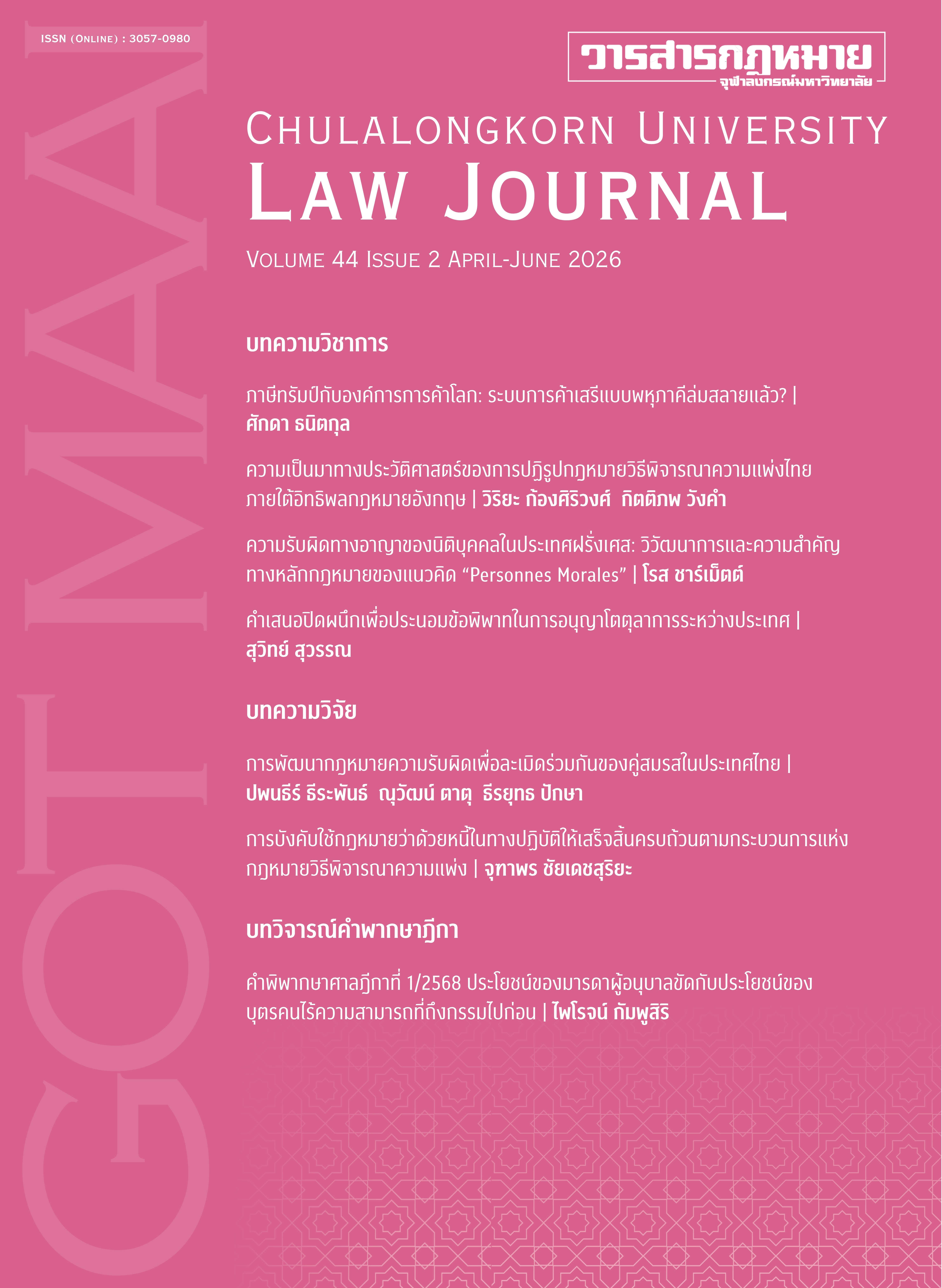
Trump Tariffs and the World Trade Organization: Has the Multilateral Free Trade System Collapsed?
Article Sidebar
Main Article Content
Abstract
Although the World Trade Organization (WTO) has been unable to effectively discipline the so-called “Trump tariffs” and has, in practice, permitted the United States to increase tariff rates on 59 trading partners through bilateral negotiations, the multilateral trading system cannot yet be regarded as having collapsed. This assessment rests on two principal considerations. Firstly, with the exception of the People’s Republic of China, affected trading partners have largely refrained from imposing retaliatory import tariffs, and the United States accounts for approximately 11 percent of global trade. The relative share of U.S. trade in the global system suggests that the structural foundations of multilateral trade remain intact. Secondly, the Trump tariffs—grounded in protectionist ideology—stand in marked tension with the core tenets of mainstream economic theory, which generally endorse multilateral free trade. This conceptual inconsistency supports the view that such tariffs are unlikely to prove sustainable over the long term. Nonetheless, two significant “ruptures” has emerged within the multilateral trading system administered by the WTO. In particular, the absence of appointed members to the Appellate Body has rendered the WTO dispute settlement mechanism effectively paralyzed. Consequently, the United States occupies a uniquely advantaged position relative to the other 165 WTO members, as it is the only member able to unilaterally determine import tariff rates by invoking national security justifications without the prospect of effective appellate review.
Article Details

This work is licensed under a Creative Commons Attribution-NonCommercial-NoDerivatives 4.0 International License.
The copyright in this website and the material on this website (including without limitation the text, computer code, artwork, photographs, images, music, audio material, video material and audio-visual material on this website) is owned by Chulalongkorn University Law Journal and its licensors.
1. Chulalongkorn University Law Journal grants to you a worldwide non-exclusive royalty-free revocable license to:
- view this website and the material on this website on a computer or mobile device via a web browser;
- copy and store this website and the material on this website in your web browser cache memory; and
- print pages from this website for your use.
- All articles published by Chulalongkorn University Law Journal are licensed under the Creative Commons Attribution 4.0 International License. This permits anyone to copy, redistribute, remix, transmit and adapt the work provided the original work and source is appropriately cited.
2. Chulalongkorn University Law Journal does not grant you any other rights in relation to this website or the material on this website. In other words, all other rights are reserved. For the avoidance of doubt, you must not adapt, edit, change, transform, publish, republish, distribute, redistribute, broadcast, rebroadcast or show or play in public this website or the material on this website (in any form or media) without appropriately and conspicuously citing the original work and source or Chulalongkorn University Law Journal prior written permission.
3. You may request permission to use the copyright materials on this website by writing to journal@law.chula.ac.th.
4. Chulalongkorn University Law Journal takes the protection of its copyright very seriously. If Chulalongkorn University Law Journal discovers that you have used its copyright materials in contravention of the license above, Chulalongkorn University Law Journal may bring legal proceedings against you seeking monetary damages and an injunction to stop you using those materials. You could also be ordered to pay legal costs.
If you become aware of any use of Chulalongkorn University Law Journal's copyright materials that contravenes or may contravene the license above or any material on the website that you believe infringes your or any other person's copyright, please report this by email to journal@law.chula.ac.th.
References
หนังสือภาษาไทย
กรมเศรษฐกิจการพาณิชย์ กระทรวงพาณิชย์. คำแปลกรรมสารสุดท้าย: รวบรวมผลการเจรจาการค้าพหุภาคีรอบอุรุกวัย. กรุงเทพฯ: โรงพิมพ์ชุมนุมสหกรณ์การเกษตรแห่งประเทศไทย, 2537.
ชวนชัย อัชนันท์. วิเคราะห์การค้าและนโยบายการค้าประเทศไทย. กรุงเทพฯ: สำนักพิมพ์จุฬาลงกรณ์มหาวิทยาลัย.
ประพีร์ อภิชาติสกล. TRUMP 2.0: ระเบียบโลกใหม่ยุค America first. กรุงเทพฯ: มติชน, 2568.
ปิติ ศรีแสงนาม และจักรี ไชยพินิจ. Amidst the Geo-Economic Clashes: ไทยในสงครามเย็น 2.0. กรุงเทพฯ: มติชน, 2567.
อาร์ม ตั้งนิรันดร. สงครามเศรษฐกิจโลกและทางรอดไทยในยุคทรัมป์ 2.0. กรุงเทพฯ: บุ๊คสเคป, 2568.
หนังสือภาษาต่างประเทศ
A.G. Kenwood and A.L. Lougheed. THE GROWTH OF THE INTERNATIONAL ECONOMY 1820-1980: AN INTRODUCTORY TEXT. London: George Allen & Unwin, 1984.
Andreas F. Lowenfeld. INTERNATIONAL ECONOMIC LAW. Oxford: Oxford University Press, 2003.
Anne O. Krueger. INTERNATIONAL TRADE: WHAT EVERYONE NEEDS TO KNOW. Oxford: Oxford University Press, 2020.
David Collins. FOUNDATION OF INTERNATIONAL ECONOMIC LAW. Second Edition. Cheltenham: Edward Elger, 2025.
David Hunter, James Salzman and Durwood Zaelke. INTERNATIONAL ENVIRONMENTAL LAW AND POLICY. New York: Foundation Press, 2007.
FINAL ACT: EMBODYING THE RESULTS OF THE URUGUAY ROUND OF MULTILATERAL TRADE NEGOTIATIONS. Washington D.C: U.S. Government Printing Office, 2002.
Gregory N. Mankiw, Mark P. Taylor and Andrew Ashwin. BUSINESS ECONOMICS. Fourth Edition. Hampshire: Cengage Learning UK, 2024.
John H. Jackson. THE WORLD TRADING SYSTEMS: LAW AND POLICY OF INTERNATIONAL ECONOMIC RELATIONS. Second Edition. Massachusetts: MIT Press, 2000.
Jon Danielsson. GLOBAL FINANCIAL SYSTEMS: STABILIITY AND RISK. London: Pearson, 2013.
Kamata Isao and Nakajiwa Atsushi. KOKUSAIKEIZAIGAKU (国際経済学). Tokyo: Nihon Hyoransha, 2024.
Nakagawa J., Shimizu A., Taira K., Mamiya I (Editors). KOKUSAIKEIZAIHOU (国際経済法). Tokyo: Yuhikaku, 2003.
Peter B. Kenen (Editor). MANAGING THE WORLD ECONOMY: FIFTY YEARS AFTER BRETTON WOODS. Washington D.C: Institute for International Economics, September 1994.
Peter Van den Bossche and Werner Zdouc. THE LAW AND POLICY OF THE WORLD TRADE ORGANIZATION: TEXT, CASES, AND MATERIALS. Cambridge: Cambridge University Press, 2017.
World Trade Organization. WTO DISPUTE SETTLEMENT: ONE-PAGE CASE SUMMARIES 1995 – 2022. 2023 edition. World Trade Organization, 2023.
บทความในวารสารภาษาต่างประเทศ
Jean Galbraith. “United States Continues to Block New Appellate Body Members from the World Trade Organization, Risking the Collapse of the Appellate Process.” The American Journal of International Law 113, no. 4 (October 2019): 822-831.
บทในหนังสือภาษาต่างประเทศ
Erdal Yalcin, Gabriel Felbermayr and Marina Steinger. “United States: What to Expect from a Protective U.S. Trade Policy.” THE HANDBOOK OF GLOBAL TRADE POLICY, ed. Andreas Klasen. New Jersey: Wiley Blackwell, 2022.
I.H. Courage-Van Lier. “Supervision within the General Agreement on Tariffs and Trade.” SUPERVISORY MECHANISM IN INTERNATIONAL ECONOMIC ORGANISATIONS: IN THE PERSPECTIVE OF A RESTRUCTURING OF THE INTERNATIONAL ECONOMIC ORDER, P. van Dijk (General Editor). Kluwer Law and Taxation Publishers, 1984.
John Odell and Barry Eichengreen. “The United States, the ITO, and the WTO: Exit options, Agent Slack, and Presidential Leadership.” THE WTO AS AN INTERNATIONAL ORGATINIZATION, ed. Anne O. Krueger. Chicago: University of Chicago Press, 1998.
John Ravenhill and Erin Hannah. “The Study of Global Political Economy.” GLOBAL POLITICAL ECONOMY, eds. Erin Hannah and John Ravenhill. seventh edition. Oxford: Oxford University Press, 2024.
ออนไลน์ภาษาต่างประเทศ
Prime Minister’s Office Singapore. “Ministerial Statement by PM Lawrence Wong on the US Tariffs and Implications.” accessed 15 February 2026. https://www.pmo.gov.sg/newsroom/ministerial-statement-by-pm-lawrence-wong-on-the-us-tariffs-and-implication/
Rick Newman. “Scott Bessent’s 3-3-3 plan will turn out more like 2-6-0.” accessed 17 January 2026. https://finance.yahoo.com/news/scott-bessents-3-3-3-plan-will-turn-out-more-like-2-6-0-213848777.html
Stella Nalwoga, Tobias Dolle, and Paolo R. “The expanding use of Section 232 national security-related additional tariffs under the America First Trade Policy.” accessed 15 February 2026. https://www.fratinivergano.eu/en/trade-perspectives/5-may-2025/#Section232
กฎหมายภาษาต่างประเทศ
Article XXI of the General Agreement on Tariffs and Trade 1994.
Chile - Price Band System (DS207), China-Auto Parts (DS339, DS340, DS342) EC-Chicken Cuts (DS269, DS286).
Chile - Price Band System and Safeguard Measures Relating to Certain Agricultural Products (DS207) (23 October 2002).
DS512 Russia – Measures Concerning Traffic in Transit, paragraph 7.132.
DS591 Columbia – Anti-Dumping Duties on Frozen Fries (21 Dec 2022).
DS611 China – Enforcement of Intellectual Property Rights (21 July 2025).
DS638, UNITED STATES – UNIVERSAL AND COUNTRY – SPECIFIC ADDITIONAL DUTIES ON IMPORTS FROM CHINA, COMMUNICATION FROM THE UNITED STATES.
European Communities – Regime for the Importation, sale and distribution of Bananas (DS27, 25 September 1997).
Indonesia-Certain Measures Affecting the Automotive industry (DS54, DS55, DS59, DS64) (23 July 1998).
National Security Strategy 2022 (October 12, 2022), 8, 23.
National Security Strategy of the United States of America (December 2017), 17.
National Security Strategy of the United States of America (November 2025), 21.
United States - Universal and Country - Specific Additional Duties on Imports from China, DS638.
WT/DS638/3, UNITED STATES – UNIVERSAL AND COUNTRY – SPECIFIC ADDITIONAL DUTIES ON IMPORTS FROM CHINA, COMMUNICATION FROM THE UNITED STATES, 23 April 2025.
WTO, WTO ANALYTICAL INDEX, GATT 1994-Article XXI (DS reports), paragraph 33, 34, 35.
