
The Model of Innovative Leadership of School Administrators in Education Sandbox under the Office of the Basic Education Commission Yala Province
Keywords:
The model, innovative leadership, school administrators, Education SandboxAbstract
The purposes of this research were to 1. study approaches to create the model of innovative leadership for school administrators and 2. the evaluation efficiency of the model of innovative leadership for school administrators. The research divided 2 steps were; step
1: create the model of innovative leadership for school administrators and 3 sub steps. Step 1.1: was to study the current state, desired state and needs identification of innovative leadership of school administrators. The population were 650 school administrators under the office of the basic education commission Yala province. Sample size 248 school administrators. The research instrument consisted of a rating scaled questionnaire. The data were analyzed by average, standard deviation and PNImodified. Step 1.2: were study about the guideline to develop innovative leadership of the school administrators. The informants were specific sampling 6 school administrators. The research instrument consisted of verbal structured Interview and the data were analyzed by content Analysis. Step 1.3: create the model of innovative leadership. Step 2: to evaluation efficiency of the model of innovative leadership. The target group were 28 school administrators by use the whole of population. The research instrument consisted of a rating scaled questionnaire. The data were analyzed by average and standard deviation.
The research findings were as follow:
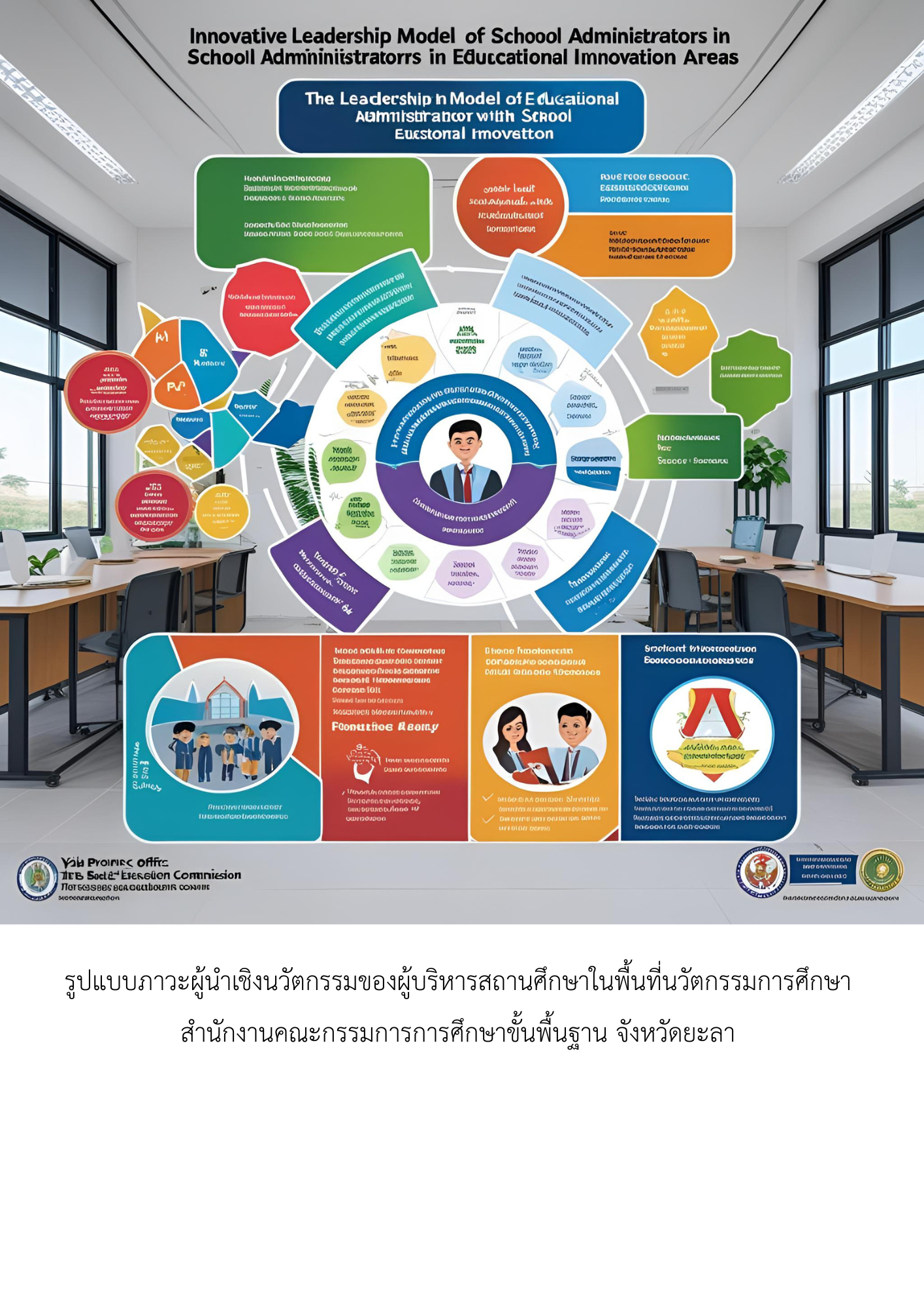
- The model of the model of innovative leadership for school administrators was verbal model and 8 components were 1.Objectives 2.Principles 3.Systems and mechanisms
4.Procedures 5.Evaluation guidelines 6.Descriptions and 7.Conditions of Utilization and 8.Work manual. - The evaluation efficiency of the model of innovative leadership for school administrators were found that the efficiency of the model of innovative leadership for school administrators overall at high level. (μ = 4.35, σ = 0.70). The first of all was utility standard at highest level. (μ = 4.40, σ = 0.66). The next was feasibility standard (m = 4.38, s = 0.69) and propriety standard (μ = 4.33, σ = 0.70) and the finally was accuracy standard at lowest level (m = 4.30, s = 0.73).
References
กนกพิชญ์ สรรพศรี. (2564). การพัฒนาโปรแกรมเสริมสร้างภาวะผู้นำเชิงนวัตกรรมของผู้บริหาร สถานศึกษาในศตวรรษที่ 21 สังกัดสำนักงานเขตพื้นที่การศึกษาประถมศึกษากาฬสินธุ์เขต 1. วิทยานิพนธ์หลักสูตรการศึกษามหาบัณฑิต สาขาวิชาการบริหารและพัฒนาการศึกษา บัณฑิตวิทยาลัย มหาวิทยาลัยมหาสารคาม.
ชลกร ตันประภัสร. (2556). ปัจจัยที่ส่งผลต่อความสร้างสรรค์และนวัตกรรม ของโรงเรียนเอกชนประเภท สามัญ ศึกษา ระดับการศึกษาขั้นพื้นฐาน. วารสารการบริหารการศึกษามหาวิทยาลัยบูรพา. 7(2), 42-55.
ฐิตินันท์ นันทะศรี วาโร เพ็งสวัสดิ์ วัลนิกา ฉลากบาง และพรเทพ เสถียรนพเก้า. (ตุลาคม 2563). ภาวะผู้นำเชิงนวัตกรรมของผู้บริหารสถานศึกษา. วารสารบัณฑิตศึกษา. 17(79), 11–20.
พัฒนา พรหมณี ศรีสุรางค์ เอี่ยมสะอาด ปณิธาน กระสังข์. (กรกฎาคม - ธันวาคม2560). แนวคิดการพัฒนา
รูปแบบเพื่อใช้ในการดำเนินงานด้านการสาธารณสุขสำหรับนักสาธารณสุข. สมาคมสถาบันอุดมศึกษาเอกชนแห่งประเทศไทยในพระราชูปถัมภ์ สมเด็จพระเทพรัตนราชสุดาฯ สยามบรมราชกุมารี. 6(2): 128-134.
ราชกิจจานุเบกษา. (2562). พระราชบัญญัติพื้นที่นวัตกรรมการศึกษา พ.ศ. 2562. ในราชกิจจานุเบกษา. 136(56ก).
รัตนะ บัวสนธ์. (2565). การวิจัยและพัฒนา. กรุงเทพฯ: สำนักพิมพ์จุฬาลงกรณ์มหาวิทยาลัย.
รุ่งชัชดาพร เวหะชาติ. (2565). กลยุทธ์การพัฒนานวัตกรรมการบริหารสถานศึกษา. พิมพ์ครั้งที่ 1.สงขลา : เทมการพิมพ์.
ศึกษาธิการจังหวัดยะลา, สำนักงาน. (2564). รายงานผลการดำเนินงานพื้นที่นวัตกรรมการศึกษา ประจำปีงบประมาณ พ.ศ. 2564. ยะลา : สำนักงานศึกษธิการจังหวัดยะลา.
สาลี่ สุภาภรณ์. (2550). วิจัยเชิงคุณภาพทางพลศึกษาและกีฬา. กรุงเทพมหานคร: ห้างหุ้นส่วนจำกัด สามลดา.
สำนักงานคณะกรรมการพัฒนาการเศรษฐกิจและสังคมแห่งชาติ. (2562). ยุทธศาสตร์ชาติระยะ 20 ปี (พ.ศ. 2561-2580). พิมพ์ครั้งที่ 2. กรุงเทพฯ : สำนักงานเลขานุการของคณะกรรมการยุทธศาสตร์ชาติสำนักงานคณะกรรมการพัฒนาการเศรษฐกิจและสังคมแห่งชาติ.
สุกัญญา แช่มช้อย. (2562). การบริหารสถานศึกษาในยุคดิจิทัล. กรุงเทพฯ: สำนักพิมพ์แห่งจุฬาลงกรณ์มหาวิทยาลัย.
สุภาวดี ดวงจันทร์. (2559). รูปแบบการบริหารความเสี่ยงของงานวิชาการของสถานศึกษาสังกัดสำนักงานคณะกรรมการการศึกษาขั้นพื้นฐานในภาคใต้. วิทยานิพนธ์ดุษฎีบัณฑิต สาขาวิชาการบริหารการศึกษา บัณฑิตวิทยาลัย มหาวิทยาลัยสงขลานครินทร์.
อนุพงษ์ ชุมแวงวาปี. (2560). การพัฒนารูปแบบองค์การแห่งนวัตกรรมของโรงเรียนมัธยมศึกษา สังกัดสำนัก
งานคณะกรรมการการศึกษาขั้นพื้นฐาน. ดุษฎีนิพนธ์ปรัชญาดุษฎีบัณฑิต สาขาวิชาการบริหารการศึกษา บัณฑิตวิทยาลัย มหาวิทยาลัยบูรพา.
อังคณา เติมวิถี. (2564). ความต้องการจําเป็นของภาวะผู้นําเชิงนวัตกรรมของข้าราชการครู สังกัดสำนักงานเขตพื้นที่การศึกษาประถมศึกษาสมุทรปราการ เขต 2. วิทยานิพนธ์ ศึกษาศาสตรมหาบัณฑิต สาขาวิชาการบริหารการศึกษา มหาวิทยาลัยรังสิต
Davis, M. W. (2019). Innovative Leadership. Journal of Leadership, Accountability & Ethics.
(4), 69-73.
Horth, D., & Buchner, D. (2014). Innovation Leadership: How to use innovation to lead effectively, work collaboratively and drive results. London: Center for Creative Leadership.
Ivancevich, J. M., and Matteson, M.T. (1999). Organizational Behavior and Management. Singapore: McGraw-Hill. Management of Innovation and Technology, 2008. ICMIT 2008. 4th IEEE International Conference on 21-24 September 2008, 98-103.
Khalili, A. (2017). Creative and innovative leadership: measurement development and validation. Management Research Review, 40(10), 1117-1138.
Riddel, M., & Zulfikar, I. R. (2024). The role of innovative leadership in transforming student learning effectiveness: A review of best practices and future directions. Development Studies in Educational Management and Leadership, 3(1), 35–50.
Seidman, I. (1998). Interviewing as Qualitative Research: A Guide for Researchers in Education and the Social Sciences. 2nd ed. New York: Teachers College, Columbia University.
Soares, L., Gagliardi, J. S., Wilkinson, P. J., & Hughes, S. L. (2018). Innovative leadership. The American Council on Education & the TIAA Institute.
Stufflebeam, D. L., Madaus, G. F. and Kellaghan, T. (2000). EVALUATIONMODEL: Viewpoints on Educational and Human Services Evaluation. 2nd ed. Dordrecht: Kluwer Academic Publisher.
Werang, B. R., Agung, A. A. G., Jampel, I. N., Sujana, I. W., & Asaloei, S. I. (2023). Exploring the outside-the-box leadership of an Indonesian school principal: A qualitative case study. Cogent Education, 10(2).
Yamane, Taro. (1967). Statistics, An Introductory Analysis. 2nd ed. New York: Harpen and Row
Downloads
Published
Issue
Section
License
Copyright (c) 2025 Nussarin Kariji, นิตยา เรืองแป้น, จรุณี เก้าเอี้ยน

This work is licensed under a Creative Commons Attribution-NonCommercial-NoDerivatives 4.0 International License.
Proposed Creative Commons Copyright Notices

