
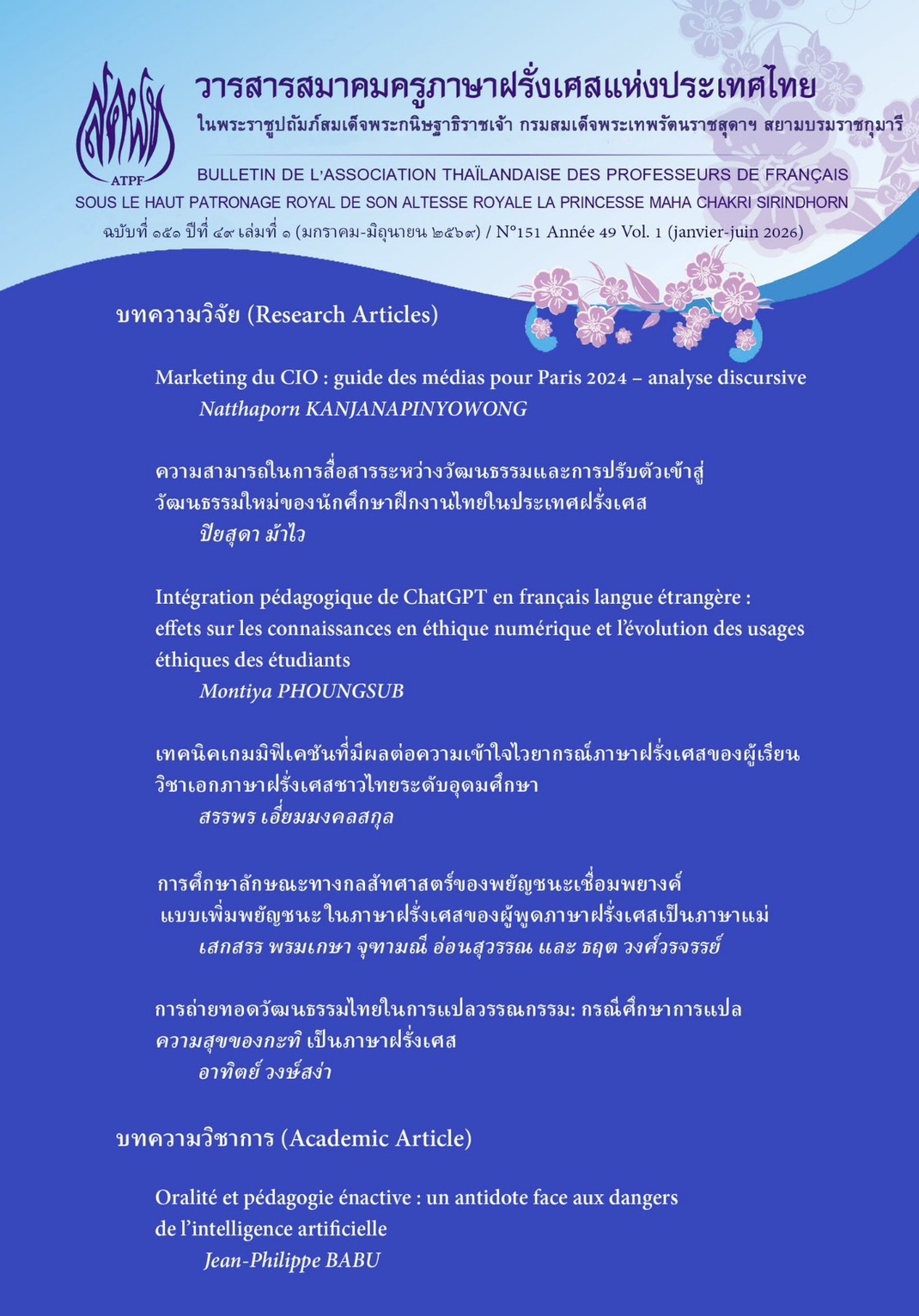
IOC Marketing Media Guide Paris 2024 : Discourse analysis
Article Sidebar
Main Article Content
Abstract
The Olympic and Paralympic Games represent the world’s most significant sporting event, bringing together not only professional athletes but also other stakeholders of the Olympic Movement, with the aim of transmitting Olympic values globally. The International Olympic Committee (IOC), a non-profit organization responsible for organizing the Games, primarily relies on its marketing resources and The Olympic Partners (TOP) programme to ensure the smooth execution of its activities.
Through discourse and lexical analysis, this article examines the IOC’s document, IOC Marketing: Media Guide. Paris 2024, to understand (1) how the text fits the discursive universe in terms of genres and the “scene of enunciation” theory (Maingueneau, 1998) and (2) analyze the legitimization processes of partnerships with companies from diverse sectors of activity. The analytical results reveal that the IOC’s discourse is predominantly displayed within an institutional and formal “enclosing scene”, following the norms of an informative and explanatory “generic scene”, with the primary objective of providing useful information to media representatives. Nevertheless, the third section, "Olympic Partnerships," adheres more closely to an argumentative “generic scene”, relying on linguistics strategies of argumentation to justify the global companies’ involvement in the Olympic Games. Furthermore, the use of Iramuteq software reveals the vocabulary derived from this discourse and its relation in the “lexical world”. The analysis brings to light the diverse discursive strategies employed by the IOC and its global partner companies to legitimize their roles in the Olympic Games through their identification with Olympic values and social engagement.
Downloads
Article Details
References
Austin, J. L. (1970). Quand dire, c’est faire (G. Lane, Trad.). Le Seuil. (Éd. orig. 1962).
Bonnafous, S., et Kreig-Planque, A. (2014). L’analyse du discours. Dans Sciences de l’information et de la communication : Objets, savoirs, discipline. Presses universitaires de Grenoble.
Centre National de Ressources Textuelles et Lexicales. (s.d.). Guide. Dans Trésor de la langue française informatisé. https://www.cnrtl.fr/definition/guide
Comité International Olympique. (2023a). Charte olympique. État en vigueur au 15 octobre 2023 [PDF]. Comité International Olympique. https://cnosf.france olympique.com/la-charte-olympique
Comité International Olympique. (2023b, 15 octobre). Les amendements à la Charte olympique approuvés par la 141e Session du CIO. Comité International Olympique. https://www.olympics.com/cio/news/les-amendements-a-la-charte-olympique-approuves-par-la-141e-session-du-cio
Comité International Olympique. (2024a). Marketing du CIO : guide des médias pour
Paris 2024 [PDF]. Comité International Olympique. https://stillmed.olympics.com/ media/Documents/International-Olympic-Committee/IOC-Marketing-And-Broad casting/IOC-Marketing-Media-Guide-Paris-2024.pdf
Comité International Olympique. (2024b, 5 décembre). Les Jeux Olympiques de Paris 2024 ont été suivis par près de cinq milliards de personnes, soit 84 % de l’audience mondiale potentielle. Olympics.com. https://olympics.com/cio/news/ les-jeux-olympiques-de-paris-2024-ont-ete-suivis-par-pres-de-cinq-milliards-de-personnes-soit-84-de-l-audience-mondiale-potentielle
Comité International Olympique. (s.d.-a). Foires aux questions. Marketing olympique. Qu’est-ce que le « programme TOP » ? Comité International Olympique.
Comité International Olympique. (s.d.-b). Jeux olympiques. Comité International Olympique. https://www.olympics.com/fr/olympic-games
Comité International Olympique. (s.d.-c). Valeurs olympiques – excellence, respect et amitié. Comité International Olympique. https://www.olympics.com/cio/valeurs-olympiques
Danglade, J.-P. (2024, avril 28). Entre les JO 2024 et LVMH, quelle est la logique du sponsoring ? The Conversation. https://theconversation.com/entre-les-jo-2024-et-lvmh-quelle-est-la-logique-du-sponsoring-228574
Duteil, C., Richard, A., & Longhi, J. (2021). Les valeurs de l’Olympisme dans et par le discours : topique instituante et dynamique du sens. Espaces Linguistiques, 3. https://doi.org/10.25965/espaces-linguistiques.387
Ferrand, A., Chappelet, J.-L., & Séguin, B. (2012). Olympic marketing. Routledge.
Fleck-Dousteyssier, N. (2007). Le parrainage : D’une intuition à une stratégie de communication. Décisions Marketing, 47, 07‑20. https://doi.org/10.7193/DM. 047.07.20
France industrie. (s.d.). Différents secteurs d’activité économique. France industrie. https://www.france-industrie.pro/secteur-dactivite/
Garnier, B., & Guérin-Pace, F. (2010). Appliquer les méthodes de la statistique textuelle.
Kerbrat-Orecchioni, C. (1990). Les interactions verbales, tome 1, Armand Colin.
Krieg-Planque, A. (2013). Analyser les discours institutionnels. Armand Colin.
Maingueneau, D. (1997). L’Analyse du discours. Hachette.
Maingueneau, D. (1998). Analyser les textes de communication. Dunod.
Maingueneau, D. (2000). Analyser les textes de communication. Nathan.
Maingueneau, D. (2014). Discours et analyse du discours. Armand Colin.
Maltese, L., & Danglade, J.-P. (2014). Marketing du sport et événementiel sportif. Dunod.
Monte, M., & Oger, C. (2015). Discours d’autorité : Des discours sans éclat(s) ? Mots, 107. https://doi.org/10.4000/ mots.21844
Poudat, C., et Landragin, F. (2017). Explorer des données textuelles : Méthodes - pratiques - outils. De Boeck supérieur.
Riegel, M., Pellat, J.-C., et Rioul, R. (2014). Grammaire méthodique du français (5. éd. [rev. et augm.]). Presses Universitaire de France.
Searle, J. R. (1972). Les actes de langage : essai de philosophie du langage (H. Pauchard, Trad.). Hermann.
