
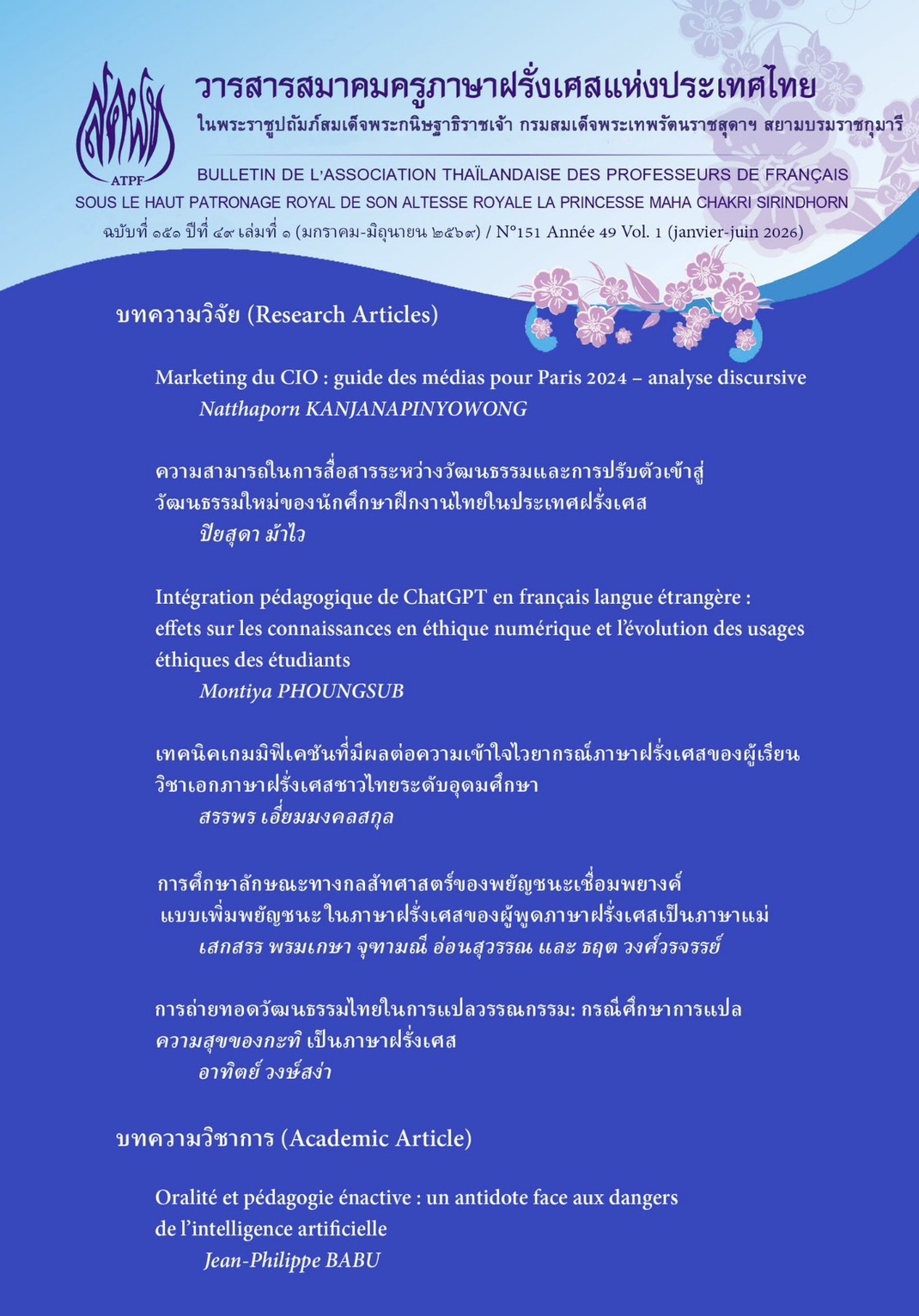
Pedagogical integration of ChatGPT in French as a foreign language: effects on digital-ethics knowledge and the evolution of learners’ ethical-use practices
Article Sidebar
Main Article Content
Abstract
Generative artificial intelligence (GenAI) raises major challenges for learning, particularly in terms of critical thinking and digital ethics. This study examines its pedagogical integration in French as a foreign language to promote responsible use among students. Activities were designed to encourage active adaptation of generated content and to prevent passive use of GenAI tools such as ChatGPT. After a four-month course incorporating principles of digital ethics, students expressed an overall positive perception of ChatGPT while also identifying its benefits and associated risks. The results indicate a clear improvement in digital-ethics knowledge between November 2023 and June 2024. At the same time, a significant evolution in ethical practices was observed: students adjusted content, verified information, and adopted a more critical stance. Between June 2024 and June 2025, these ethical reflexes were maintained, suggesting lasting appropriation and sustained learning gains. These findings confirm the essential role of teachers in guiding and regulating GenAI use. They also highlight the need to integrate appropriate pedagogical strategies to fully harness the potential of this technology while limiting its possible misuses.
Downloads
Article Details
References
Ahmad, S. F., Han, H., Alam, M. M., Rehmat, M. K., Irshad, M., Arraño-Muñoz, M. & Ariza-Montes, A. (2023). Impact of artificial intelligence on human loss in decision making, laziness and safety in education. Humanities and Social Sciences Communications, 10(311), 1-14. https://doi.org/10.1057/s41599-023-01787-8
Aljabr, F. S. & Al-Ahdal, A. A. M. H. (2024). Ethical and pedagogical implications of AI in language education: An empirical study at Ha'il University. Acta Psychologica, 251, Article No.104605. https://doi.org/10.1016/j.actpsy.2024.104605
Anson, C. M. & Straume, I. S. (2022). Amazement and Trepidation: Implications of AI-Based Natural Language Production for the Teaching of Writing. Journal of Academic Writing, 12(1), 1-9. https://doi.org/10.18552/joaw.v12i1.820
Athaluri, S. A., Manthena, S. V., Kesapragada, V. S. R. K. M., Yarlagadda, V., Dave, T. & Duddumpudi, R. T. S. (2023). Exploring the Boundaries of Reality: Investigating the Phenomenon of Artificial Intelligence Hallucination in Scientific Writing Through ChatGPT References. Cureus, 15(4). DOI: 10.7759/cureus.37432
Barrot, J. S. (2023). Using ChatGPT for second language writing: Pitfalls and potentials. Assessing Writing, 57, Article No.100745. https://doi.org/10.1016/j.asw.2023.100745
Blewett, C. (2016). From Traditional Pedagogy to Digital Pedagogy. In M. A. Samuel, R. Dhunpath & N. Amin (Eds.), Disrupting Higher Education Curriculum. Undoing Cognitive Damage (265-287). Series Constructing Knowledge: Curriculum Studies in Action. Vol.13. Brill.
Boissière, J. & Bruillard, E. (2021). Chapitre 13. Intelligence artificielle dans l’éducation : une place à trouver. Dans J. Boissière & É. Bruillard (Dir.), L'école digitale : Une éducation à apprendre et à vivre (289-317). Armand Colin.
Cao, L., & Dede, C. (2023). Navigating a World of Generative AI: Suggestions for Educators. Harvard Graduate School of Education.
Chatterji, A., Cunningham, T., Deming, J. D., Hitzig, Z., Ong, C., Shan, C. Y., & Wadman, K. (2025). How People Use ChatGPT (NBER Working Paper Series. Paper No.34255). National Bureau of Economic Research. https://doi.org/10.3386/w34255
Choi, M. (2016). A Concept Analysis of Digital Citizenship for Democratic Citizenship Education in the Internet Age. Theory and Research in Social Education, 44(4), 565-607. https://doi.org/10.1080/00933104.2016.1210549
Collin, S. & Marceau, E. (2022). Enjeux éthiques et critiques de l’intelligence artificielle en enseignement supérieur. Éthique publique, 24(2). https://doi.org/10.4000/ethiquepublique.7619
Cotton, D. R., Cotton, P. A., & Shipway, J. R. (2024). Chatting and cheating: Ensuring academic integrity in the era of ChatGPT. Innovations in Education and Teaching International, 61(2), 228-239. https://doi.org/10.1080/14703297.2023.2190148
Digital Education Council (2025). DEC AI Literacy Framework. AI Literacy For All. https://moodle.net/.pkg/@moodlenet/ed-resource/dl/ed-resource/lei05IDJ/771 _DEC_AI_Literacy_Framework.pdf
Djelti, M. & Kouninef, B. (2022). L’impact de l’intelligence artificielle sur le système éducatif. Dans B. Chouam & D. Reguieg Issaad (dir.), L’intelligence artificielle appliquée à l’entreprise algérienne : impacts managériaux, organisationnels et éducatifs (187-214). Centre de Recherche en Anthropologie Sociale et Culturelle.
Eynon, R. (2020). The myth of the digital native: Why it persists and the harm it inflicts. In T. Burns & F. Gottschalk (Eds.), Education in the Digital Age: Healthy and Happy Children (131-149). OECD Publishing. https://doi.org/10.1787/1209166a-en
Farazouli, A., Cerratto-Pargman, T., Bolander-Laksov, K. & McGrath, C. (2024). Hello GPT! Goodbye home examination? An exploratory study of AI chatbots impact on university teachers’ assessment practices. Assessment & Evaluation in Higher Education, 49(3), 363-375. https://doi.org/10.1080/02602938.2023.2241676
Friedman, M. (1937). The use of ranks to avoid the assumption of normality implicit in the analysis of variance. Journal of the American Statistical Association, 32(200), 675–701. https://doi.org/10.2307/2279372
Halaweh, M. (2023). ChatGPT in education: Strategies for responsible implementation. Contemporary Educational Technology, 15(2), Article No: ep421, 1-11. https://doi.org/10.30935/cedtech/13036
Haton, J.-P. (2024). L’intelligence artificielle générative. Techniques de l’ingénieur. Réf : H3760 v2 https://www.techniques-ingenieur.fr/base-documentaire/technologies-de-l-information-th9/intelligence-artificielle-42679210/l-intelligence-artificielle-generative-h3760/
Hsu, J. (2023), Should schools ban AI chatbots? New Scientist, 257(3422), 15. https://doi.org/10.1016/S0262-4079(23)00099-4
Iskender, A. (2023). Holy or unholy? Interview with open AI’s ChatGPT. European Journal of Tourism Research, 34(3414), 1-11. https://doi.org/10.54055/ejtr. v34i.3169
Jandrić, P., Knox, J., Besley, T., Ryberg, T., Suoranta, J., & Hayes, S. (2018). Postdigital science and education. Educational Philosophy and Theory, 50(10), 893 899. https://doi.org/10.1080/00131857.2018.1454000
Johinke, R., Cummings, R., & Di Lauro, F. (2023). Reclaiming the technology of higher education for teaching digital writing in a post-pandemic world. Journal of University Teaching & Learning Practice, 20(2), 1-18. https://doi.org/10.53761/1.20.02.01
Joo, S. H. (2024). Generative AI as Writing or Speaking Partners in L2 Learning: Implications for Learning-Oriented Assessments. Studies in applied linguistics & TESOL, 24(1), 54-59. https://doi.org/10.52214/salt.v24i1.12865
Karpouzis, K. (2024). Artificial Intelligence in Education: Ethical Considerations and Insights from Ancient Greek Philosophy. SETN '24: Proceedings of the 13th Hellenic Conference on Artificial Intelligence. Article No.57, 1-7. https://doi.org/10.1145/3688671.3688772
Leaver, T., & Srdarov, S. (2023). ChatGPT Isn’t Magic: The Hype and Hypocrisy of Generative Artificial Intelligence (AI) Rhetoric. M/C Journal, 26(5). https://doi.org/10.5204/mcj.3004
Likert, R. (1932). A technique for the measurement of attitudes. Archives of Psychology, 22(140), 5-55.
Mahapatra, S. (2024). Impact of ChatGPT on ESL students’ academic writing skills: a mixed methods intervention study. Smart Learning Environnements. 11(9), https://doi.org/10.1186/s40561-024-00295-9
Marchal, B. & Phoungsub, M. (2025). L’Intelligence Artificielle Générative dans l’enseignement du FLE en Asie du Sud-Est : défis éthiques vers une rédaction créative computationnelle. Bulletin de l'Association Thaïlandaise des Professeurs de Français, 48(149), 25-65. https://so01.tci-thaijo.org/index.php/bulletinatpf/article/view/278499
Mohamed, S. P. M. (2024). Exploring Ethical Dimensions of AI-enhanced Language Education: A Literature Perspective. Technology in Language Teaching & Learning, 6(3): Special Issue on AI Technology in Language Education, 1-11. https://doi.org/10.29140/tltl.v6n3.1813
Mohammadkarimi, E. (2023). Teachers’ reflections on academic dishonesty in EFL students’ writings in the era of artificial intelligence. Journal of Applied Learning & Teaching, 6(2), 105-113. https://doi.org/10.37074/JALT.2023.6.2.10
Nhu, P. T. T. (2024). Investigating the effectiveness of practicing English conversation with ChatGPT in improving non-English majored students’ English speaking skills at Nguyen Tat Thanh University. Journal of Science and Technology, 7(4), 175-182. DOI: 10.55401/b1rnww21
Phu’o’ng, N. T. (2024). The Role of ChatGPT in Teaching Speaking Skills for English Majored Students: A Research Perspective. International journal of social science and human research, 7(10), 7815-7819. DOI: 10.47191/ijsshr/v7-i10-60
Qin, F., Li, K., & Yan, J. (2020). Understanding user trust in artificial intelligence‐based educational systems: Evidence from China. British Journal of Educational Technology, 51(5), 1693–1710. https://doi.org/10.1111/bjet.12994
Qin, L. & Zhong, W. (2024). Adaptive System of English-Speaking Learning Based on Artificial Intelligence. Journal of Electrical Systems, 20(6s), 267-275. DOI: 10.52783/jes.2637
Ramakrishnan, S., Bishnoi, M. M., Joghee, S., Jijitha, S. & Kumar, A. (2024). Social Engineering: Role of Teachers in Cohabitation of AI with Education. 2nd International Conference on Cyber Resilience (ICCR), Dubai, United Arab Emirates, 1-6. https://ieeexplore.ieee.org/document/10532897
Rahmi, R., Amalina, Z, Andriansyah, A & Rodgers, A. (2024). Does it really help? Exploring the impact of Al-Generated writing assistant on the students’ English writing. Studies in English Language and Education, 11(2), 998-1012. https://doi.org/10.24815/siele.v11i2.35875
Rosselló-Geli, J. (2023). Impact of AI on Student’s Research and Writing Projects. In A. K. Das, J. Nayak, B. Naik, S. Vimal, D. Pelusi (Eds), Computational Intelligence in Pattern Recognition. Proceeding of CIPR 2022 (705-713). Lecture Notes in Networks and Systems, vol.725. Springer. https://doi.org/10.1007/978-981-99-3734-9_57
Sangkala, I. & Mardonovna, N. S. (2024). Artificial intelligence as a personalized tutor in language learning: a systematic review. Klasikal: Journal of Education, Language Teaching and Science, 6(2), 565-576. https://doi.org/10.52208/klasikal.v6i2.1193
Shapiro, S. S. & Wilk, M. B. (1965). An analysis of variance test for normality (complete samples). Biometrika, 52(3–4), 591–611. https://doi.org/10.1093/biomet/52.3-4.591
Simondon, G. (2017). L'individuation à la lumière des notions de forme et d'information. Jérôme Million.
Simpson, D. D. (2023). Educators, students, and plagiarism in age of AI. BMJ, 381, 1403. https://doi.org/10.1136/bmj.p1403
Sirirojjananan, T. (2023). Thai high school students' perception toward the use of ChatGPT in EFL classes. Master of Arts in English Language Teaching, Language Institute, Thammasat University.
Stahl, G., Koschmann, T., & Suthers, D. (2006). Computer-supported collaborative learning: An historical perspective. In R. K. Sawyer (Ed.), Cambridge Handbook of the Learning Sciences (409–426). Cambridge University Press.
Su, Y., Lin, Y. & Lai, C. (2023). Collaborating with ChatGPT in argumentative writing classrooms. Assessing Writing, 57, Article No.100752. https://doi.org/10.1016/j.asw.2023.100752
Szabó, F. & Szoke, J. (2024). How does generative AI promote autonomy and inclusivity in language teaching? ELT Journal, 78(4), 478–488. https://doi.org/10.1093/elt/ccae052
Tan, M. J. T. & Maravilla, N. M. A. T. (2024). Shaping Integrity: Why Generative Artificial Intelligence Does Not Have to Undermine Education. Frontiers in Artificial Intelligence, 7. Article No. 1471224. 1-9. https://doi.org/10.3389/frai.2024.1471224
The Jamovi project. (2026). Jamovi (Version 2.3.28) [Computer software]. https://www.jamovi.org
Wilcoxon, F. (1945). Individual Comparisons by Ranking Methods. Biometrics Bulletin, 1(6), 80–83. https://doi.org/10.2307/3001968
Yu, H. (2023). Reflection on whether Chat GPT should be banned by academia from the perspective of education and teaching. Frontiers in Psychology, 14. Article No.1181712. 1-12. https://doi.org/10.3389/fpsyg.2023.1181712
