
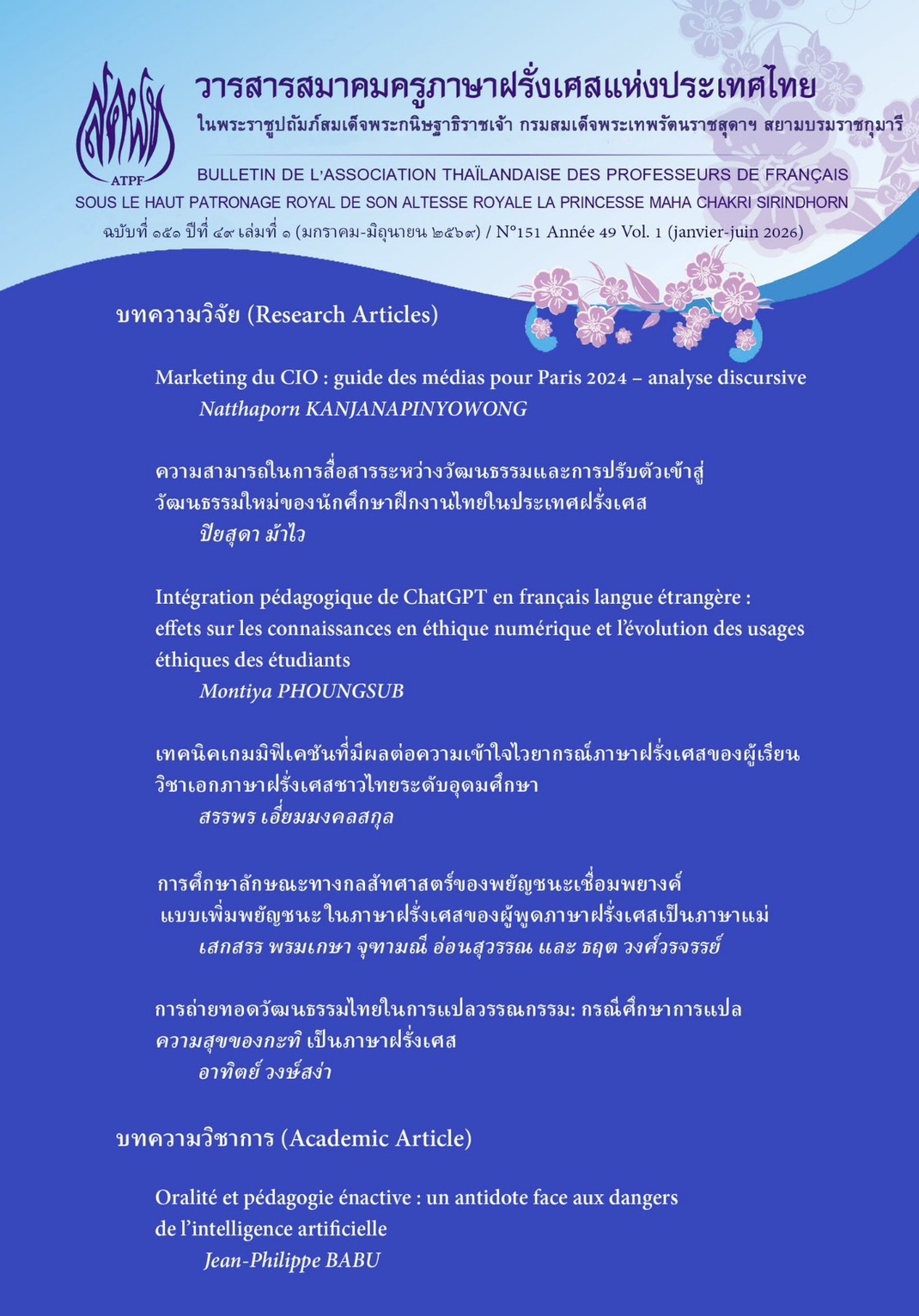
Oralité et pédagogie énactive : un antidote face aux dangers de l’intelligence artificielle
Article Sidebar
Main Article Content
บทคัดย่อ
Face aux transformations induites par l'intelligence artificielle dans l'enseignement des langues, cet article défend une approche énactive de l'oralité en FLE comme antidote aux risques de désincarnation et de prolétarisation cognitive. S'appuyant sur l'énaction de Varela et le modèle PAS de Masciotra (se disposer, se situer, se positionner, (se) réaliser), nous proposons de recentrer la didactique sur une parole incarnée et située.
L'article expose d'abord les fondements de la pédagogie énactive où la compétence émerge de l'interaction dynamique entre l'apprenant et son environnement. Il développe ensuite une méthodologie de l'oralité articulant travail vocal, prosodie structurante et expressive, gestes co-verbaux, partitions orales multiniveaux et exercices rythmiques. Les outils d'IA (transcription automatique, visualisation prosodique) sont repositionnés comme supports d'observation plutôt que substituts de l'apprentissage.
Dans une perspective pharmacologique inspirée de Stiegler, nous analysons l'ambivalence de l'IA : poison lorsqu'elle court-circuite l'appropriation subjective, remède si elle soutient la réflexivité. Cette réflexion, ancrée dans la pratique de classe, vise à former des sujets parlants autonomes et non de simples utilisateurs de technologies langagières.
Downloads
Article Details
เอกสารอ้างอิง
Aden, J. (2017). Langues et langage dans un paradigme énactif. Recherches en didactique des langues et des cultures, 14(1). https://doi.org/10.4000/rdlc.1085
Baudelaire, C. (2020). Les Fleurs du mal (C. Pichois, Ed.). Gallimard.
Bergson, H. (1889). Essai sur les données immédiates de la conscience. PUF.
Billières, M. (2002). Le corps en phonétique corrective. In R. Renard (Ed.), Apprentissage d'une langue étrangère/seconde. Vol. 2 : La phonétique verbotonale (pp. 35–70). De Boeck Supérieur. https://doi.org/10.3917/dbu.renar.2002.01.0035
Bobin, C. (2019). Pierre. Gallimard.
Claverie, B. (2019). Dynamique exponentielle et naturalité de l'intelligence artificielle. Hermès, La Revue, 85, 187–200. https://doi.org/10.3917/herm.085.0187
Conseil de l'Europe. (2021). Cadre européen commun de référence pour les langues : apprendre, enseigner, évaluer – Volume complémentaire. Éditions du Conseil de l'Europe.
Delhay, C. (2022, 13 juin). Salle de classe : « Des espaces modulables, des tables en îlots, des espaces vides favorisent l’échange. Ils créent l’espace du collectif, de l’écoute et de la parole ». Le Monde.
de Saussure, F. (2002). Écrits de linguistique générale (S. Bouquet & R. Engler, Éds., avec la collab. d’A. Weil). Gallimard.
Fulcher, G. (1996). Does thick description lead to smart tests? A data-based approach to rating scale construction. Language Testing, 13(2), 208–238. https://doi.org/10.1177/026553229601300205
Gerlich, M. (2025). AI tools in society: Cognitive offloading and the future of critical thinking. Societies, 15(1), 6. https://doi.org/10.3390/soc15010006
Goody, J. (1979). La Raison graphique. La domestication de la pensée sauvage. Minuit.
Husserl, E. (1964). Leçons pour une phénoménologie de la conscience intime du temps (H. Dussort, Trans.). PUF.
Kaewchoom, N., Thamthangsat, S., Langu, T., Rungsang, N., Meejit, C., Kawinkoonset, P., & Suebsook, K. (2023). Investigating factors causing anxiety in speaking English of Thai university students: The case of students in English program at HCU. Huachiew
Chalermprakiet University. https://has.hcu.ac.th/jspui/handle/ 123456789/2816
Lhote, É., & Llorca, R. (2001). Le geste, outil d’écoute. Le Français dans le monde. Recherches et applications, numéro spécial, Oral : variabilité et apprentissages, 160–164.
Masciotra, D., Roth, W.-M., & Morel, D. (2007). Enaction: Toward a Zen Mind in Learning and Teaching (Vol. 14). Sense Publishers.
Masciotra, D., Roth, W.-M., & Morel, D. (2008). Énaction. Apprendre et enseigner en situation. De Boeck Supérieur.
Masciotra, D., & Medzo, F. (2009). Développer un agir compétent : Vers un curriculum pour la vie. De Boeck Supérieur.
Masciotra, D. (2017). La compétence : entre le savoir agir et l’agir réel. Perspective de l’énaction. Éthique publique. Revue internationale d’éthique sociétale et gouvernementale, 19(1). https://doi.org/10.4000/ethiquepublique.2888
Meunier, C. (2015). Petit guide pratique de la phonétique corrective du FLE. Éditions du FLE.
Meunier, C. (2020). Initiation à la phonétique corrective du FLE : Phonèmes, prosodie et intonation. BoD – Books on Demand.
Ong, W. J. (2014). Oralité et écriture : La technologie de la parole. Les Belles Lettres.
Pelissero, C. (2019). Énaction : principe et moyens dans le cadre du français langue étrangère. Synergies Europe, 14, 159–174. https://gerflint.fr/Base/Europe14 /pelissero.pdf
Réseau Canopé. (2019, septembre). L’apprentissage de l’oral, un enjeu de société : Entretien avec Cyril Delhay. Magazine « Oral » – Nouveaux Programmes. https://www.reseau-canope.fr/nouveaux-programmes/magazine/ oral/lapprentis sage -de-loral-un-enjeu-de-societe.html
Simondon, G. (1989). L’individuation psychique et collective. Aubier.
Stiegler, B. (1990). Les temps de la lecture et les nouveaux instruments de la mémoire. Ars Industrialis. https://arsindustrialis.org/node/1935
Stiegler, B. (1994). La technique et le temps, 1 : La faute d’Épiméthée. Galilée.
Stiegler, B. (2001). La technique et le temps, tome 3 : Le temps du cinéma et la question du mal-être. Galilée.
Stiegler, B. (2008). Économie de l’hypermatériel et psychopouvoir : Entretiens avec Philippe Petit et Vincent Bontems. Mille et une nuits.
Stiegler, B. (2013). L’esprit des Lumières à l’époque du philosophical engineering. Intellectica. Revue de l’Association pour la Recherche
Cognitive, 59(1), 29–40. https://doi.org/10.3406/intel.2013.1084
Stiegler, B. (2015). Du psychopouvoir au neuropouvoir. In C. Larsonneur, A. Regnauld, P. Cassou-Noguès, & S. Touiza (Éds.), Le Sujet Digital (pp. 42–60). Presses universitaires de Paris Nanterre. https://doi.org/10.4000/books.pupo.25602
Suratin, N., & Sribayak, V. (2025). Factors contributing to speaking anxiety and anxiety reduction techniques in Thai adult EFL learners. LEARN Journal: Language Education and Acquisition Research Network, 18(1), 294–319. https://doi.org/10.70730/MYTS3987
Thaksanan, P. (2024). The study of EFL students’ public speaking anxiety and academic oral presentation strategies at a tertiary level in Thailand. Journal of Education and Innovation, 26(4), 48–59. https://so06.tci-thaijo.org/index.php/edujournal_nu/article/view/270538
Thompson, E. (2007). Mind in Life: Biology, Phenomenology, and the Sciences of Mind. Harvard University Press.
Valéry, P. (1941). Tel quel. Gallimard.
Varela, F. J. (1989). Invitation aux sciences cognitives (1re éd.). Seuil.
Varela, F. J. (1996). Invitation aux sciences cognitives (rééd.). Seuil.
Varela, F., Thompson, E., & Rosch, E. (1993). L’inscription corporelle de l’esprit : Sciences cognitives et expérience humaine. Seuil.
Vygotsky, L. S. (1978). Mind in society: The development of higher psychological processes. Harvard University Press.
Wang, J., & Fan, W. (2025). The effect of ChatGPT on students’ learning performance, learning perception, and higher-order thinking: insights from a meta-analysis. Humanities and Social Sciences Communications, 12, Article 621. https://doi.org/10.1057/s41599-025-04787-y
Zhai, C., Wibowo, S., & Li, L. D. (2024). The effects of over-reliance on AI dialogue systems on students’ cognitive abilities: A systematic review. Smart Learning Environments, 11, Article 28. https://doi.org/10.1186/s40561-024-00316-7
