
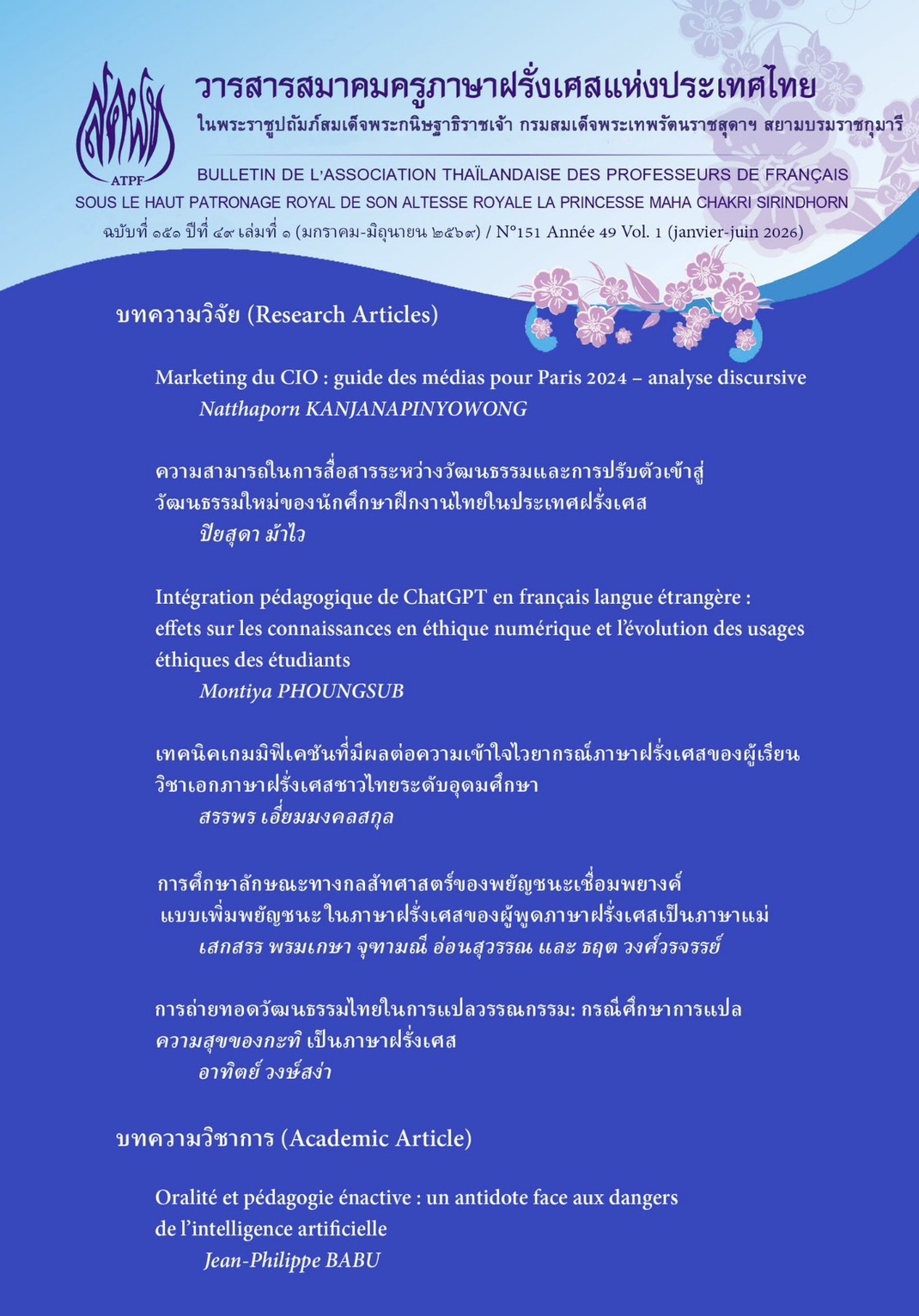
การศึกษาลักษณะทางกลสัทศาสตร์ของพยัญชนะเชื่อมพยางค์แบบเพิ่มพยัญชนะในภาษาฝรั่งเศสของผู้พูดภาษาฝรั่งเศสเป็นภาษาแม่
Article Sidebar
Main Article Content
บทคัดย่อ
งานวิจัยชิ้นนี้เน้นวิเคราะห์ลักษณะทางกลสัทศาสตร์ด้านค่าระยะเวลา (durée) ของสระที่อยู่ก่อนหน้า (V1) พยัญชนะ (C) และสระตามหลัง (V2) และค่าระยะเวลาโดยรวม (total) ของช่วงต่อเนื่องของสระที่อยู่ก่อนหน้า(V1)+พยัญชนะ (C)+สระตามหลัง (V2) ในบริบทที่ปรากฏพยัญชนะเชื่อมพยางค์ฯ (CL) (เช่น dernier oignon ‘หอมหัวใหญ่หัวสุดท้าย’) เปรียบเทียบกับบริบทที่ปรากฏเป็นพยัญชนะต้นพยางค์ทั่วไป (CI) (เช่น dernier rognon ‘ไตชิ้นสุดท้าย’) โดยเก็บข้อมูลจากผู้พูดภาษาฝรั่งเศสเป็นภาษาแม่ เพศชายและเพศหญิง ช่วงอายุ 20-30 ปี จำนวน 4 คน ด้วยวิธีการบันทึกเสียงจากการอ่านคำเป้าหมายในกรอบประโยคที่มีความยาวใกล้เคียงกัน และนำมาวิเคราะห์โดยใช้โปรแกรมวิเคราะห์เสียง Praat ผลการวิจัยแสดงให้เห็นว่า ค่าระยะเวลาเฉลี่ยของสระที่อยู่ก่อนหน้า (V1) และพยัญชนะ (C) และค่าระยะเวลาโดยรวม (total) ในบริบทที่ปรากฏพยัญชนะเชื่อมพยางค์ฯ (CL) สั้นกว่าค่าระยะเวลาในบริบทที่ปรากฏพยัญชนะต้นพยางค์ (CI) อย่างมีนัยสำคัญทางสถิติ ทั้งนี้ค่าระยะเวลาของพยัญชนะเชื่อมพยางค์ฯ แต่ละชนิดมีรูปแบบแนวโน้มที่แตกต่างกันไป ดังนั้น จะเห็นได้ว่าการออกเสียงพยัญชนะเชื่อมพยางค์ฯ (CL) มีความแตกต่างไปจากพยัญชนะต้นทั่วไป (CI) โดยเฉพาะอย่างยิ่ง เมื่อพิจารณาร่วมไปกับหน่วยเสียงสระที่อยู่ก่อนหน้าและตามหลัง
Downloads
Article Details
เอกสารอ้างอิง
กิตติพล ฐิโนทัย. (2551). การออกเสียงเชื่อมพยางค์โดยการเพิ่มพยัญชนะ: การวิเคราะห์ข้อผิดพลาดและพัฒนาการออกเสียงของนิสิตชั้นปีที่ 1 มหาวิทยาลัยศรีนครินทร วิโรฒ. วารสารมนุษยศาสตร์ปริทัศน์, 30(2), 65-80.
ธีระ รุ่งธีระ. (2565). การออกเสียงภาษาฝรั่งเศสสำหรับผู้เรียนชาวไทย: จากทฤษฎีสู่การปฏิบัติ. สำนักพิมพ์มหาวิทยาลัยธรรมศาสตร์.
ป้อมเพชร ตาณังกร และสัญชัย สุลักษณานนท์. (2568). การศึกษาการเปล่งเสียงต่อเนื่องของพยัญชนะในภาษาฝรั่งเศส โดยคนไทยในหนังสือเรียนภาษาฝรั่งเศสด้วยตนเอง. วารสารสมาคมครูภาษาฝรั่งเศสแห่งประเทศไทยในพระราชูปถัมภ์ฯ, 48(150), 94-120.
Babineau, M., & Shi, R. (2013). Ambiguity related to French liaisons: The role of bottom-up and top-down processes. In Proceedings of the 165th Meeting of the Acoustical Society of America. Vol. 19, 1-8.
Bannert, R. (1998). Temporal aspects of liaison consonants and their word initial correspondences in French. Reports from the Department of Phonetics Umeå University, PHONUM 6: 29-49.
Boë, L.J., Tubach, J.P. (1992). De A à Zut, dictionnaire phonétique du français parlé. Grenoble: Editions littéraires et linguistiques de l'université de Grenoble.
Boersma, P., & Weenink, D. (2023). Praat: doing phonetics by computer (Version 6.3.08) [Computer software]. http://www.praat.org/.
Clements, G. & Keyser S. (1983). CV PHONOLOGY : A Generative Theory of the Syllable. MIT Press.
Dejean de la Bâtie, B., & Bradley, D.C. (1995). Resolving word boundaries in spoken French: native and nonnative strategies. Applied Psycholinguistics, 16, 59-81.
Durand, J., & Lyche, C. (2008). French Liaison in the Light of Corpus Data. Journal of French Language Studies, 18, 33–66.
Durand, J., Laks, B., Calderone, B., & Tchobanov, A. (2011). Que savons-nous de la liaison aujourd’hui ? Langue française, 169, 103–135.
Encrevé, P. (1988). La liaison avec et sans enchaînement, phonologie tridimensionnelleet usages du français. Le Seuil.
Encrevé, P. & Scheer, T. (2005a). Autosegmental association is not automatic. 13th Phonology Meeting, Manchester.
Encrevé, P. & Scheer T. (2005b). L’association n’est pas automatique. 7e colloque du GDR 1954 ‘Phonologie’, 2-4 June, Aix-en-Provence.
Gaskell, G., Spinelli, E., & Meunier, F. (2002). Perception of resyllabification in French. Memory & Cognition, 30, 798–810.
Hornsby, D. (2020). Norm and ideology in spoken French: A sociolinguistic history of liaison. Palgrave Macmillan, 36-37
Léon, P. (1972). Prononciation du français standard. Didier.
Matter, J. F. (1986). À la recherche des frontières perdues: Étude sur la perception de la parole en français. Thèse de doctorat. Université de Utrecht. De Werelt.
Spinelli, E., McQueen, J. M., & Cutler, A. (2003). Processing resyllabified words in French. Journal of Memory and Language, 48(2), 233-254.
Schane, S. (1968). French Phonology and Morphology. The MIT Press.
Stridfeldt, M. (2005). La perception du français oral par des apprenants suédois. Thèse de doctorat. Université d’Umeå.
Vroomen, J., & de Gelder, B. (1999). Lexical access of resyllabified words: Evidence from phoneme monitoring. Memory & Cognition, 27, 413–421.
Wauquier-Gravelines, S. (1996). Organisation phonologique et traitement de la parole Continue. Thèse de doctorat en linguistique théorique et formelle. Université Paris 7.
Wauquier, S. (2009). Acquisition de la liaison en L1 et L2: stratégies phonologiques ou lexicales ?. Aile…Lia 2, 112–114.
Yersin-Besson, C., & Grosjean, F. (1996). L’effet de l’enchainement sur la reconnaissance des mots dans la parole continue. L’année Psychologique, 96, 9-30.
