
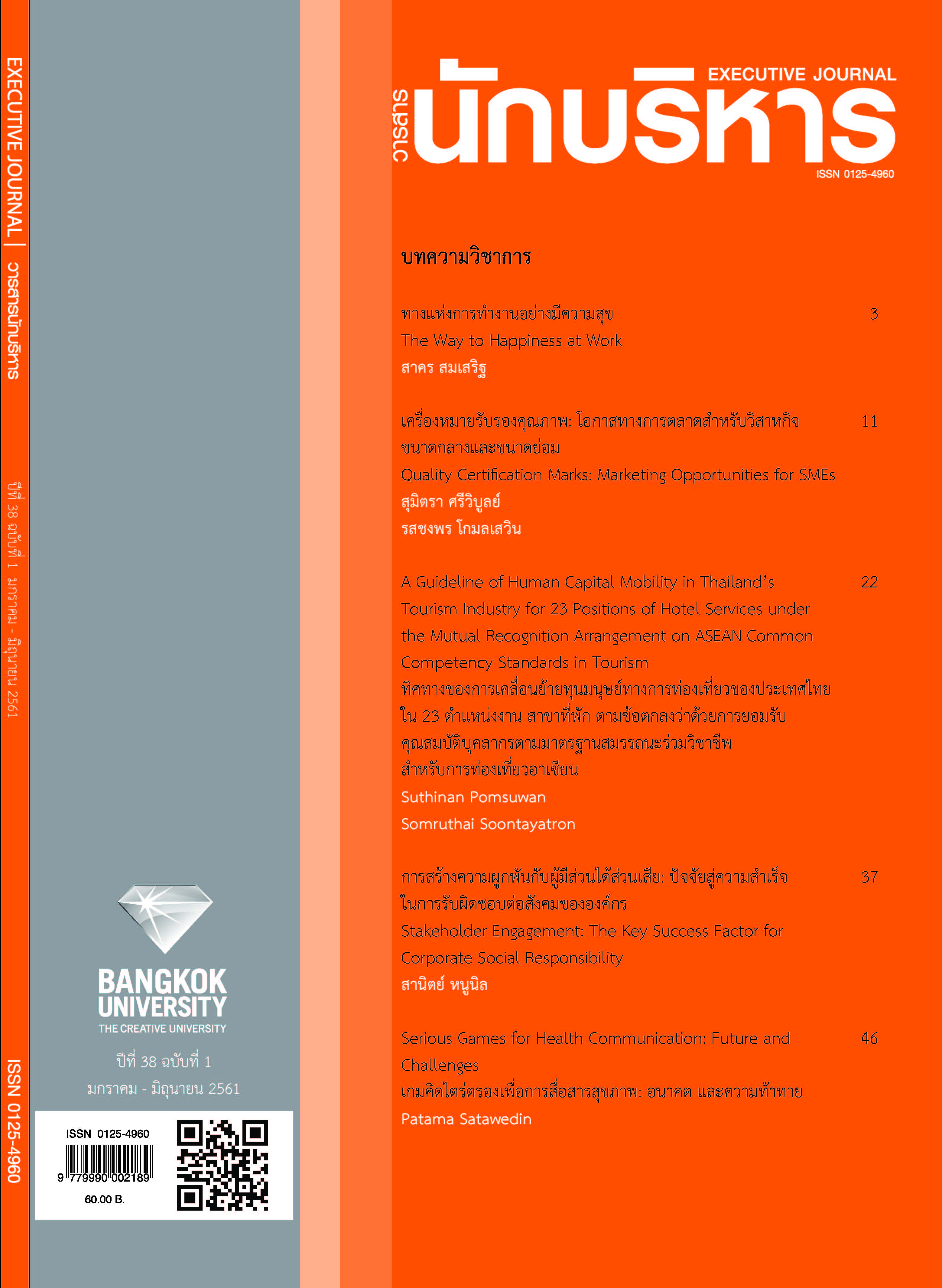
Serious Games for Health Communication: Future and Challenges
Article Sidebar
Main Article Content
Abstract
Individuals are predominantly exposed to something that makes them entertained, relaxed, and fun. Without doubt, games play an important role of responding to such people’s needs. In health orientation, besides entertainment gratification, games provide better learning and understanding, persuasiveness, and health behaviour adaptation. Of all types of gamification, serious games are particularly addressed in this paper because of their high popularity, not only in healthcare and public health, but also in other fields of study. Some examples of serious games including Escape from Diab, A Mysterious Poisoning, and StreetWise are given in this paper. Their future and challenges are discussed.
Article Details
The manuscript submitted for publication must be the original version, submitted only to this particular journal with no prior acceptance for publication elsewhere in other academic journals. The manuscript must also not violate the copyright issue by means of plagiarism.
References
Alahäivälä, T., & Oinas-Kukkonen, H. (2016). Understanding persuasion contexts in health gamification: A systematic analysis of gamified health behavior change support systems literature. International Journal of Medical Informatics, 96, 62-70.
Calderon, A. & Ruiz, M. (2015). A systematic literature on serious games evaluation: An application to software project management. Computers & Education, 87, 396-422. doi: https://doi.org/1016/j.compedu.2015.07.011
Charles, M., Bustard, D., & Black, M. (2009). Game inspired tool support for e-learning processes. Electronic Journal of e-Learning, 7(2), 101-110.
Crovato, S., Pinto, A., Giardullo, P., Mascarello, G., Neresini, F., & Ravarotto, L. (2016). Food safety and young consumers: Testing a serious game as a risk communication tool. Food Control, 62, 134-141. doi: 10.1016/j.foodcont.2015.10.009
Cugelman, B. (2013). Gamification: What it is and why it matters to digital health behavior change developers. JMIR Serious Games, 1(1), e3. Doi: 10.2196/games.3139
DeSmet, A., Van Ryckeghem, D., Compernolle, S., Baranowski, T., Thompson, D., Crombez, F., Poels, K., Van Lippevelde, W., Bastiaensens, S., Van Cleemput, K., Vandebosch, H., & De Bourdeaudhuij, L. (2014). A meta-analysis of serious digital games for healthy lifestyle promotion. Preventive Medicine, 69, 95-107. doi: 10.1016/j.ypmed.2014.08.026
Dias, J. D., Mekaro, M. S., Lu, J. K. C., Otsuka, J. L., Fonseca, L. M. M., & Zem-Mascarenhas, S. H. (2016). Serious game development as a strategy for health promotion and tackling childhood obseity. Revista Latino-Amricana de Enfermagem, 24,: e2759, 1-9. Doi: 10.1590/1518-8345.1015.2759
Drummond, D., Hadchouel, A., & Tesnière, A. (2017). Serious games for health: Three steps forwards. Advances in Simulation, 2(3). doi: 10.1186/s41077-017-0036-3
Edwards, E. A., Lumsden, J., Rivas, C., Edwards, L., & Caton, H. (2016a). ‘Gamification’ for health behaviour change in smartphone apps. Frontiers in Public Health, 4. doi: 10.3389/conf.FPUBH.2016.01.00043
Edwards, E. A., Lumsden, J., Rivas, C., Steed, L., Edwards, L. A., Thiyagarajan, A., Sohanpal, R., Caton, H., Griffiths, C. J., Munafo, M. R., Taylor, S., & Walton, R. T. (2016b). Gamification for health promotion: Systematic review of behaviour change techniques in smartphone apps. BMJ Open, 6(10). doi: 10.1136/bmjopen-2016-012447
Emmerich, K., & Bockholt, M. (2016). Serious games evaluation: Processes, models, and concepts. Entertainment Computing and Serious Games, 265-283.
Fuchslocher, A., Niesenhaus, J., & Krämer, N. (2010). Serious games for health: An empirical study of the game “Balance” for teenagers with diabetes mellitus. Entertainment Computing, 2(2), 97-101. doi: https://dx.doi.org/10.1016/j.entcom.2010.12.001
Giunti, G. (2015). Using gamification to drive patient’s personal data validation in a personal health record. Frontiers in Public Health, 4. doi: 10.3389/conf.FPUBH.2016.01.0015
González, C. S., Gómez, N., Navarro, V., Cairós, M., Quirce, C., Toledo, P., & Marrero-Gordillo, N. (2016). Learning healthy lifestyles through active videogames, motor games and the gamification of educational activities. Computers in Human Bahavior, 55, 529-551. doi: https://dx.doi.org/10.1016/j.chb.2015.08.052
Graafland, M., Schraagen, J. M., & Schijven, M. P. (2012). Systematic review of serious games for medical education and surgical skills training. British Journal of Surgery, 99, 1322-1330. doi: 10.1002/bjs.8819
Grimes, A., Kantroo, V., & Grinter, R. E. (2010). Let’s play! mobile health games for adults. In Proceedings of The 2010 ACM Conference on Ubiquitous Computing (pp. 241-250). Copenhagen, Denmark: n.p.
Hodge, P., Davis, J., Maiden, N., Mann, B., Nidsjo, A., Simpson, A., & Reynolds, L. (2015). StreetWise: A valid ecology for a serious game in a secure forensic mental health setting. Procedia Computer Science, 63, 252-259. doi: https://dx.doi.org/10.1016/j.procs.2015.08.341
Institute for the Future. (2012). Innovations in games: Better health and healthcare. Retrieved January 10, 2017, from https://www.healthit.gov/sites/default/files/IFTF_SR-1494_Innovations_in_Games.pdf
Kang, J., Liu, M., & Qu, W. (2017). Using gameplay data to examine learning behavior patterns in a serious game. Computers in Human Behavior, 72, 757-770. doi: 10.1016/j.chb.2016.09.062
Kharrazi, H., Lu, A. S., Gharhabi, F., & Coleman, W. (2012). A scoping review of health game research: Past, present, and future. Games Health Journal, 1(2), 153-164. doi: 10.1089/g4h.2012.0011
Lieberman, D. A. (2015). Using digital games to promote health behavior change. In S. S. Sundar (Ed.), The handbook of the psychology of communication technology. Malden, MA: Wiley Blackwell.
Lister, C., West, J. H., Cannon, B., Sax, T., & Brodegard, D. (2014). Just a Fad? Gamification in health and fitness apps. JMIR Serious Games, 2(2), e9. Doi: 10.2196/games.3413
Luz, S., Masoodian, M., Cesario, R. R., & Cesario, M. (2016). Using a serious game to promote community-based awareness and prevention of neglected tropical diseases. Entertainment Computing, 15, 43-55. doi: 10.1016/j.entcom.2015.11.001
Ma, M. (2011). Introduction to serious games development and applications. Entertainment Computing, 2(2), 59-60. doi: https://dx.doi.org/10.1016/j.entcom.2011.03.001
Marsh, T. (2011). Serious games continuum: Between games for purpose and experiential environments for purpose. Entertainment Computing, 2(2), 61-68. doi: https://dx.doi.org/10.1016/j.entcom.2010.12.004
McCallum, S. (2012). Gamification and serious games for personalized health. Retrieved 12 January 2017, from https://gtl.hig.no/images/4/40/McCallum2012.pdf
Ohannessian, R., Yaghobian, S., Verger, P., & Vanhems, P. (2016). A systematic review of serious video games used for vaccination. Vaccine, 34(38), 4478-4483. doi: 10.1016/j.vaccine.2016.07.048
Orji, R., Mandryk, R. L., Vassileva, J., & Gerling, K. M. (2013). Tailoring persuasive health games to gamer type. In Proceedings of ACM CHI human factors in computing systems–CHI 2013 (pp. 2467-2476). Paris, France: n.p.
Paredes, P., Tewari, A., & Canny, J. (2013). Design principles for the conceptualization of games for health behavior change. In CHI 2013: Changing perspectives (pp. 44-49). Paris, France: n.p.
Ricciardi, F., & De Paolis, L. T. (2014). A comparative review of serious games in health profession. International Journal of Computer Games Technology, 2014. doi: https://dx.doi.org/10.1155/2014/787968
Ryanm W., Samuel, D., Andrew, G., & Daniel, K. (2016). A systematic review of serious games in training health care professionals. Simulation in Healthcare, 11(1), 41-51. doi: 10.1097/SIH.0000000000000118
Sardi, L., Idri, A., & Fernández-Alemán, J. (2017). Methodological review: A systematic review of gamification in e-health. Journal of Biomedical Informatics, 71, 31-48. doi: 10.1016/j.jbi.2017.05.011
Scholtus, P. (2007). Escape from Diab, a video game to prevent childhood obesity and related illness. Retrieved March 2, 2017, from https://www.treehugger.com/green-food/escape-from-diab-a-video-game-to-prevent-childhood-obesity-and-related-illnesses.html
ScienceDaily. (2017). Mobile phone game trains players to make healthier diet selections. Retrieved July 28, 2017, from https://www.sciencedaily.com/releases/2010/10/101012101243.htm
Thompson, D. (2012). Designing serious video games for health behaviour change: Current status and future directions. Journal of Diabetes Science and Technology, 6(4), 807-811.
Thompson, D., Baranowski, T., Buday, R., Baranowski, J., Thompson, V., Jago, R., & Griffith, M. J. (2010). Serious video games for health: How behavioral science guided the development of a serious video game. Simulation & Gaming, 41(4), 587-606. Doi: 10.1177/1046878108328087
Wattanasoontorn, V., Boada, I., Garcia, R., & Sbert, M. (2013a). Serious games for health. Entertainment Computing, 4(4), 231-247. doi: 10.1016/j.entcom.2013.09.002
Wattanasoontorn, V., Boada, I., Hernandez, R.J.C., & Sbert, M. (2013b). Serious games for health. Adv in Health Sci Edu. Retrieved July 28, 2017, from https://www.researchgate.net/publication/259167089_Serious_games_for_health
Wenk, N., & Gbron, S. (2017). Reinforcing the difference between simulation, gamification, and serious game. Retrieved January 5, 2018, from https://gsgs.ch/wp-content/uploads/2017/10/GSGS17-intro-speech.pdf
