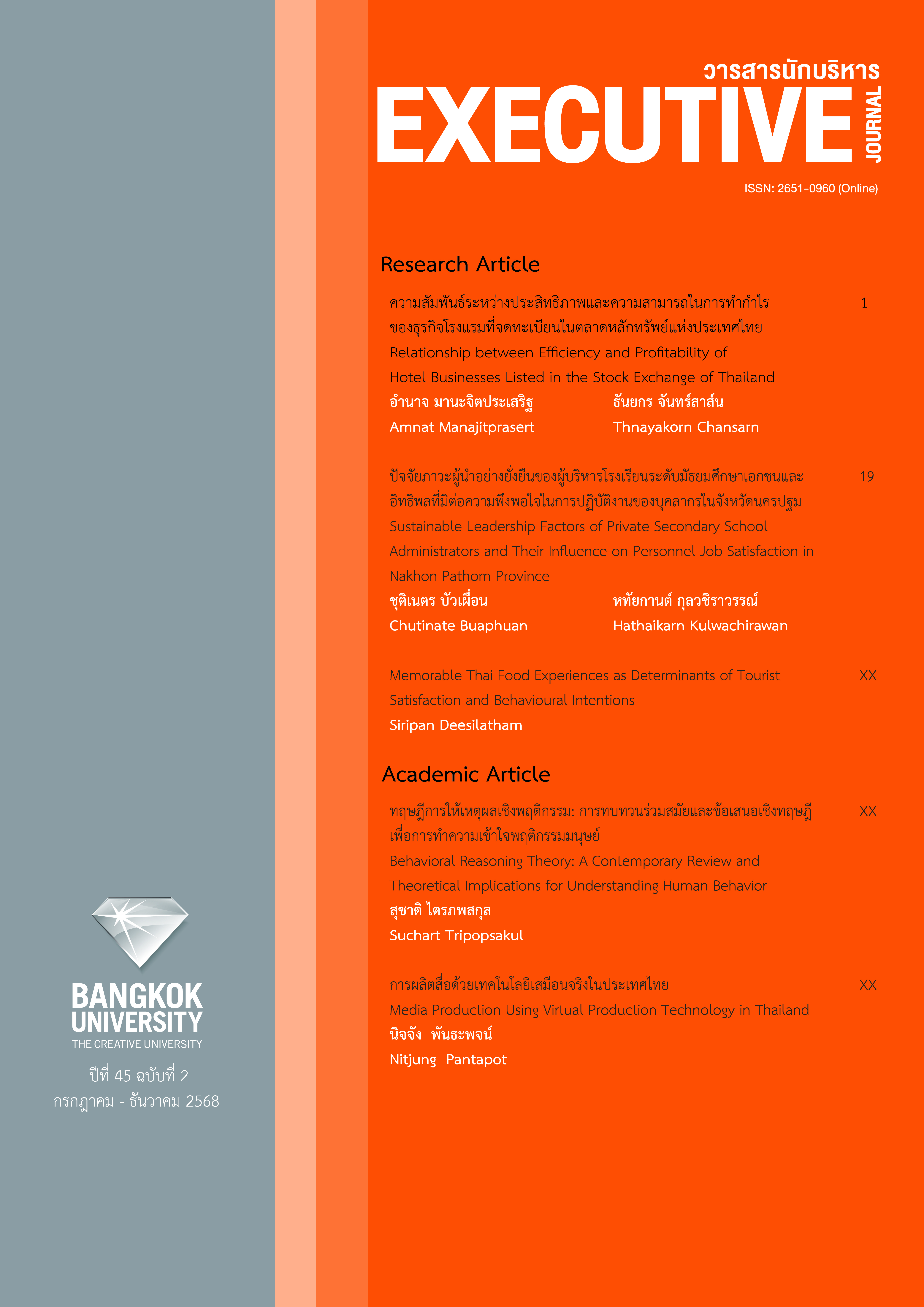
Sustainable Leadership Factors of Private Secondary School Administrators and Their Influence on Personnel Job Satisfaction in Nakhon Pathom Province
Article Sidebar
Main Article Content
Abstract
This research aimed to study the sustainable leadership factors of private secondary school administrators and their influence on personnel job satisfaction. The sample consisted of 305 teachers and personnel of private secondary schools in Nakhon Pathom Province, randomly selected based on the proportion of schools in each district. The research instrument was a questionnaire. Data were analyzed using descriptive statistics and multiple linear regression analysis. The findings revealed that: 1) The level of sustainable leadership factors of private secondary school administrators, with overall opinions at a high level, 2) study the level of the job satisfaction of personnel is at the highest level, and 3) the sustainable leadership factors of private secondary school administrators affecting the job satisfaction of personnel, ranked from the factors with the highest to lowest influence, namely, promotion of diversity; depth of knowledge; morality, ethics, and fairness; and the distribution of leadership, respectively, With the 4 sustainable leadership factors affecting the job satisfaction of personnel at 72.70 percent, while the factors of continuation of success and working together did not have a statistically significant effect.
Article Details

This work is licensed under a Creative Commons Attribution-NonCommercial-NoDerivatives 4.0 International License.
The manuscript submitted for publication must be the original version, submitted only to this particular journal with no prior acceptance for publication elsewhere in other academic journals. The manuscript must also not violate the copyright issue by means of plagiarism.
References
จิตติพร กงจักร์, และ จุฑามาศ ทวีไพบูลย์วงษ์. (2567). อิทธิพลของภาวะผู้นำการเปลี่ยนแปลงที่มีต่อการเปิดรับการเปลี่ยนแปลงและความพึงพอใจในงานของพนักงานภายหลังการควบรวมกิจการ. วารสารนักบริหาร, 4(1), 1-17.
เชษินีร์ แสวงสุข. (2560). ภาวะผู้นำการเปลี่ยนแปลงของผู้บริหารสถานศึกษาที่ส่งผลต่อความพึงพอใจในการปฏิบัติงานของครู [วิทยานิพนธ์ปริญญามหาบัณฑิต, มหาวิทยาลัยราชภัฏรำไพพรรณี].
ธีระนันต์ โมธรรม. (2566). กลยุทธ์การพัฒนาภาวะผู้นำแบบยั่งยืนของผู้บริหารโรงเรียน สังกัดสำนักงานเขตพื้นที่การศึกษามัธยมศึกษานครพนม [ปริญญาปรัชญาดุษฎีบัณฑิต, มหาวิทยาลัยราชภัฏสกลนคร].
นันทนา มลาตรี, และ สิทธิชัย สอนสุภี. (2567). ภาวะผู้นำอย่างยั่งยืนที่ส่งผลต่อคุณภาพชีวิตการทำงานของครู สังกัดสำนักงานเขตพื้นที่การศึกษาประถมศึกษาหนองคายเขต 1. วารสารปัญญาปณิธาน, 9(1), 127-140.
พรชัย เจดามาน, สนิท ตีเมืองซ้าย, สุทธิพงศ์ หกสุวรรณ์, และ ประมุข ศรีชัยวงษ์. (2564). การพัฒนาคุณลักษณะภาวะผู้นำแบบเหนือชั้นอย่างยั่งยืนที่ส่งผลต่อความพึงพอใจในงานและความผูกพันองค์กรของบุคลากรทางการจัดการศึกษา. วารสารมนุษยศาสตร์และสังคมศาสตร์ มหาวิทยาลัยนครพนม, 11(1), 64-75.
พา อักษรเสือ, และ เอกราช โฆษิตพิมานเวช. (2562). ภาวะผู้นำแบบยั่งยืนของผู้บริหารสถานศึกษาเอกชน สังกัดสำนักงานศึกษาธิการจังหวัดขอนแก่น. วารสารบัณฑิตศึกษามหาจุฬาขอนแก่น, 6(3), 634-644.
วสันต์ ศักดาศักดิ์. (2565). แนวทางการพัฒนาภาวะผู้นำที่ยั่งยืนกับประสิทธิภาพการบริหารงานวิชาการโรงเรียนของผู้บริหารสถานศึกษา สังกัดสำนักงานเขตพื้นที่การศึกษามัธยมศึกษานนทบุรี [วิทยานิพนธ์ปริญญา มหาบัณฑิต, มหาวิทยาลัยราชภัฏพระนคร].
สำนักงานคณะกรรมการส่งเสริมการศึกษาเอกชน [สช.]. (2566ก). แผนพัฒนาการศึกษาเอกชน พ.ศ. 2566-2570. เจี้ยฮั้ว.
สำนักงานคณะกรรมการส่งเสริมการศึกษาเอกชน [สช.]. (2566ข). กดดูรู้ที่เรียน. https://school.opec.go.th/
สำนักงานคณะกรรมการส่งเสริมการศึกษาเอกชน [สช.]. (2567). แผนปฏิบัติราชการประจำปีงบประมาณ พ.ศ. 2567. https://opec.go.th/uploads/2024/plan/20240418_133825_405_แผนปฏิบัติราชการประจำปีงบประมาณพ.ศ.2567เผยแพร่.pdf
สำนักงานปลัดกระทรวงศึกษาธิการ สำนักงานศึกษาธิการภาค 2. (2565). รายงานสารสนเทศทางการศึกษาระดับภาค ปี 2565 ของสำนักงานศึกษาธิการภาค 2. https://reo2.moe.go.th/wp-content/uploads/2022/10/0_information-65.pdf
สุนทรีพร อำพลพร, อรสา จรูญธรรม, และ ชาญชัย วงศ์สิรสวัสดิ์. ( 2565). รูปแบบการพัฒนาภาวะผู้นำที่ยั่งยืนของผู้บริหารสถานศึกษา สังกัดสำนักงานเขตพื้นที่การศึกษามัธยมศึกษา. วารสาร มจร บาฬีศึกษาพุทธโฆสปริทรรศน์, 8(1), 240-255.
Avery, G. C., & Bergsteiner, H. (2011). Sustainable leadership: Honeybee and locust approaches. Routledge.
Baluyos, G. R., Rivera, H. L., & Baluyos, E. L. (2019). Teachers’ job satisfaction and work performance. Open Journal of Social Sciences, 7(8), 206-221. https://doi.org/10.4236/jss.2019.78015
Çayak, S. (2021). The effect of sustainable leadership behaviors of school principals on teacher’s organizational commitment and job satisfaction.Discourse and Communication for Sustainable Education, 12(1), 102-120. https://doi.org/10.2478/dcse-2021-0008
Çayak, S., & Çetin, M. (2018). Sustainable leadership scale: Validity and reliability study. Turkish Studies Educational Sciences, 13(11), 1561–1582. http://dx.doi.org/10.7827/TurkishStudies.13703
Cook, W. J. (2014). Sustainable school leadership: The teachers’ perspective. NCPEA International Journal of Educational Leadership Preparation, 9(1), 1-17. https://files.eric.ed.gov/fulltext/EJ1024112.pdf
Dasic, M., & Novakovic Bozic, N. (2023). Analytical review of sustainable leadership concept. International Scientific Conference on Economy, Management and Information Technologies, 1(1), 189-195. https://doi.org/10.46793/ICEMIT23.189D
George, D., & Mallery, P. (2010). SPSS for windows step by step: A simple guide and reference, 17.0 update (10th ed.). Allyn and Bacon.
Hair, J. F., Black, C. W., Babin, J. B., & Anderson, E. R. (2019). Multivariate data analysis (8th ed.). Annabel Ainscow.
Hargreaves, A. (2007). Sustainable leadership and development in education: Creating the future, conserving the past. European Journal of Education, 42(2), 223-233.
Hargreaves, A., & Fink, D. (2006). Sustainable leadership. Jossey Bass.
Herzberg, F. (2003). One more time: How do you motivate employees?. Harvard Business Review, 1-13. https://pdodds.w3.uvm.edu/files/papers/others/1968/herzberg1968.pdf
Lambert, S. (2011). The perception and implementation of sustainable leadership strategies in further education colleges. The Journal of Leadership Education, 11(2), 102-120.
Liao, Y. (2022). Sustainable leadership: A literature review and process for future research. Frontiers in Psychology, 22(13), 1-11. https://doi.org/10.3389/fpsyg.2022.1045570
Rovinelli, R. J., & Hambleton, R. K. (1977). On the use of content specialists in the assessment of criterion-referenced test item validity. Tijdschrift Voor Onderwijs Research, 2(2), 49–60.
Sulaimi, H., & Jantan, M. (2024). Examining the effect of female teachers’ job satisfaction on their retention in public schools of Oman. Journal of Human Resource and Sustainability Studies, 12(2), 389-397. https://doi.org/10.4236/jhrss.2024.122021
Suriyankietkaew, S., & Avery, G. C. (2014). Employee satisfaction and sustainable leadership practices in Thai SMEs. Journal of Global Responsibility, 5(1), 160–173. https://doi.org/10.1108/JGR-02-2014-0003
Yamane, T. (1967). Statistics, an introductory analysis (2nd ed.). Harper and Row.
