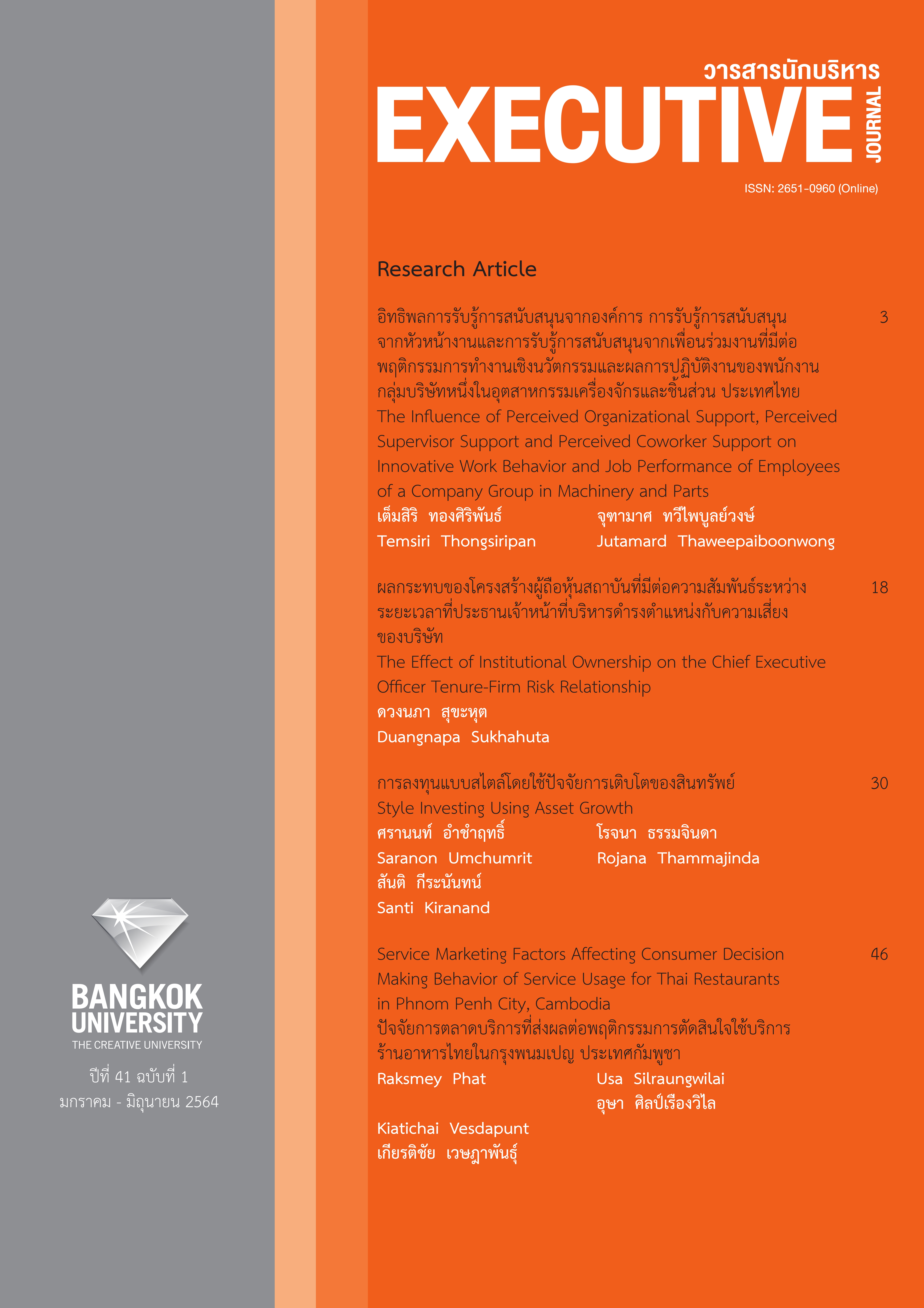
อิทธิพลการรับรู้การสนับสนุนจากองค์การ การรับรู้การสนับสนุนจากหัวหน้างานและการรับรู้การสนับสนุนจากเพื่อนร่วมงานที่มีต่อพฤติกรรมการทำงานเชิงนวัตกรรม และผลการปฏิบัติงานของพนักงานกลุ่มบริษัทหนึ่ง ในอุตสาหกรรมเครื่องจักรและชิ้นส่วน ประเทศไทย
Article Sidebar
Main Article Content
บทคัดย่อ
การวิจัยครั้งนี้มีวัตถุประสงค์เพื่อ 1) วิเคราะห์ระดับของการรับรู้การสนับสนุนจากองค์การ การรับรู้การสนับสนุนจากหัวหน้างาน การรับรู้การสนับสนุนจากเพื่อนร่วมงาน พฤติกรรมการทำงานเชิงนวัตกรรม และผลการปฏิบัติงาน และ 2) วิเคราะห์อิทธิพลของการรับรู้การสนับสนุนจากองค์การ การรับรู้การสนับสนุนจากหัวหน้างาน และการรับรู้การสนับสนุนจากเพื่อนร่วมงาน ที่มีต่อพฤติกรรมการทำงานเชิงนวัตกรรม และผลการปฏิบัติงานของพนักงานในกลุ่มบริษัทหนึ่ง ในอุตสาหกรรมเครื่องจักรและชิ้นส่วน ประเทศไทย จำนวนตัวอย่าง 198 คน จากจำนวนประชากร 646 คน ใช้วิธีการเลือกตัวอย่างแบบบังเอิญ เครื่องมือที่ใช้ในการวิจัยคือแบบสอบถาม วิเคราะห์ข้อมูลโดยใช้ ความถี่ ร้อยละ ค่าเฉลี่ย ค่าเบี่ยงเบนมาตรฐาน และการวิเคราะห์สมการโครงสร้าง ผลการวิจัย พบว่า 1) พนักงานมีระดับการรับรู้การสนับสนุนจากองค์การ การรับรู้การสนับสนุนจากหัวหน้างาน การรับรู้การสนับสนุนจากเพื่อนร่วมงาน พฤติกรรมการทำงานเชิงนวัตกรรม และผลการปฏิบัติงาน อยู่ในระดับสูง และ 2) การรับรู้การสนับสนุนจากองค์การมีอิทธิพลต่อผลการปฏิบัติงานและพฤติกรรมการทำงานเชิงนวัตกรรมอย่างมีนัยสำคัญทางสถิติ รวมไปถึงพฤติกรรมการทำงานเชิงนวัตกรรมเองก็มีอิทธิพลต่อผลการปฏิบัติงานอย่างมีนัยสำคัญทางสถิติเช่นกัน ผลจากการศึกษาสามารถนำมาใช้เป็นแนวทางให้กับผู้บริหารในการกำหนดนโยบายการจัดการที่เกี่ยวข้อง
Article Details
บทความที่นำมาสมัครลงตีพิมพ์ในวารสารต้องไม่เคยได้รับการตีพิมพ์เผยแพร่มาก่อน และไม่ส่งต้นฉบับบทความซ้ำซ้อนกับวารสารอื่น รวมทั้งผู้เขียนบทความต้องไม่ละเมิดหรือคัดลอกผลงานของผู้อื่น
เอกสารอ้างอิง
Bakhla, A. K., Verma, V., Hembram, M., Praharaj, S. K., & Sinha, V. K. (2013). Internal consistency and factor structure of 12-item general health questionnaire in visually impaired students. Industrial Psychiatry Journal, 22(2), 109–113.
Binnewies, C., & Gromer, M. (2012). Creativity and innovation at work: The role of work characteristics and personal initiative. Psicothema, 24(1), 100-105.
Boonriw, P. (2020) Itthiphon khō̜ng watthanatham ʻongkān læ kānčhatkān khwāmrū thī song phon tō̜ phonkān patibat ngān khō̜ng phanakngān radap patibatkān ʻutsāhakam ʻāhān prǣrūp nai nikhom ʻutsāhakam lǣm chabang čhangwat Chon Burī [Influences of organizational culture and knowledge management on job performance of operational employees in the processing food industry in Laem Chabang industrial estate, Chon Buri province] (Master’s thesis, Kasetsart University).
Borman, W. C., & Motowidlo, S. M. (1993). Expanding the criterion domain to include elements of contextual performance. In N. Schmitt & W. C. Borman (Eds.), Personnel Selection in Organizations (pp. 71–98). San Francisco, CA: Jossey-Bass.
Chen, T., Li, F., & Leung, K. (2016). When does supervisor support encourage innovative behavior? Opposite moderating effects of general self-efficacy and internal locus of control. Personnel Psychology, 69(1), 123–158.
De Jong, J., & Den Hartog, D. (2010). Measuring innovative work behavior. Creativity and Innovation Management, 19(1), 23-36.
Dogru, C. (2018). The relationship between perceived support and innovative behavior: Analyzing the mediating role of work engagement. Journal of Business Research Turk, 10(2), 384-402.
Eisenberger, R., & Stinglhamber, F. (2011). Perceived organizational support: Fostering enthusiastic and productive employees. Washington, DC: APA Books.
Froehlich, J. K., Hoegl, M., & Weiss, M. (2015). Thematic thinking and individual performance in research and development. Journal of Product Innovation Management, 32(6), 939–953.
Gagnon, M. A., & Michael, J. H. (2004). Outcomes of perceived supervisor support for wood production employees. Forest Products Journal, 54(12), 172-177.
Gurbuz, F. G., & Ataoglu, B. T. (2018). Understanding the relationship between human resource practices and innovative work behavior: Role of perceived organizational support. International Journal of Science and Research, 7(11), 1821-1829.
Hair, J. F., Black, W. C., Babin, B. J., & Anderson, R. E. (2010). Multivariate data analysis (7th ed.). Upper Saddle River, NJ; Prentice Hall.
Hassan, S., & ul Hassan, M. (2015). Testing the mediating role of perceived organizational support between leadership styles, organizational justice and employees’ behavioral outcomes. Pakistan Journal of Commerce & Social Sciences, 9(1), 131–158.
Kaiwan, Y. (2013). Kān wikhro̜ sathiti lāi tūaprǣ samrap ngānwičhai [Multivariate statistical analysis for research]. Bangkok: Chulalongkorn University Press.
Ketsa-ard, M. (2018). Bukkhalikkaphāp hā ʻongprakō̜p læ ʻitthiphon rawāng kan khō̜ng kh
wāmphưngphō̜čhai nai ngān læ phonkān patibat ngān khō̜ng phū prakō̜p wichāchīp kānphayābān nai ʻamphœ̄ sī rāchā čhangwat Chon Burī [Relationship between big five personal traits and simultaneous reciprocal influences between job satisfaction and job performance of Nursing professionals in Si Racha Chon Buri] (Master’s thesis, Kasetsart University).
Kim, H. J., Hur, W.-M., Moon, T.-W., & Jun, J.-K. (2017). Is all support equal? The moderating effects of supervisor, coworker, and organizational support on the link between emotional labor and job performance. BRQ Business Research Quarterly, 20(2), 124-136.
Leong, C. T., & Rasli, A. (2014). The relationship between innovative work behavior on work role performance: An empirical study. Procedia - Social and Behavioral Sciences, 129, 592–600.
Matookchund, N. G., & Steyn, R. (2019). Performance appraisal as an antecedent to innovation: An analysis of its importance relative to other human resource practices. South African Journal of Human Resource Management, 17(1), 1–11.
Middelkoop, C. (2016). How does innovative work behavior of employees affect their individual job performance? (Master’s thesis, University of Twente).
Miller, K. (2006). Organizational communication: Approaches and processes (4th ed.). Belmont, CA: Thomson Wadsworth.
Nagami, M., Tsutsumi, A., Tsuchiya, M., & Morimoto, K. (2010). Job control and coworker support improve employee job performance. Industrial Health, 48(6), 845-851.
Nasurdin, A. M., Ling, T. C., & Khan, S. N. (2018). Linking social support, work engagement and job performance in Nursing. International Journal of Business & Society, 19(2), 363–386.
Nguyen, P. V., Le, H. T. N., Trinh, T. V. A., & Do, H. T. S. (2019). The effects of inclusive leadership on job performance through mediators. Asian Academy of Management Journal, 24(2), 63–94.
Phusee-orn, S. (2008). Kānprayukchai SPSS wikhro̜ khō̜mūn ngānwičhai .[Applied SPSS for research data analysis]. Kalasin: Prasan Printing.
Rattanamanee, N. (2018). Itthiphon khō̜ng kānraprū kān sanapsanun čhāk ʻongkān hūanā ngān læ phư̄an rūam ngān thī mī phon tō̜ kānmī phrưttikam kān pen samāchik thī dī khō̜ng ʻongkān: Kō̜ranī sưksā bō̜risat chō̜ thawī čhamkat (Mahāchon) [The influence of perceived organizational support, supervisor support and colleagues support on the organization citizenship behavior: A case study of Cho Thavee Public Company Limited] (Master’s thesis, Sillapakorn University).
Qureshi, F., Zaman, Q., & Butt, M. (2020). Mediating effect of perceived organizational support on the relationship between leader- member exchange and the innovation work behavior of nursing employees: A social exchange perspective. Business Innovation and Entrepreneurship Journal, 2(1), 68-77.
Rhoades, L., & Eisenberger, R. (2002). Perceived organizational support: A review of the literature. Journal of Applied Psychology, 87(4), 698–714.
Rutherford, B., Park, J., & Han, S.-L. (2011). Increasing job performance and decreasing salesperson propensity to leave: An examination of an Asian sales force. Journal of Personal Selling & Sales Management, 31(2), 171–184.
Shanock, L. R., & Eisenberger, R. (2006). When supervisors feel supported: Relationships with subordinates' perceived supervisor support, perceived organizational support, and performance. Journal of Applied Psychology, 91(3), 689-695.
Siddiqi, M. A. (2015). Employee innovative work behavior and its roots in their work engagement: An Indian experience. Pranjana: The Journal of Management Awareness, 18(2), 1–18.
Sritangratanakul, K. (2013). Khwāmsamphan rawāng khwām kraprīkraprao nai ngān kap phonkān patibat ngān dōi mī khwām yư̄tyun thāngkān rūkhit kān sanapsanun čhāk phư̄an rūam ngān khwām yư̄nyat nai ngān læ kānkamnot paomāi thī thāthāi pentūa prǣ song phān [Relationship between vigor and job performance: The mediating effects of cognitive flexibility, coworker support, task persistence, and difficulty of self-set goals] (Master’s thesis, Chulalongkorn University).
Thiposot, S. (2013). Kānraprū kān sanapsanun čhāk ʻongkān khō̜ng phanakngān thī mī tō̜ phonkān patibat ngān nai phāk thurakit thanākhān [Perceived organizational support affecting job performance of employees in Banking business] (Master’s thesis, Rajamangala University of Technology Thanyaburi).
Trott, P. (2005). Innovation management and new product development (3rd ed.). Harlow, England: FT Prentice-Hall.
Ur Rehman, W., & Ahmad, M. (2015). AMO framework and psychological empowerment: Conceptual model decoding the black box between HRM and innovative work behavior. Business Review, 10(1), 86–101.
van Acker, W., Wynen, J., & Op de Beeck, S. (2018). Illuminating the gender divide in public sector innovation: Evidence from the Australian public service. Public Personnel Management, 47(2), 175–194.
Zhuang, L., Williamson, D., & Carter, M. (1999). Innovate or liquidate-are all organizations convinced? A two-phased study into the innovation process. Management Decision, 37(1), 57-71.
