
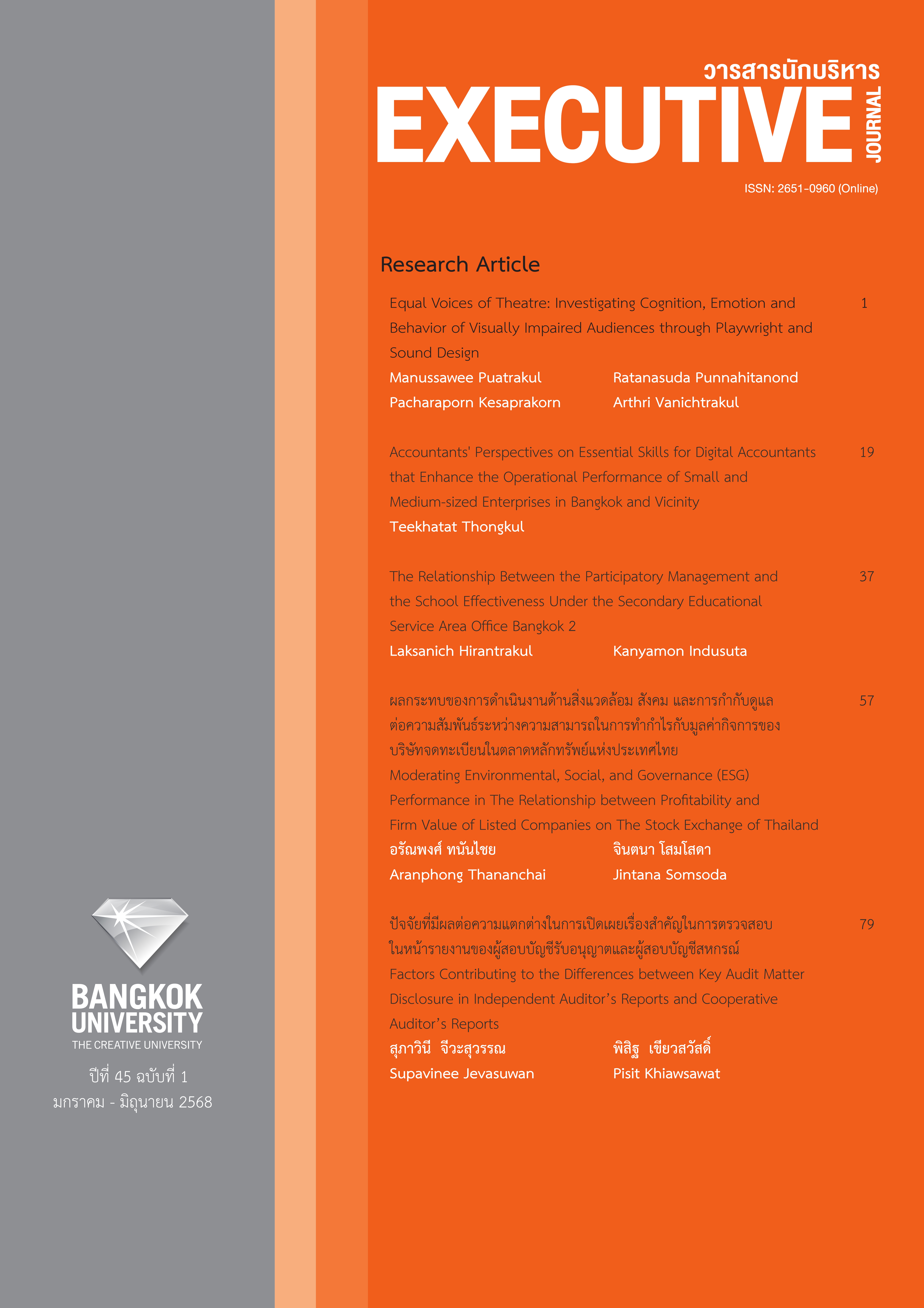
ผลกระทบของการดำเนินงานด้านสิ่งแวดล้อม สังคม และการกำกับดูแล ต่อความสัมพันธ์ระหว่างความสามารถในการทำกำไรกับมูลค่ากิจการของบริษัทจดทะเบียนในตลาดหลักทรัพย์แห่งประเทศไทย
Article Sidebar
Main Article Content
บทคัดย่อ
งานวิจัยนี้มีวัตถุประสงค์เพื่อศึกษาผลกระทบของการดำเนินงานด้านสิ่งแวดล้อม สังคม และการกำกับดูแล ต่อความสัมพันธ์ระหว่างความสามารถในการทำกำไร และมูลค่ากิจการของบริษัทจดทะเบียนในตลาดหลักทรัพย์แห่งประเทศไทย โดยใช้ข้อมูลทุติภูมิระหว่างปี พ.ศ. 2564-2566 กลุ่มตัวอย่างที่ใช้วิเคราะห์จำนวน 331 ข้อมูลรายปีรายบริษัทที่เปิดเผยข้อมูลตามตัวแปรที่สนใจในฐานข้อมูลบลูมเบิร์ก การวิเคราะห์ข้อมูลใช้วิธีถดถอยเชิงพหุ เพื่อทดสอบสมมติฐาน ผลการวิจัยพบว่า ความสามารถในการทำกำไรมีความสัมพันธ์เชิงบวกและมีนัยสำคัญต่อมูลค่ากิจการ นอกจากนี้ การดำเนินงานด้านสิ่งแวดล้อม สังคม และการกำกับดูแล มีผลต่อความสัมพันธ์ระหว่างความสามารถในการทำกำไรและมูลค่ากิจการอย่างมีนัยสำคัญ โดยปฏิสัมพันธ์ระหว่างความสามารถในการทำกำไรกับการดำเนินงานด้านสิ่งแวดล้อมส่งผลในทิศทางบวกอย่างมีนัยสำคัญ ขณะที่ปฏิสัมพันธ์ระหว่างความสามารถในการทำกำไรกับการดำเนินงานด้านสังคมและด้านการกำกับดูแล ส่งผลในทิศทางลบและมีนัยสำคัญต่อมูลค่ากิจการ
Article Details

อนุญาตภายใต้เงื่อนไข Creative Commons Attribution-NonCommercial-NoDerivatives 4.0 International License.
บทความที่นำมาสมัครลงตีพิมพ์ในวารสารต้องไม่เคยได้รับการตีพิมพ์เผยแพร่มาก่อน และไม่ส่งต้นฉบับบทความซ้ำซ้อนกับวารสารอื่น รวมทั้งผู้เขียนบทความต้องไม่ละเมิดหรือคัดลอกผลงานของผู้อื่น
เอกสารอ้างอิง
ดารารัตน์ โพธิ์ประจักษ์, ชนาเมธ น้อยอ่าง, และ อุภาวดี เนื่องวรรณะ. (2566). การสังเคราะห์โมเดลสมการโครงสร้างการเปิดเผยข้อมูลการพัฒนาที่ยั่งยืนที่ส่งผลต่อมูลค่ากิจการผ่านความเข้มแข็งทางการเงินของบริษัทที่จดทะเบียนในตลาดหลักทรัพย์แห่งประเทศไทย กลุ่มเกษตรและอุตสาหกรรมอาหาร กลุ่มบริการ และกลุ่มสินค้าอุปโภคบริโภค ภายใต้วิกฤตการณ์การแพร่ระบาดของเชื้อไวรัสโคโรนา 2019. วารสารนวัตกรรมธุรกิจ การจัดการ และ สังคมศาสตร์, 4(1), 42-59.
Abdi, Y., Li, X., & Càmara-Turull, X. (2022). Exploring the impact of sustainability (ESG) disclosure on firm value and financial performance (FP) in airline industry: The moderating role of size and age.Environment, Development and Sustainability, 24(4), 5052-5079. https://doi.org/10.1007/s10668-021-01649-w
Aydoğmuş, M., Gülay, G., & Ergun, K. (2022). Impact of ESG performance on firm value and profitability. Borsa Istanbul Review, 22, S119-S127. https://doi.org/10.1016/j.bir.2022.11.006
Bahadır, O., & Akarsu, S. (2024). Does company information environment affect ESG–financial performance relationship? Evidence from European markets. Sustainability, 16(7), 2701. https://doi.org/10.3390/su16072701
Baldwin, C. Y. (2016). Return on invested capital (ROIC). In The Palgrave Encyclopedia of Strategic Management (pp. 1-4). Palgrave Macmillan. https://doi.org/10.1057/978-1-349-94848-2_678-1
Barney, J. (1991). Firm resources and sustained competitive advantage. Journal of Management, 17(1), 99-120. https://doi.org/10.1177/014920639101700108
Bloomberg. (2024). Bloomberg for education: The environmental, social, and governance course. https://www.bloomberg.com/professional/products/bloomberg-terminal/education/certificate-courses/
Bowerman, B. L., & O’Connell, R. T. (2000). Linear statistical models: An applied approach (2nd ed.). Duxbury.
Chairani, C., & Siregar, S. V. (2021). The effect of enterprise risk management on financial performance and firm value: The role of environmental, social and governance performance. Meditari Accountancy Research, 29(3), 647-670. https://doi.org/10.1108/MEDAR-09-2019-0549
Chung, K. H., & Pruitt, S. W. (1994). A simple approximation of Tobin’s Q. Financial Management, 23(3), 70–74. https://doi.org/10.2307/3665623
Delvina, E. M., & Hidayah, R. (2023). The effect of ESG (environmental, social and governance) performance on company value and company performance. Management Studies and Entrepreneurship Journal (MSEJ), 4(5), 5436-5444. https://journal.yrpipku.com/index.php/msej/article/view/2903
Fernandes, C. G., de Freitas Luna, M. S., Junior, E. M., & Maria, M. M. L. (2024). The impact of controversial ESG on the market value and financial constraints of brics companies. Revista De Gestão Social E Ambiental, 18(4), e04679. https://doi.org/10.24857/rgsa.v18n4-042
Freeman, R. E., & Reed, D. L. (1983). Stockholders and stakeholders: A new perspective on corporate governance. California Management Review, 25(3), 88–106. https://doi.org/10.2307/41165018
Friede, G., Busch, T., & Bassen, A. (2015). ESG and financial performance: Aggregated evidence from more than 2000 empirical studies. Journal of Sustainable Finance & Investment, 5(4), 210–233. https://doi.org/10.1080/20430795.2015.1118917
Giannopoulos, G., Fagernes, R. V. K., Elmarzouky, M., & Hossain, K. A. B. M. A. (2022). The ESG Disclosure and the financial performance of Norwegian listed firms. Journal of Risk and Financial Management, 15(6), 1-16. https://doi.org/10.3390/jrfm15060237
Hair, J. F., Black, W. C., Babin, B. J., & Anderson, R. E. (2019). Multivariate data analysis (8th ed.). Cengage Learning.
Hanggraeni, D. (2023). The influence of Enterprise Risk Management (ERM) on profitability, cost of debt, and company value: The role of moderation of Environmental, Social, Governance (ESG) In Asean-5 countries period 2017-2021. International Journal of Economics Development Research (IJEDR), 4(2), 830-845. https://journal.yrpipku.com/index.php/ijedr/article/view/2823
Jensen, M. C., & Meckling, W. H. (1976). Theory of the firm: Managerial behavior, agency costs and ownership structure. Journal of Financial Economics, 3(4), 305-360. https://doi.org/10.1016/0304-405X(76)90026-X
Karina, R., Lestari, F., & Ivone, I. (2023). The effect of enterprise risk management on financial performance and firm value: The role of environmental, Social and Governance Performance. Global Financial Accounting Journal, 7(2), 213-229. https://doi.org/10.37253/gfa.v7i2.8706
KnowESG. (2023, February 14). ESG ratings: A benchmark for performance. https://www.knowesg.com/featured-article/esg-ratings-a-benchmark-for-performance
Maharani, C., & Yonnedi, E. (2023). The influence of advanced enterprise risk management implementation analyses: The role of environmental, social and governance performances. Ilomata International Journal of Management, 4(3), 267-286. https://doi.org/10.52728/ijjm.v4i3.830
Penrose, E. T. (1959). The theory of the growth of the firm. Basil Blackwell.
Perdana, M., Salim, U., Ratna, K., & Rofiq, A. (2023, July). The effect of Environmental Social Governance (ESG) performance and financial performance on firm value: Evidence from the banking sector in ASEAN. In 1st Brawijaya international conference on business and law (BICoBL 2022) (pp. 183-193). Atlantis Press. https://doi.org/10.2991/978-94-6463-214-9_20
Poornima, B. G., Narayan, P., & Reddy, Y. V. (2015). Economic value-added as an emerging tool of performance measurement: Evidence from Indian companies. IUP Journal of Accounting Research & Audit Practices, 14(3), 38-48.
S&P Global. (n.d.). ESG scores and raw data. https://www.spglobal.com/esg/solutions/esg-scores-data
Seok, J., Kim, Y., & Oh, Y. K. (2024). How ESG shapes firm value: The mediating role of customer satisfaction. Technological Forecasting and Social Change, 208, 123714. https://doi.org/10.1016/j.techfore.2024.123714
Shaikh, I. (2022). Environmental, social, and governance (ESG) practice and firm performance: An international evidence. Journal of Business Economics and Management, 23(1), 218-237. https://doi.org/10.3846/jbem.2022.16202
Singh, A. K., & Bansal, P. (2016). Impact of financial leverage on firm’s performance and valuation: A panel data analysis. Indian Journal of Accounting, 48(2), 73-80.
Terdpaopong, K., Wegmann, G., Kraiwanit, T., Limna, P., & Rafiyya, A. (2024). Unveiling the influence of ESG disclosures on corporate profitability: Insights from Thailand’s publicly listed companies. Journal of Infrastructure, Policy and Development, 8(7), 4787. https://doi.org/10.24294/jipd.v8i7.4787
Tukey, J. W. (1977). Exploratory data analysis. Addison-Wesley.
West, S. G., Finch, J. F., & Curran, P. J. (1995). Structural equation models with nonnormal variables: Problems and remedies. In R. H. Hoyle (Ed.), Structural equation modeling: Concepts, issues, and applications (pp. 56–75). Sage.
Yu, X., & Xiao, K. (2022). Does ESG performance affect firm value? Evidence from a new ESG-scoring approach for Chinese enterprises. Sustainability, 14(24), 16940. https://doi.org/10.3390/su142416940
Zhang, F., Qin, X., & Liu, L. (2020). The interaction effect between ESG and green innovation and its impact on firm value from the perspective of information disclosure. Sustainability, 12(5), 1866. https://doi.org/10.3390/su12051866
