
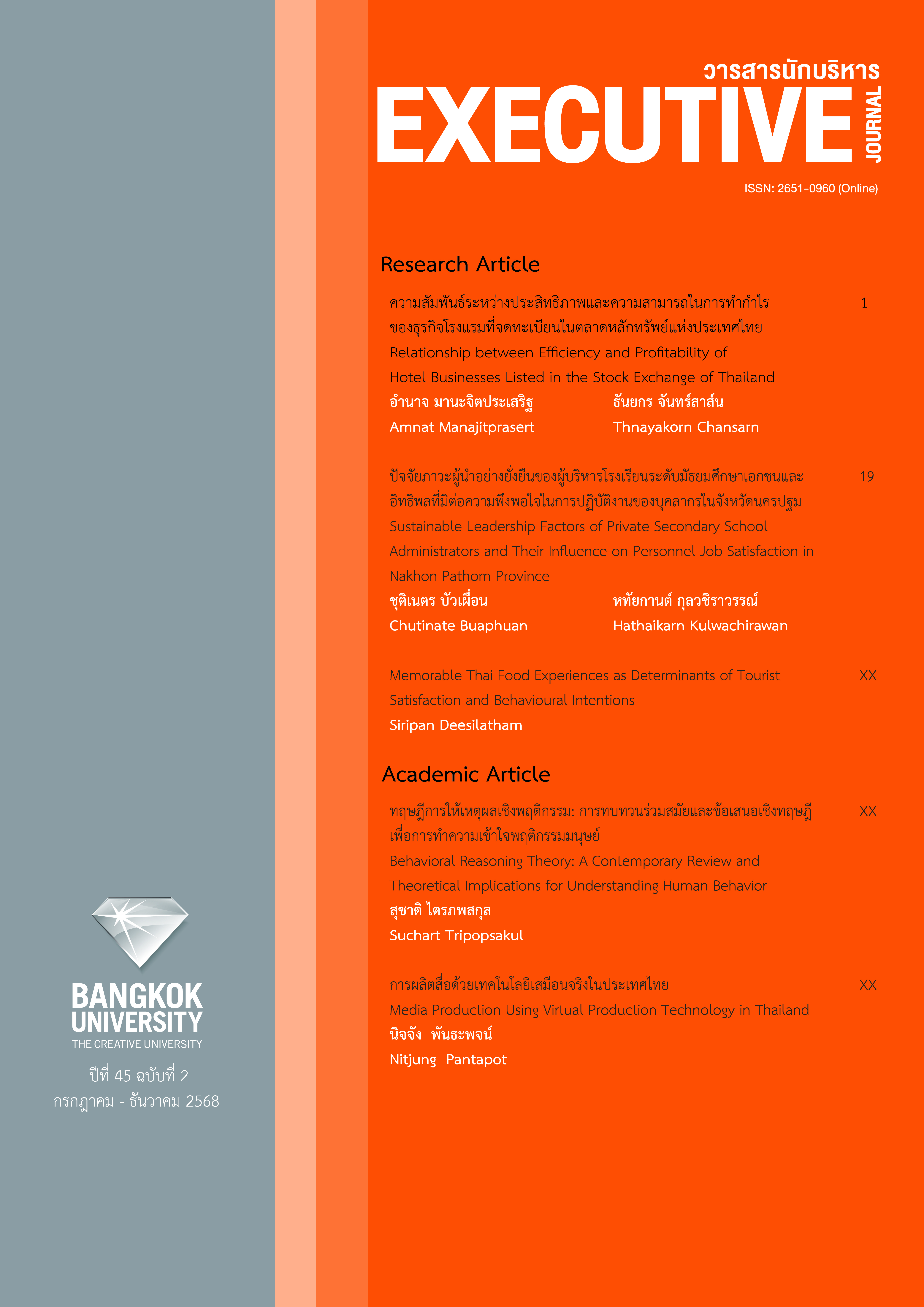
ทฤษฎีการให้เหตุผลเชิงพฤติกรรม: การทบทวนร่วมสมัยและข้อเสนอ เชิงทฤษฎีเพื่อการทำความเข้าใจพฤติกรรมมนุษย์
Article Sidebar
Main Article Content
บทคัดย่อ
นักจิตวิทยาและนักวิจัยด้านพฤติกรรมศาสตร์มีความพยายามมาโดยตลอดที่จะอธิบายและทำความเข้าใจสาเหตุของพฤติกรรมมนุษย์ ซึ่งถือเป็นโจทย์สำคัญของศาสตร์นี้มาเป็นเวลานาน ความพยายามดังกล่าวได้ก่อให้เกิดการพัฒนาแบบจำลองเชิงทฤษฎีหลากหลาย ทั้งที่อธิบายเชิงทัศนคติ บรรทัดฐานทางสังคม แรงจูงใจภายใน และการรับรู้การควบคุมพฤติกรรม โดยแบบจำลองเหล่านี้ เช่น ทฤษฎีการกระทำโดยใช้เหตุผล และทฤษฎีการวางแผนพฤติกรรม ต่างก็มีบทบาทสำคัญในการวางรากฐานความเข้าใจเกี่ยวกับกระบวนการตัดสินใจของมนุษย์ อย่างไรก็ตาม แบบจำลองเดิมยังมีข้อจำกัด เนื่องจากไม่ได้อธิบายอย่างชัดเจนถึงบทบาทของ “เหตุผล” ซึ่งเป็นสิ่งที่ผู้กระทำใช้ในการให้ความชอบธรรมหรือการปกป้องพฤติกรรมของตนเอง ด้วยเหตุนี้ ทฤษฎีการให้เหตุผลเชิงพฤติกรรม จึงถูกพัฒนาขึ้นเพื่อยกระดับศักยภาพในการอธิบายและทำนายพฤติกรรมมนุษย์
บทความฉบับนี้มีวัตถุประสงค์สองประการสำคัญ ประการแรก คือ การสังเคราะห์เนื้อหาหลักและพัฒนาการของทฤษฎีการให้เหตุผลเชิงพฤติกรรม เพื่อให้เห็นถึงจุดแข็งในการอธิบายกลไกการตัดสินใจและพฤติกรรมของมนุษย์ ประการที่สอง คือ การวิเคราะห์ข้อบกพร่องและช่องว่างที่ยังคงมีอยู่ในงานวิจัยปัจจุบัน โดยใช้กรอบมุมมอง 3 ด้าน ได้แก่ (1) การสร้างและพัฒนาทฤษฎีซึ่งยังต้องการการขยายตัวแปรใหม่ๆ เช่น อารมณ์ ความกลัว ความคาดหวังล่วงหน้า เข้าสู่แบบจำลอง (2) การพัฒนาวิธีวิจัยที่ควรเน้นการศึกษาติดตามเวลาและการใช้วิธีวิเคราะห์ขั้นสูงเพื่อความซับซ้อนของพฤติกรรม และ (3) การศึกษาข้ามวัฒนธรรมซึ่งยังคงมีน้อย โดยเฉพาะในประเทศกำลังพัฒนา รวมถึงสังคมเอเชียที่มีโครงสร้างค่านิยมแบบรวมหมู่ ซึ่งอาจสะท้อนกลไกการให้เหตุผลแตกต่างจากบริบทตะวันตก นอกจากนี้ บทความยังเสนอแนวทางการวิจัยในอนาคตที่สามารถขยายศักยภาพของทฤษฎีการให้เหตุผลเชิงพฤติกรรมได้มากยิ่งขึ้น เช่น การสร้างมาตรฐานเครื่องมือวัดเหตุผลเชิงสนับสนุนและเหตุผลเชิงคัดค้าน การผนวกปัจจัยระดับมหภาค เช่น วัฒนธรรม องค์การ และนโยบายสาธารณะ เข้าสู่แบบจำลอง และการเชื่อมโยงทฤษฎีการให้เหตุผลเชิงพฤติกรรมเข้ากับทฤษฎีอื่นๆ เช่น ทฤษฎีการยอมรับเทคโนโลยีหรือทฤษฎีการต่อต้านนวัตกรรมเพื่ออธิบายพฤติกรรมในโลกยุคดิจิทัลและนวัตกรรมที่เปลี่ยนแปลงอย่างรวดเร็ว
Article Details

อนุญาตภายใต้เงื่อนไข Creative Commons Attribution-NonCommercial-NoDerivatives 4.0 International License.
บทความที่นำมาสมัครลงตีพิมพ์ในวารสารต้องไม่เคยได้รับการตีพิมพ์เผยแพร่มาก่อน และไม่ส่งต้นฉบับบทความซ้ำซ้อนกับวารสารอื่น รวมทั้งผู้เขียนบทความต้องไม่ละเมิดหรือคัดลอกผลงานของผู้อื่น
เอกสารอ้างอิง
Ahmad, F., Driver, N., McNally, M. J., & Stewart, D. E. (2009). Why doesn’t she seek help for partner abuse? An exploratory study with South Asian immigrant women. Social Science & Medicine, 69(4), 613–622. https://doi.org/10.1016/j.socscimed.2009.06.011
Ahmad, N., & Rasheed, H. M. W. (2025). Tourism and hospitality SMEs and digital marketing: What factors influence their attitude and intention to use from the perspective of BRT, TAM and IRT. Journal of Hospitality and Tourism Insights, 8(4), 1546-1563. https://doi.org/10.1108/JHTI-05-2024-0508
Ajzen, I. (1985). From intentions to actions: A theory of planned behavior. In J. Kuhl, & J. Beckmann (Eds.), Action-control: From cognition to behavior (pp. 11–39). Springer.
Ajzen, I. (1991). The theory of planned behavior. Organizational Behavior and Human Decision Processes, 50(2), 179–211. https://doi.org/10.1016/0749-5978(91)90020-T
Ajzen, I. (2001). Nature and operation of attitudes. Annual Review of Psychology, 52, 27–58. https://doi.org/10.1146/annurev.psych.52.1.27
Ajzen, I. (2006). Constructing a theory of planned behavior questionnaire. http://people.umass.edu/aizen/pdf/tpb.measurement.pdf
Al-Qaysi, N., Al-Emran, M., Al-Sharafi, M. A., Iranmanesh, M., Ahmad, A., & Mahmoud, M. A. (2024). Determinants of ChatGPT use and its impact on learning performance: An integrated model of BRT and TPB. International Journal of Human–Computer Interaction, 41(9), 5462-5474. https://doi.org/10.1080/10447318.2024.2361210
Bagozzi, R. P., Wong, N., Abe, S., & Bergami, M. (2000). Cultural and situational contingencies and the theory of reasoned action: Application to fast food restaurant consumption. Journal of Consumer Psychology, 9(2), 97–106. https://doi.org/10.1207/S15327663JCP0902_4
Bamberg, S., Ajzen, I., & Schmidt, P. (2003). Choice of travel mode in the theory of planned behavior: The roles of past behavior, habit, and reasoned action. Basic and Applied Social Psychology, 25(3), 175–187. https://doi.org/10.1207/S15324834BASP2503_01
Chahua-Huaqui, N., Del-Aguila-Arcentales, S., Quispe-Presentación, J., & Ruiz-Cordero, A. (2025). Innovation of food delivery: Acceptance of drone use among consumers in Peru based on TAM and BRT. Sustainable Futures, 10, 101038. https://doi.org/10.1016/j.sftr.2025.101038
Cialdini, R. B., Kallgren, C. A., & Reno, R. R. (1991). A focus theory of normative conduct: A theoretical refinement and reevaluation of the role of norms in human behavior. Advances in Experimental Social Psychology, 24, 201–234. https://doi.org/10.1016/S0065-2601(08)60330-5
Duan, W. T., & Jiang, G. R. (2008). A review of the theory of planned behavior. Advances in Psychological Science, 16(2), 315-320. https://journal.psych.ac.cn/adps/EN/Y2008/V16/I02/315
Fishbein, M. (1963). An investigation of the relationships between beliefs about an object and the attitude toward that object. Human Relations, 16(3), 233–240. https://doi.org/10.1177/001872676301600302
Fishbein, M., & Ajzen, I. (1975). Belief, attitude, intention, and behavior: An introduction to theory and research. Addison-Wesley. https://people.umass.edu/aizen/f&a1975.html
Fitzmaurice, J. (2005). Incorporating consumers’ motivations into the theory of reasoned action. Psychology & Marketing, 22(11), 911–929. https://doi.org/10.1002/mar.20090
Hassan, L. M., Shiu, E., & Parry, S. (2015). Addressing the cross‐country applicability of the theory of planned behaviour (TPB): A structured review of multi‐country TPB studies. Journal of Consumer Behaviour, 15(1), 72–86. https://doi.org/10.1002/cb.1536
Lee, C., & Green, R. T. (1991). Cross-cultural examination of the Fishbein behavioral intentions model. Journal of International Business Studies, 22(2), 289–305. https://www.jstor.org/stable/155211
Prathansong, N., & Kananurak, N. (2023). Reason (for and against) consumers affecting organic product purchase intention: Bangkok, Thailand. Journal of Family Business and Management Studies, 15(1), 103–126. https://doi.org/10.14456/fbms.2023.6
Perugini, M., & Bagozzi, R. P. (2001). The role of desires and anticipated emotions in goal-directed behaviours. British Journal of Social Psychology, 40(1), 79–98. https://doi.org/10.1348/014466601164704
Song, Z., Ren, Y., & Li, J. (2024). Exploring factors affecting millennial Tourists’ eWOM behavior: A lens of BRT theory. Behavioral Sciences, 14(11), 1056. https://doi.org/10.3390/bs14111056
Tripopsakul, S. (2025). Entrepreneurial intentions: Analyzing sociocultural and perceptual influences using the theory of planned behavior. International Review of Management and Marketing, 15(3), 98-106. https://doi.org/10.32479/irmm.17947
Turner, P., & Ireland, J. L. (2011). Officer attitudes towards intra-group aggression in young people and young adults: Does the reported motivation an aggressor impact on intervention and support?. International Journal of Law and Psychiatry, 34(4), 309–316. https://doi.org/10.1016/j.ijlp.2011.08.010
Van Hooft, E. A. J., Born, M. P., Taris, T. W., van der Flier, H., & Blonk, R. W. B. (2004). Predictors of job search behavior among employed and unemployed people. Personnel Psychology, 57(1), 25–59. https://doi.org/10.1111/j.1744-6570.2004.tb02483.x
Warshaw, P. R., & Davis, F. D. (1985). Disentangling behavioral intention and behavioral expectation. Journal of Experimental Social Psychology, 21(3), 213–228. https://doi.org/10.1016/0022-1031(85)90017-4
Westaby, J. D. (2005). Behavioral reasoning theory: Identifying new linkages underlying intentions and behavior. Organizational Behavior and Human Decision Processes, 98(2), 97–120. https://doi.org/10.1016/j.obhdp.2005.07.003
Westaby, J. D., Probst, T. M., & Lee, B. C. (2010). Leadership decision-making: A behavioral reasoning theory analysis. The Leadership Quarterly, 21(3), 481–495. https://doi.org/10.1016/j.leaqua.2010.03.011
Yadav, R., Giri, A., & Chatterjee, S. (2022). Understanding the users' motivation and barriers in adopting healthcare apps: A mixed-method approach using behavioral reasoning theory. Technological Forecasting and Social Change, 183, 121932. https://doi.org/10.1016/j.techfore.2022.121932
