
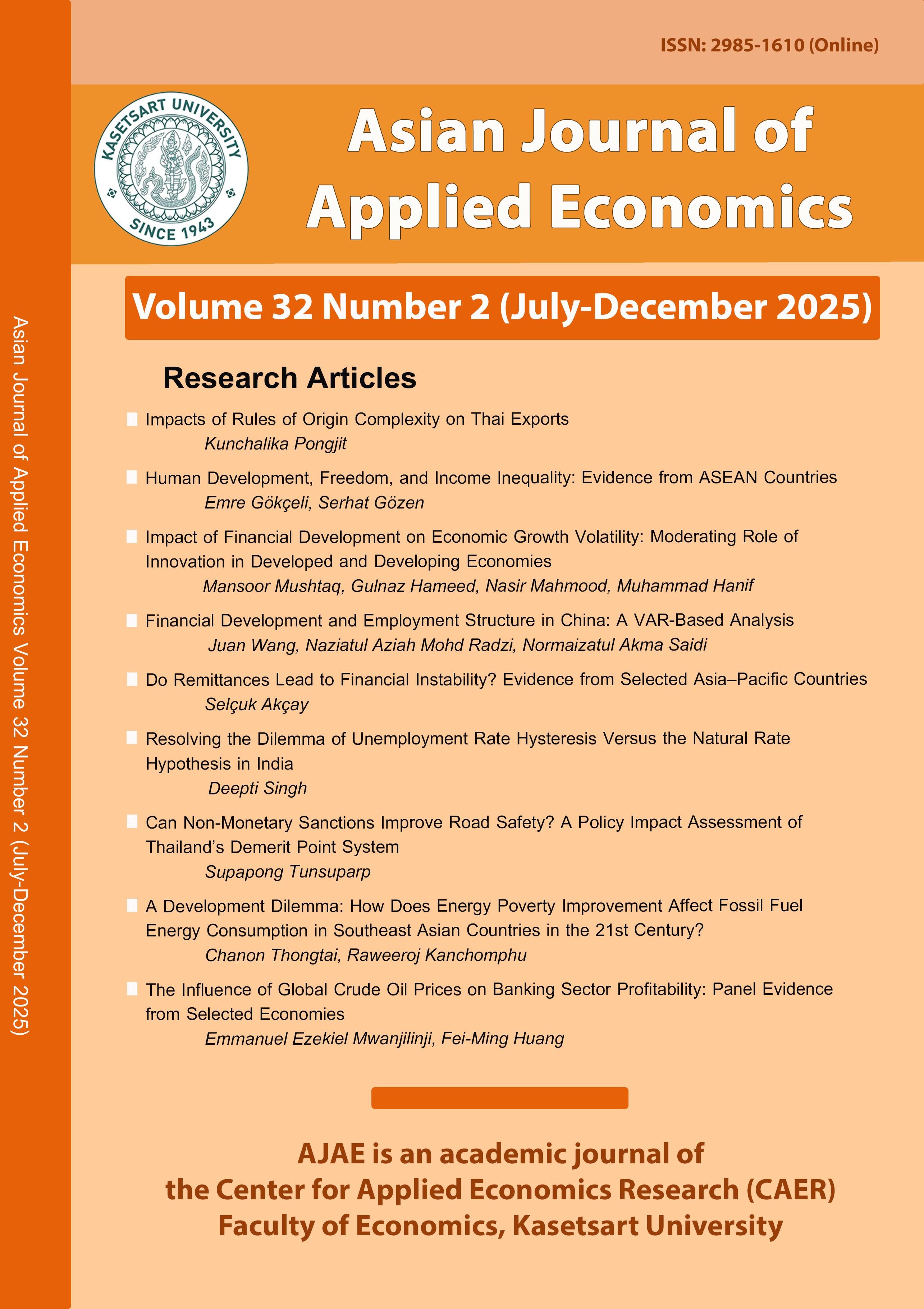
Impact of Financial Development on Economic Growth Volatility: Moderating Role of Innovation in Developed and Developing Economies
Article Sidebar
Main Article Content
Abstract
While financial development has contributed to higher economic growth, it has also influenced the volatility of that growth. Numerous studies have investigated the impact of financial development on economic growth volatility, yielding ambiguous results. Additionally, innovation has emerged as a significant determinant of growth volatility. This study explores the relationship between financial development and economic growth volatility within the context of innovation, using panel data from 1996 to 2022 for both developed and developing countries. The Generalized Method of Moments (GMM) is employed as the estimation technique. The findings reveal that, when accounting for innovation, financial development negatively affects growth volatility in both developed and developing nations. Furthermore, inflation is found to increase economic growth volatility across both panels. Government spending reduces growth volatility in developed countries but exacerbates it in developing ones. Institutional quality either positively influences or has an insignificant effect on growth volatility in developing countries, whereas it contributes to reducing volatility in developed economies. The study underscores the importance of leveraging a combination of innovation and financial development to mitigate economic growth volatility.
Article Details

This work is licensed under a Creative Commons Attribution-NonCommercial-NoDerivatives 4.0 International License.
The paper is published under CC BY-NC-ND, in which the article is freely downloaded and shared in its original form non-commercially and its citation details are identified.
References
Abanikanda, E. O., & Dada, J. T. (2024). External shocks and macroeconomic volatility in Nigeria: Does financial development moderate the effect? PSU Research Review, 8(3), 828–844.
Abdelaoui, T. M. L., & Abdelaoui, O. (2020). The impact of innovation on economic development in Arab countries: The case of selected Arab countries from 2007 to 2016. Journal of African Economies, 16, 33–54.
Acemoglu, D., Johnson S., & Robinson, J. A. (2005). Institutions as a fundamental cause of growth. In P. Aghion & S. N. Durlauf (Eds.), Handbook of economic growth (Vol. 1, pp. 386–454). North-Holland.
Aghion, P., Bloom, N., Blundell, R., Griffith, R., & Howitt, P. (2005). Competition and innovation: An inverted-U relationship. The Quarterly Journal of Economics, 120(2), 701–728.
Ajide, K. B., Raheem, I. D., & Adeniyi, O. (2015). Output growth volatility, remittances and institutions. International Journal of Development Issues, 14(3), 190–203.
Arcand, J. L., Berkes, E., & Panizza, U. (2015). Too much finance? Journal of Economic Growth, 20, 105–148.
Avom, D., Kamguia, B., Ngameni, J. P., & Njangang, H. (2021). How does terms of trade volatility affect macroeconomic volatility? The roles of financial development and institutions. International Economics, 168, 98–114.
Awan, A., Asghar, N., & Rehman, H. U. (2021). The impact of financial globalization on output volatility: Panel data evidence for Asian countries. Pakistan Journal of Commerce and Social Sciences (PJCSS), 15(1), 213–239.
Beck, T., Degryse, H., & Kneer, C. (2014). Is more finance better? Disentangling intermediation and size effects of financial systems. Journal of Financial Stability, 10, 50–64.
Bezooijen, E., & Bikker, J. A. (2017). Financial structure and macroeconomic volatility: A panel data analysis [DNB Working Paper No. 568]. Utrecht University; De Nederlandsche Bank.
Cavoli, T., Gopalan, S., & Rajan, R. S. (2020). Does financial inclusion amplify output volatility in emerging and developing economies? Open Economies Review, 31(4), 901–930.
Dynan, K. E., Elmendorf, D. W., & Sichel, D. E. (2006). Can financial innovation help to explain the reduced volatility of economic activity? Journal of Monetary Economics, 53(1), 123–150.
Ehigiamusoe, K. U., & Samsurijan, M. S. (2021). What matters for finance-growth nexus? A critical survey of macroeconomic stability, institutions, financial and economic development. International Journal of Finance & Economics, 26(4), 5302–5320.
Fagiolo, G., Giachini, D., & Roventini, A. (2020). Innovation, finance, and economic growth: An agent-based approach. Journal of Economic Interaction and Coordination, 15, 703–736.
Galeano, L., Izquierdo, A., Puig, J. P., Vegh, C. A., & Vuletin, G. (2021). Can automatic government spending be procyclical? (No. 28521). National Bureau of Economic Research.
Ghosh, P., & Adhikary, M. (2023). Dynamicity and nonlinearity in the association between different facets of financial development and macroeconomic volatility: Evidence from the world economy. International Review of Applied Economics, 37(6),745-766.
Gopalan, S., & Rajan, R. S. (2022). Does digital financial inclusion moderate or exacerbate output volatility? Applied Economics Letters, 29(19), 1804–1809.
Hall, R. E., & Jones, C. I. (1999). Why do some countries produce so much more output per worker than others? The Quarterly Journal of Economics, 114(1), 83–116.
Ibrahim, M. H., Law, S. H., & Sukmana, R. (2024). Finance and output volatility during the global financial crisis. Muslim Business and Economics Review, 3(1), 1–31.
Iftikhar, S. F., & Abbas, W. (2016). Does financial development volatility affect growth volatility of industries in Pakistan? Econometrics Letters, 3(2), 15–27.
Iwasaki, I., Kočenda, E., & Shida, Y. (2022). Institutions, financial development, and small business survival: Evidence from European emerging markets. Small Business Economics, 58, 1261–1283.
Kaffenberger, M. (2020). Modelling the long-run learning impact of the Covid-19 learning shock: Actions to (more than) mitigate loss. International Journal of Educational Development, 81, 102326.
Kapingura, F. M., Mkosana, N., & Kusairi, S. (2022). Financial sector development and macroeconomic volatility: Case of the Southern African Development Community region. Cogent Economics & Finance, 10(1), 2038861.
Kpodar, K. R., Le Goff, M., & Singh, R. J. (2019). Financial deepening, terms of trade shocks and growth in low-income countries (IMF Working Paper No. 2019/068). International Monetary Fund.
Levine, O., & Warusawitharana, M. (2021). Finance and productivity growth: Firm-level evidence. Journal of Monetary Economics, 117, 91–107.
Levine, R. (2005). Finance and growth: Theory and evidence. Handbook of Economic Growth, 1, 865–934.
Levine, R., Lin, C., & Wei, L. (2017). Insider trading and innovation. The Journal of Law and Economics, 60(4), 749–800.
Mohamed, M. M. A., Liu, P., & Nie, G. (2022). Causality between technological innovation and economic growth: Evidence from the economies of developing countries. Sustainability, 14(6), 3586.
Mulugeta, E. T. (2024). Output growth volatility, remittances, and financial development in the Common Market for Eastern and Southern Africa Region: A system generalized method of moments approach. Journal of the Knowledge Economy, 5, 1–17.
Nguyen, T. P., Dinh, T. T. H., Tran Ngoc, T., & Duong Thi Thuy, T. (2022). Impact of ICT diffusion on the interaction of growth and its volatility: Evidence from cross-country analysis. Cogent Business & Management, 9(1), 2054530.
Oro, O. U., & Alagidede, I. P. (2019). The non-linear relationship between financial development, economic growth and growth volatility: Evidence from Nigeria. African Review of Economics and Finance, 11(2), 67–97.
Penzin, D. J., Isah, K. O., & Salisu, A. A. (2025). Climate change-stock return volatility nexus in advanced economies: The role of technology shocks. Journal of Economic Studies, 52(1), 119–135.
Roodman, D. (2009). How to do xtabond2: An introduction to difference and system GMM in Stata. The Stata Journal, 9(1), 86–136.
Sahay, R., Čihák, M., N’Diaye, P., Barajas, A., Bi, R., Ayala, D., ... & Yousefi, S. R. (2015). Rethinking financial deepening: Stability and growth in emerging markets. Revista de Economía Institucional, 17(33), 73–107.
Schumpeter, J. A. (1934). The theory of economic development: An inquiry into profits, capital, credit, interest, and the business cycle (R. Opie, Trans.). Cambridge, MA: Harvard University Press. (Original work published 1911).
Shleifer, A., & Vishny, R. W. (2010). Unstable banking. Journal of Financial Economics, 97(3), 306–318.
Stiglitz, J. E. (2015). Macroeconomic fluctuations, inequality, and human development. In D. Nayyar (Ed.), Macroeconomics and human development (pp. 31–58). Routledge.
Tang, C. F., & Abosedra, S. (2020). Does financial development moderate the effects on growth volatility? The experience of Malaysia. Margin: The Journal of Applied Economic Research, 14(4), 361–381.
Tang, S. H. K. (2018). Does scientific and technical research reduce macroeconomic volatility? Bulletin of Economic Research, 70(1), 68–88.
Verma, A., Dandgawhal, P. S., & Giri, A. K. (2023). Impact of ICT diffusion and financial development on economic growth in developing countries. Journal of Economics, Finance and Administrative Science, 28(55), 27–43.
