
Peer Review Process
All manuscripts submitted to Asian Journal of Applied Economics (AJAE) undergo a rigorous double-blind peer review process to ensure academic quality, originality, and ethical integrity. Each submission is initially screened by the Editor-in-Chief or Handling Editor for relevance to the journal’s aims and scope, academic merit, and compliance with submission and ethical guidelines. Manuscripts that pass this stage are reviewed by at least two independent external reviewers with relevant subject-matter expertise. The final editorial decision is based on the reviewers’ reports. Accepted manuscripts subsequently undergo professional copyediting and proofreading prior to online publication.
The peer review workflow is summarized in the flowchart below.
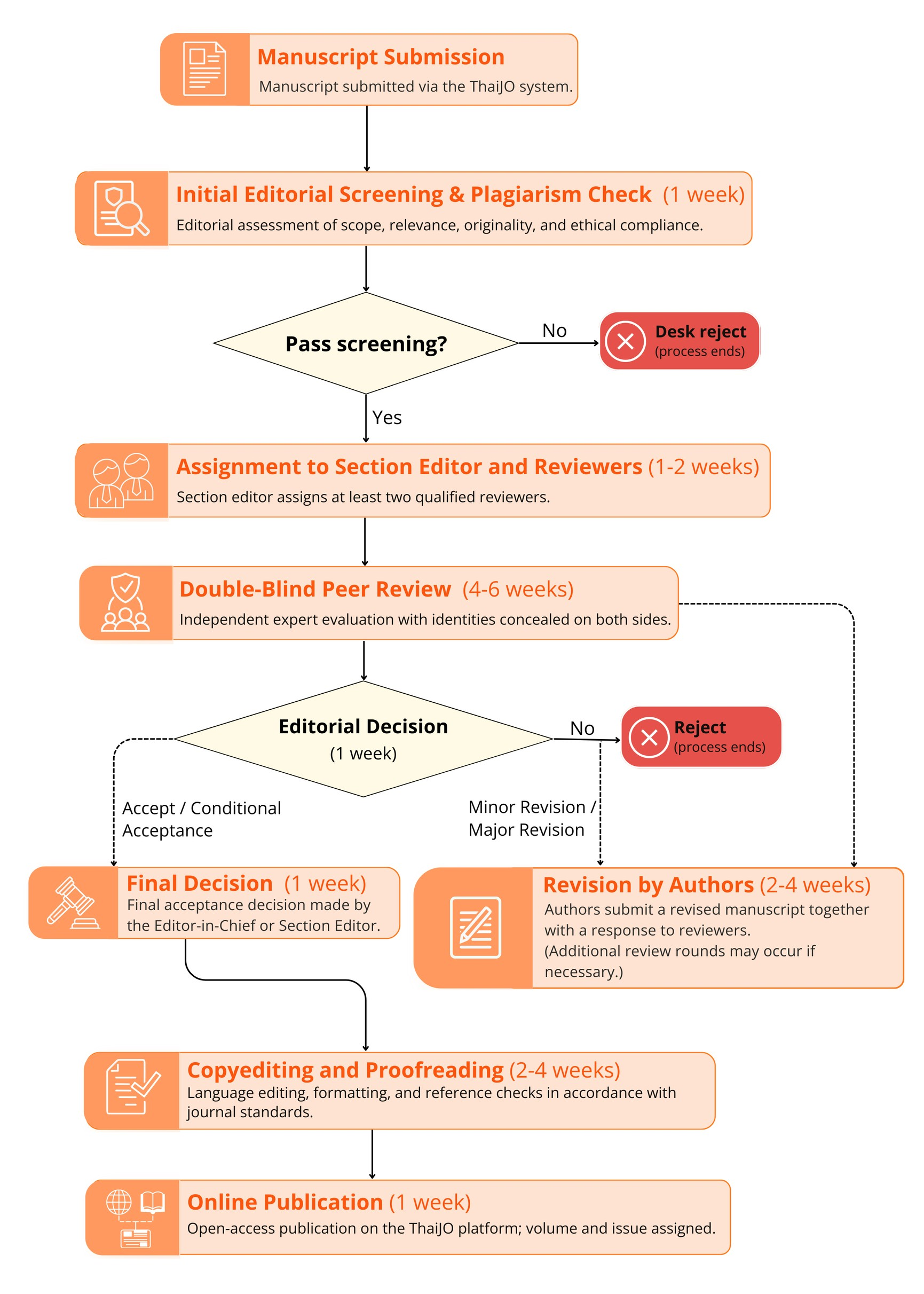
Detailed Review Steps and Timeline
- Step 1: Manuscript Submission
- Authors submit their manuscripts through the ThaiJO online submission system. Authors must ensure that all submission requirements, including the Cover Letter and ORCID iDs, are met at this stage.
- Step 2: Initial Editorial Screening & Plagiarism Check (1 week)
- The Editor-in-Chief or Handling Editor conducts an initial screening to assess relevance, academic quality, and methodological soundness.
- Plagiarism Screening: All manuscripts are screened using professional software (e.g., Turnitin) to ensure originality. Manuscripts that do not meet these criteria or fail the plagiarism check may be desk rejected.
- Step 3: Assignment to Section Editor and Reviewers (1–2 weeks)
- Manuscripts that pass initial screening are assigned to a Section Editor specializing in the relevant sub-field, who then invites at least two independent external reviewers.
- Step 4: Double-Blind Peer Review (4–6 weeks)
- AJAE utilizes a double-blind system where reviewers and authors remain anonymous to each other. Reviewers evaluate the manuscript based on scholarly contribution, theory, methodology, data analysis, and policy relevance.
- Step 5: Editorial Decision (1 week)
- The Section Editor, in consultation with the Editor-in-Chief, makes one of the following decisions: Accept, Minor Revision, Major Revision, or Reject.
- Conditional Acceptance: Note that manuscripts are often accepted in principle, provided that authors strictly adhere to all final technical and formatting requirements (e.g., APA 7th Edition compliance, high-resolution figures, and metadata accuracy). Failure to meet these technical standards may result in the withdrawal of the acceptance decision.
- Step 6: Revision by Authors (2–4 weeks)
- Authors must submit a revised manuscript and a point-by-point response to reviewers’ comments. Major revisions may undergo a second round of review.
- Step 7: Final Decision (1 week)
- The final publication decision is made by the Editor-in-Chief, based solely on academic merit and the quality of the revisions.
- Step 8: Copyediting and Proofreading (2–4 weeks)
- Accepted manuscripts undergo scientific and language editing, formatting, and layout preparation.
- Technical Compliance Check: Authors must cooperate fully with the editorial team. The journal reserves the right to rescind the acceptance decision or delay publication if authors fail to comply with mandatory technical standards (e.g., APA 7th formatting, figure clarity, and providing original data files upon request).
- Step 9: Online Publication (1 week)
- The final article is published online and made Open Access via the ThaiJO platform.
Estimated Turnaround Time
The total time from initial submission to online publication is approximately 14–22 weeks, depending on the number of revision cycles and the authors' responsiveness to technical requirements.
