
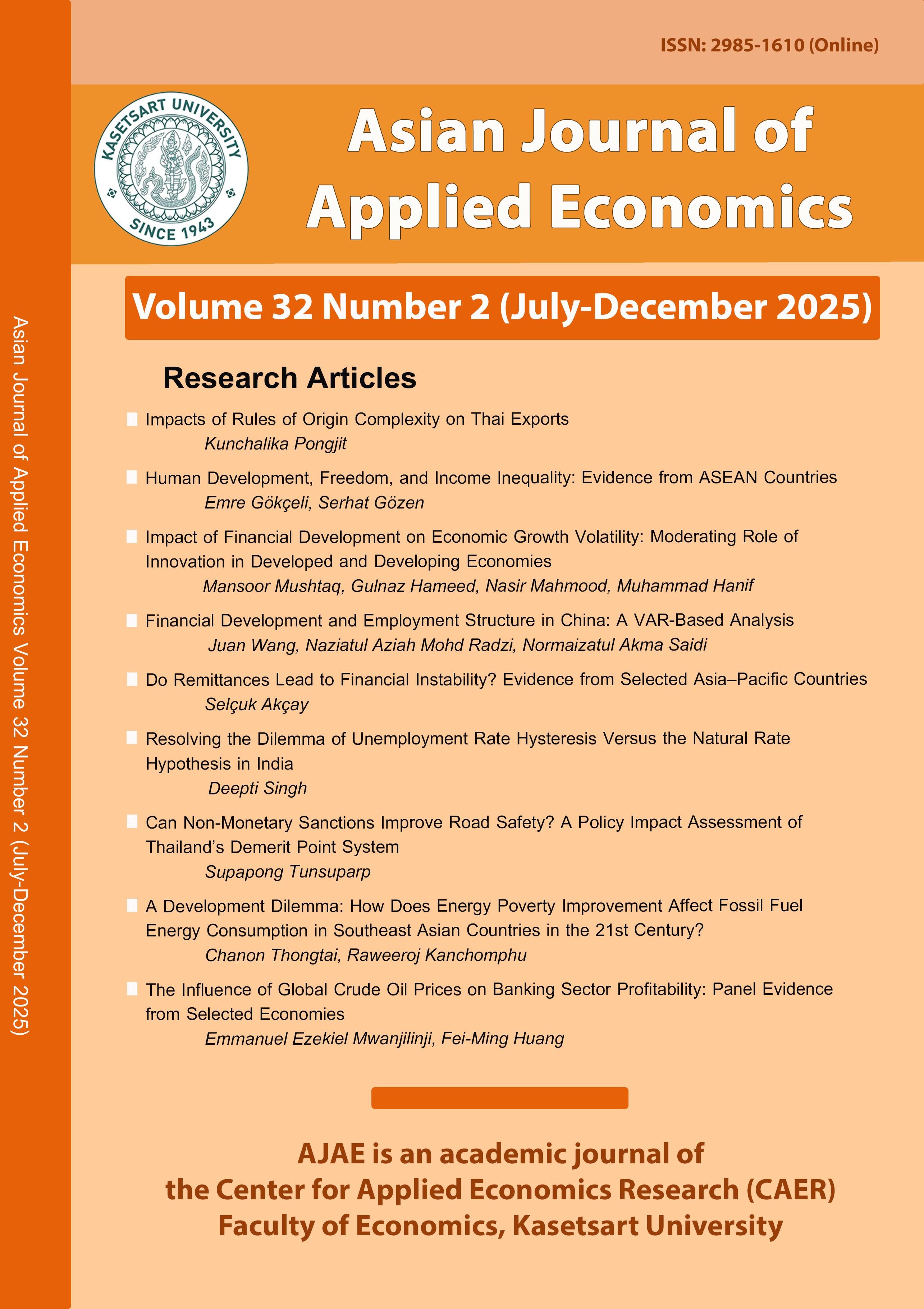
The Influence of Global Crude Oil Prices on Banking Sector Profitability: Panel Evidence from Selected Economies
Article Sidebar
Main Article Content
Abstract
This study investigates the impact of global crude oil prices on banking sector profitability in 16 selected economies from 2000 to 2021. Using panel Autoregressive Distributed Lag (ARDL) analysis, the study explores both long-run and short-run relationships, incorporating GDP growth, inflation, and real interest rates as control variables. The results reveal a weak but positive long-term association between oil prices and bank profitability, while GDP growth significantly enhances profitability, and inflation exerts a negative effect. Real interest rates also show a positive influence. In the short run, none of the macroeconomic variables exhibit statistically significant effects. The findings suggest that macroeconomic stability—particularly sustained growth and inflation control—is essential for long-term banking sector performance. Policymakers and financial institutions should consider structural drivers and adopt strategies that enhance resilience to commodity price volatility.
Article Details

This work is licensed under a Creative Commons Attribution-NonCommercial-NoDerivatives 4.0 International License.
The paper is published under CC BY-NC-ND, in which the article is freely downloaded and shared in its original form non-commercially and its citation details are identified.
References
Aizenman, J., Cheung, Y.-W., & Ito, H. (2019). The interest rate effect on private saving: Alternative perspectives. Journal of International Commerce, Economics and Policy, 10(01), 1950002.
Albertazzi, U., & Gambacorta, L. (2009). Bank profitability and the business cycle. Journal of Financial Stability, 5(4), 393–409.
Al-Harthy, L. S. H., Jalagat, Jr., R., & Sayari, K. (2021). Determinants of bank profitability during oil price decline. International Journal of Research in Business and Social Science, 10(8), 200–217.
Al-Khazali, O. M., & Mirzaei, A. (2017). The impact of oil price movements on bank non-performing loans: Global evidence from oil-exporting countries. Emerging Markets Review, 31, 193–208.
Almaqtari, F. A., Al-Homaidi, E. A., Tabash, M. I., & Farhan, N. H. (2019). The determinants of profitability of Indian commercial banks: A panel data approach. International Journal of Finance & Economics, 24(1), 168–185.
Alqahtani, F., Samargandi, N., & Kutan, A. M. (2020). The influence of oil prices on the banking sector in oil-exporting economies: Is there a psychological barrier? International Review of Financial Analysis, 69, 101470.
Alquist, R., & Kilian, L. (2010). What do we learn from the price of crude oil futures? Journal of Applied Econometrics, 25(4), 539–573.
Athanasoglou, P. P., Brissimis, S. N., & Delis, M. D. (2008). Bank-specific, industry-specific and macroeconomic determinants of bank profitability. Journal of International Financial Markets, Institutions and Money, 18(2), 121–136.
Barsky, R. B., & Kilian, L. (2002). Oil and the macroeconomy since the 1970s. Journal of Economic Perspectives, 18(4), 115–134.
Basher, S. A., & Sadorsky, P. (2006). Oil price risk and emerging stock markets. Global Finance Journal, 17(2), 224–251.
Baumeister, C., & Kilian, L. (2016). Lower oil prices and the U.S. economy: Is this time different? Brookings Papers on Economic Activity, 2016(2), 287–357.
Bernanke, B. S. (1983). Irreversibility, uncertainty, and cyclical investment. The Quarterly Journal of Economics, 98(1), 85–106.
Bernanke, B. S., Gertler, M., Watson, M., Sims, C. A., & Friedman, B. M. (1997). Systematic monetary policy and the effects of oil price shocks. Brookings Papers on Economic Activity, 1997(1), 91–157.
Blackburne III, E. F., & Frank, M. W. (2007). Estimation of nonstationary heterogeneous panels. The Stata Journal: Promoting Communications on Statistics and Stata, 7(2), 197–208.
Blanchard, O. J., & Gali, J. (2007). The macroeconomic effects of oil shocks: Why are the 2000s so different from the 1970s? (NBER Working Paper No. 13368). Cambridge, MA: National Bureau of Economic Research.
Borio, C., Gambacorta, L., & Hofmann, B. (2017). The influence of monetary policy on bank profitability. International Finance, 20(1), 48–63.
Bouri, E., Gupta, R., Hosseini, S., & Lau, C. K. M. (2018). Does global fear predict fear in BRICS stock markets? Evidence from a Bayesian Graphical Structural VAR model. Emerging Markets Review, 34, 124–142.
Bouzidi, F. M., Nefzi, A. A., & Al Yousif, M. (2024). Impact of international oil price shocks and inflation on bank efficiency and financial stability: Evidence from Saudi Arabian banking sector. Journal of Risk and Financial Management, 17(12), 543.
Boyd, J. H., Levine, R., & Smith, B. D. (2001). The impact of inflation on financial sector performance. Journal of Monetary Economics, 47(2), 221–248.
Brei, M., Gadanecz, B., & Mehrotra, A. (2020). SME lending and banking system stability: Some mechanisms at work. Emerging Markets Review, 43, 100676.
Büyükşahin, B., & Robe, M. A. (2014). Speculators, commodities and cross-market linkages. Journal of International Money and Finance, 42, 38–70.
Christiano, L. J., Eichenbaum, M., & Evans, C. L. (2005). Nominal rigidities and the dynamic effects of a shock to monetary policy. Journal of Political Economy, 113(1), 1–45.
Corden, W. M., & Neary, J. P. (1982). Booming sector and de-industrialisation in a small open economy. The Economic Journal, 92(368), 825–848.
Cunado, J., & de Gracia, F. P. (2005). Oil prices, economic activity and inflation: Evidence for some Asian countries. The Quarterly Review of Economics and Finance, 45(1), 65–83.
Demirgüç-Kunt, A., & Huizinga, H. (1999). Determinants of commercial bank interest margins and profitability: Some international evidence. The World Bank Economic Review, 13(2), 379-408.
Dery, C., & Serletis, A. (2024). Business cycles in the USA: The role of monetary policy and oil shocks. Empirical Economics, 67(1), 1–30.
Diamond, D. W., & Dybvig, P. H. (1983). Bank runs, deposit insurance, and liquidity. Journal of Political Economy, 91(3), 401–419.
Dietrich, A., & Wanzenried, G. (2011). Determinants of bank profitability before and during the crisis: Evidence from Switzerland. Journal of International Financial Markets, Institutions and Money, 21(3), 307–327.
Dima, B., & Opris, P. E. (2013). Financial intermediation and economic growth. Timisoara Journal of Economics and Business, 6(20), 127–136.
El-Ansary, O., & Rashwan, M. M. (2020). Introducing financial inclusion to MENA Islamic-banks profitability determinants. Corporate Ownership and Control, 18(1, Special Issue), 242–260.
El-Chaarani, H. (2019). The impact of oil prices on the financial performance of banking sector in Middle East region. International Journal of Energy Economics and Policy, 9(5), 148–156.
Elsayed, A. H., Naifar, N., Uddin, G. S., & Wang, G.-J. (2023). Multilayer information spillover networks between oil shocks and banking sectors: Evidence from oil-rich countries. International Review of Financial Analysis, 87, 102602.
Esmaeil, J., Rjoub, H., & Wong, W.-K. (2020). Do oil price shocks and other factors create bigger impacts on Islamic banks than conventional banks? Energies, 13(12), 3106.
Fattouh, B., Kilian, L., & Mahadeva, L. (2013). The role of speculation in oil markets: What have we learned so far? The Energy Journal, 34(3), 7–33.
Filis, G., Degiannakis, S., & Floros, C. (2011). Dynamic correlation between stock market and oil prices: The case of oil-importing and oil-exporting countries. International Review of Financial Analysis, 20(3), 152–164.
Fraumeni, B. M. (2022). Gross domestic product: Are other measures needed? IZA World of Labor, 368(2). Retrieved from https://wol.iza.org/articles/gross-domestic-product-are-other-measures-needed
Garzon, A. J., & Hierro, L. A. (2021). Asymmetries in the transmission of oil price shocks to inflation in the eurozone. Economic Modelling, 105, 105665.
Hamilton, J. D. (1983). Oil and the macroeconomy since World War II. Journal of Political Economy, 91(2), 228–248.
Hamilton, J. D. (2009a). Causes and consequences of the oil shock of 2007-08 (NBER Working Paper No. 15002). Cambridge, MA: National Bureau of Economic Research.
Hamilton, J. D. (2009b). Understanding crude oil prices. The Energy Journal, 30(2), 179-206.
Hooker, M. A. (2002). Are oil shocks inflationary? Asymmetric and nonlinear specifications versus changes in regime. Journal of money, credit and banking, 34(2),540-561.
Hooshyari, N., & Moghanloo, A. P. (2015). Evaluating the impact of inflation on profitability of banks. Arabian Journal of Business and Management Review (Kuwait Chapter), 4(9), 19–23.
Im, K. S., Pesaran, M. H., & Shin, Y. (2003). Testing for unit roots in heterogeneous panels. Journal of Econometrics, 115(1), 53–74.
Jones, D. W., Leiby, P. N., & Paik, I. K. (2004). Oil price shocks and the macroeconomy: What has been learned since 1996. The Energy Journal, 25(2), 1–32.
Kang, W., Ratti, R. A., & Yoon, K. H. (2015). The impact of oil price shocks on the stock market return and volatility relationship. Journal of International Financial Markets, Institutions and Money, 34, 41–54.
Katırcıoglu, S., Ozatac, N., & Taspınar, N. (2018). The role of oil prices, growth and inflation in bank profitability. The Service Industries Journal, 40(7–8), 565–584.
Khairullah, A. H., & Rosita, S. (2022). Theoretical study of Indian banking system. Journal of Social Commerce, 2(1), 42–46.
Kilian, L. (2008). The economic effects of energy price shocks. Journal of Economic Literature, 46(4), 871–909.
Kilian, L., & Murphy, D. P. (2012). Why agnostic sign restrictions are not enough: Understanding the dynamics of oil market VAR models. Journal of the European Economic Association, 10(5), 1166–1188.
Kilian, L., & Park, C. (2009). The impact of oil price shocks on the U.S. stock market. International Economic Review, 50(4), 1267–1287.
Killins, R. N., & Mollick, A. V. (2020). Performance of Canadian banks and oil price movements. Research in International Business and Finance, 54, 101258.
Caliskan, M. M. T., & Lecuna, H. K. S. (2020). The determinants of banking sector profitability in Turkey. Business and Economics Research Journal, 11(1), 161–167.
Komlichenko, O. O., & Rotan, N. (2021). Loan portfolio structure model and its impact on the bank’s efficiency. Odessa National University Herald. Economy, 26(3(88)), 103–110.
Koppány, K., Vakhal, P., & Pusztai, P. (2023). Hungary’s inflationary exposures to global price movements. Society and Economy, 45(3), 186–207.
Köse, N., & Ünal, E. (2021). The effects of the oil price and oil price volatility on inflation in Turkey. Energy, 226, 120392.
Kudabayeva, L., Abubakirova, A., Zurbayeva, A., Mussaeva, G., & Chimgentbayeva, G. (2024). The relationship between oil prices and inflation in oil importing countries (1980–2022). International Journal of Energy Economics and Policy, 14(1), 359–364.
Kutu, A. A., & Ohonba, A. (2024). The impact of crude oil price fluctuation on revenue generation in the oil dependent economy: Nigeria. International Journal of Energy Economics and Policy, 14(5), 181–190.
LeBlanc, M., & Chinn, M. D. (2004). Do high oil prices presage inflation? The evidence from G-5 countries. (UC Santa Cruz Economics Working Paper No. 561; SCCIE Working Paper No. 04-04). University of California, Santa Cruz.
Lee, C.-C., & Lee, C.-C. (2019). Oil price shocks and Chinese banking performance: Do country risks matter? Energy Economics, 77, 46–53.
Little, R. J., & Rubin, D. B. (2019). Statistical analysis with missing data. (3rd ed.). Hoboken, NJ: John Wiley & Sons.
Lorusso, M., & Pieroni, L. (2018). Causes and consequences of oil price shocks on the UK economy. Economic Modelling, 72, 223–236.
Marchenko, O. V., Petrykiva, O. S., & Korobko, K. O. (2022). Minimizing credit risk and improving the quality of the bank’s loan portfolio. Business Inform, 11(538), 205–210.
Mirovic, V., Kalas, B., Djokic, I., Milicevic, N., Djokic, N., & Djakovic, M. (2023). Green loans in bank portfolio: Financial and marketing implications. Sustainability, 15(7), 5914.
Mohammed, J. I., Karimu, A., Fiador, V. O., & Abor, J. Y. (2020). Oil revenues and economic growth in oil-producing countries: The role of domestic financial markets. Resources Policy, 69, 101832.
Mohanty, S. K., Nandha, M., Turkistani, A. Q., & Alaitani, M. Y. (2011). Oil price movements and stock market returns: Evidence from Gulf Cooperation Council (GCC) countries. Global Finance Journal, 22(1), 42–55.
Montoro, C. (2012). Oil shocks and optimal monetary policy. Macroeconomic Dynamics, 16(2), 240-277.
Musa, K. S., Maijama’a, R., Shaibu, H. U., & Muhammad, A. (2019). Crude oil price and exchange rate on economic growth: ARDL approach. Open Access Library Journal, 6, e05930.
Nitami, S. A., & Hayati, B. (2021). Relationship between crude oil price fluctuations, economic growth, inflation, and exchange rate in Indonesia 1967–2019. AFEBI Economic and Finance Review, 6(2), 83–97.
Papapetrou, E. (2001). Oil price shocks, stock market, economic activity and employment in Greece. Energy Economics, 23(5), 511–532.
Pedroni, P. (1999). Critical values for cointegration tests in heterogeneous panels with multiple regressors. Oxford Bulletin of Economics and Statistics, 61(S1), 653–670.
Pedroni, P. (2004). Panel cointegration: Asymptotic and finite sample properties of pooled time series tests with an application to the PPP hypothesis. Econometric Theory, 20(3), 597–625.
Pesaran, M. H., & Shin, Y. (1999). An autoregressive distributed-lag modelling approach to cointegration analysis. In S. Strom (Ed.), Econometrics and economic theory in the 20th century: The Ragnar Frisch Centennial Symposium (pp. 371–413). Cambridge: Cambridge University Press.
Pesaran, M. H., Shin, Y., & Smith, R. P. (1999). Pooled mean group estimation of dynamic heterogeneous panels. Journal of the American Statistical Association, 94(446), 621–634.
Pesaran, M. H., & Smith, R. (1995). Estimating long-run relationships from dynamic heterogeneous panels. Journal of Econometrics, 68(1), 79–113.
Pierson, K., Hand, M. L., & Thompson, F. (2015). The government finance database: A common resource for quantitative research in public financial analysis. PLOS ONE, 10(6), e0130119.
Ratti, R. A., & Vespignani, J. L. (2016). Oil prices and global factor macroeconomic variables. Energy Economics, 59, 198–212.
Reinhart, C. M., & Rogoff, K. S. (2009). The aftermath of financial crises. American Economic Review, 99(2), 466–472.
Rondinelli, C., & Zizza, R. (2020). Spend today or spend tomorrow? The role of inflation expectations in consumer behaviour (Bank of Italy Temi di Discussione Working Paper No. 1276). Bank of Italy.
Sadorsky, P. (1999). Oil price shocks and stock market activity. Energy Economics, 21(5), 449–469.
Sadorsky, P. (2012). Correlations and volatility spillovers between oil prices and the stock prices of clean energy and technology companies. Energy Economics, 34(1), 248–255.
Sadorsky, P. (2014). Modeling volatility and conditional correlations between socially responsible investments, gold and oil. Economic Modelling, 38, 609–618.
Saif-Alyousfi, A. Y. H., Saha, A., Md-Rus, R., & Taufil-Mohd, K. N. (2021). Do oil and gas price shocks have an impact on bank performance? Journal of Commodity Markets, 22, 100147.
Sain, A., & Kashiramka, S. (2023). Profitability–stability nexus in commercial banks: Evidence from BRICS. Global Business Review. Advance online publication.
Salisu, A. A., Isah, K. O., Oyewole, O. J., & Akanni, L. O. (2017). Modelling oil price-inflation nexus: The role of asymmetries. Energy, 125, 97–106.
Samargandi, N., & Sohag, K. (2022). Oil price shocks to foreign assets and liabilities in Saudi Arabia under pegged exchange rate. Mathematics, 10(24), 4752.
Başarır, Ç., & Sarıhan, A. Y. (2017). The relationship between profitability of banking sector and macroeconomic and financial variables: Panel ARDL application. Journal of Business Research - Turk, 9(3), 16–24.
Sarmah, A., & Bal, D. P. (2021). Does crude oil price affect the inflation rate and economic growth in India? A new insight based on structural VAR framework. The Indian Economic Journal, 69(1), 123–139.
Schafer, J. L., & Graham, J. W. (2002). Missing data: Our view of the state of the art. Psychological Methods, 7(2), 147–177.
Sek, S. K., Teo, X. Q., & Wong, Y. N. (2015). A comparative study on the effects of oil price changes on inflation. Procedia Economics and Finance, 26, 630–636.
Trujillo-Ponce, A. (2013). What determines the profitability of banks? Evidence from Spain. Accounting & Finance, 53(2), 561–586.
Umar, M., Ji, X., Mirza, N., & Rahat, B. (2021). The impact of resource curse on banking efficiency: Evidence from twelve oil producing countries. Resources Policy, 72, 102080.
Wen, F., Zhang, K., & Gong, X. (2021). The effects of oil price shocks on inflation in the G7 countries. The North American Journal of Economics and Finance, 57, 101391.
World Bank. (2024). World Development Indicators. Washington, DC: World Bank.
Yuan, D., Gazi, M. A. I., Harymawan, I., Dhar, B. K., & Hossain, A. I. (2022). Profitability determining factors of banking sector: Panel data analysis of commercial banks in South Asian countries. Frontiers in Psychology, 13. 1000412.
Yüksel, S., Mukhtarov, S., Mammadov, E., & Özsarı, M. (2018). Determinants of profitability in the banking sector: An analysis of post-soviet countries. Economies, 6(3), 41.
