
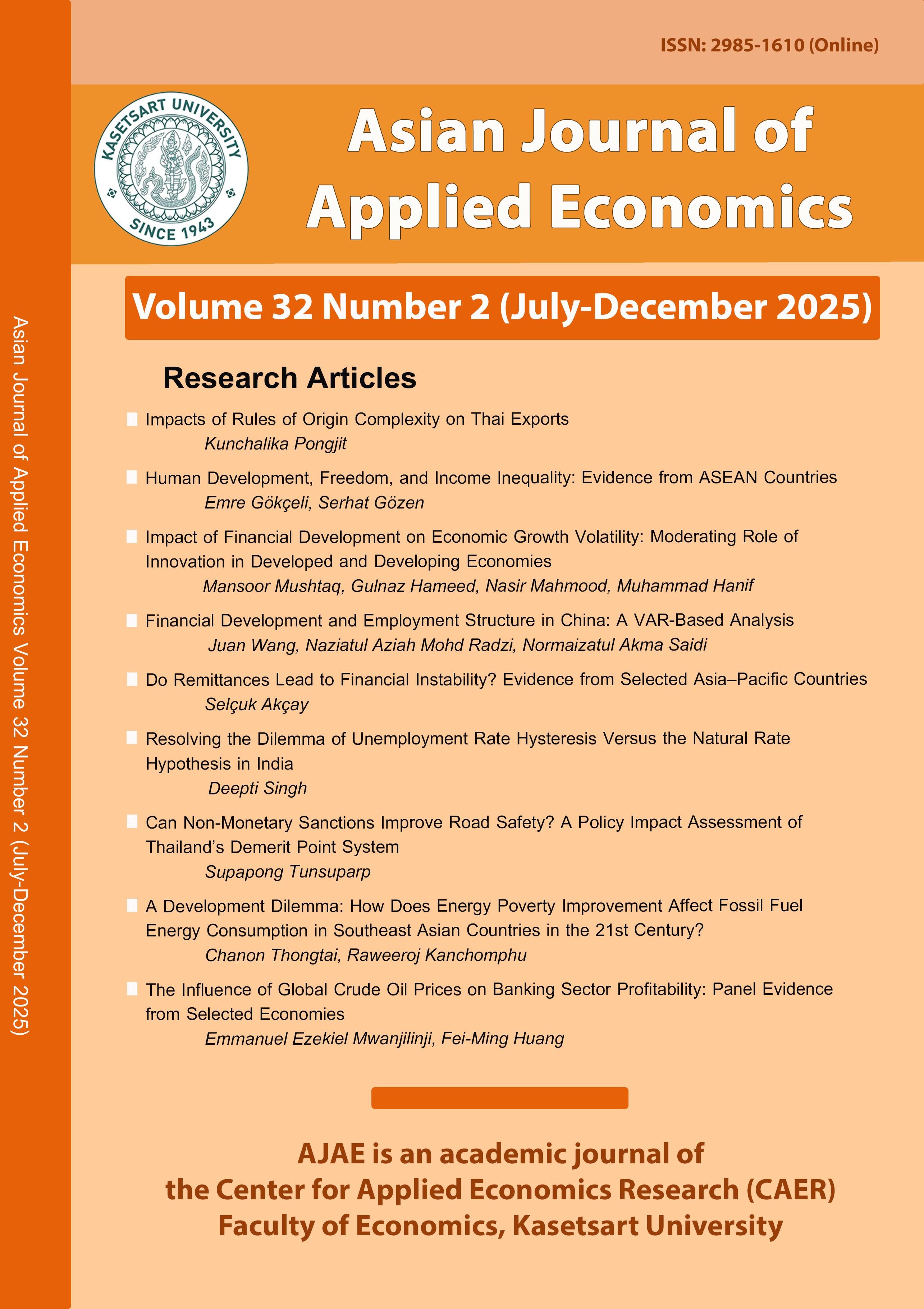
Do Remittances Lead to Financial Instability? Evidence from Selected Asia–Pacific Countries
Article Sidebar
Main Article Content
Abstract
The Asia–Pacific region is among the top recipients of international remittances globally. This study examines the impact of remittances on financial instability and investigates whether the causal relationship between remittances and financial instability is symmetric or asymmetric in selected remittance-dependent Asia–Pacific countries: Pakistan, the Philippines, and Sri Lanka. Using the frequency domain causality approach and monthly data (Pakistan: 2005m01–2023m08; the Philippines: 1998m10–2023m08; Sri Lanka: 2015m01–2022m12), the results reveal both symmetric and asymmetric unidirectional causality from remittances to financial instability in Sri Lanka. In Pakistan, symmetric and asymmetric causality is observed from financial instability to remittances. No significant symmetric or asymmetric causal relationship is found in the Philippines. These findings suggest that recognizing asymmetric effects is essential for designing targeted policy responses in remittance-dependent economies. In particular, strengthening formal remittance channels, enhancing financial sector resilience, and using foreign exchange interventions in crisis-prone contexts like Sri Lanka can help mitigate remittance-induced instability.
Article Details

This work is licensed under a Creative Commons Attribution-NonCommercial-NoDerivatives 4.0 International License.
The paper is published under CC BY-NC-ND, in which the article is freely downloaded and shared in its original form non-commercially and its citation details are identified.
References
Addi, A., Zennati, O., & Makhlouf, F. (2025). Unveiling the role of remittances in mitigating systemic risk in Pakistan's financial landscape. Retrieved from https://ssrn.com/abstract=5195935
Akçay, S. & Karasoy, A. (2019). Determinants of remittances in Egypt: Do macroeconomic instability and oil price matter? International Migration, 57(1),142–160.
Amuedo-Dorantes, C., & Pozo, S. (2023). The widespread impacts of remittance flows. IZA World of Labor, 97.
Apostolakis, G., & Papadopoulos, A. P. (2014). Financial stress spillovers in advanced economies. Journal of International Financial Markets, Institutions and Money, 32,128–149.
Apostolakis, G. N., & Giannellis, N. (2024). International financial stress spillovers during times of unconventional monetary policy interventions. Journal of Financial Stability, 72,101259.
Armas, J. C. A., & De Guzman, N. D. (2024). Introducing a multi-dimensional financial development index for the Philippines. Latin American Journal of Central Banking, 100154.
Azizi, S., Aftabi, A., Azizkhani, M., & Yektansani, K. (2023). Remittances and economic growth: A blessing for middle-income countries, ineffective for low-income countries. Journal of Economic Studies, 51(6), 1285–1303.
Ball, C. P., Lopez, C., & Reyes, J. (2013). Remittances, inflation and exchange rate regimes in small open economies. The World Economy, 36 (4), 487–507.
Basnet, H. C., Donou-Adonsou, F., & Upadhyaya, K. (2022). Remittances-inflation nexus in South Asia: An empirical examination. Journal of Financial Economic Policy, 14(2), 152–161.
Baxa, J., Horvátha, R., & Vasícek, B. (2013). Time-varying monetary-policy rules and financial stress: Does financial instability matter for monetary policy? Journal of Financial Stability, 9(1), 117–138.
Bettin, G., Presbitero, A. F., & Spatafora, N. L. (2017). Remittances and vulnerability in developing countries. The World Bank Economic Review, 31(1), 1–23.
Breitung, J., & Candelon, B. (2006). Testing for short-and long-run causality: A frequency-domain approach. Journal of Econometrics, 132(2), 363–378.
Broock, W. A., Scheinkman, J. A., Dechert, W. D., & LeBaron, B. (1996). A test for independence based on the correlation dimension. Econometric Reviews, 15(3), 197–235.
Chami, R., Barajas, A., Cosimano, T. F., Fullenkamp, C., Gapen, M. T., & Montiel, P. J. (2008). Macroeconomic consequences of remittances (IMF Occasional Paper No. 259). Washington, D.C.: International Monetary Fund.
de Padua, D., Lanzafame, M., Qureshi, I. A., & Taniguchi, K. (2024). Understanding the drivers of remittances to Pakistan (ADB Economics Working Paper Series No.733). Asian Development Bank. Retrieved from https://dx.doi.org/10.22617/WPS240348-2
Elsayed, A. H., Sohag, K., & Sousa, R. M. (2024). Oil shocks and financial stability in MENA countries. Resources Policy, 89, 104653.
Farzanegan, M. R., & Hassan, S. M. (2020). How does the flow of remittances affect the trade balance of the Middle East and North Africa? Journal of Economic Policy Reform, 23(2), 248–266.
Habib, H. (2023). Remittances and labor supply: Evidence from Tunisia. Journal of Knowledge Economy 14(2),1870–1899.
Hien, N. P., Vinh, C. T. H., Mai, V. T. P., & Xuyen, L. T. K. (2020). Remittances, real exchange rate and the Dutch disease in Asian developing countries. The Quarterly Review of Economics and Finance, 77, 131–143.
Hordofa, D. F. (2024). Impact of digital transformation on financial stability in emerging markets: Evidence from Ethiopia. Discover Sustainability 5(1), 309.
International Monetary Fund (IMF). (2023). Integrated policy framework—Principles for the use of foreign exchange intervention (Policy Paper No. 2023/061). Washington, D.C.: International Monetary Fund.
International Organization for Migration (IOM). (2023). Asia–Pacific migration data report 2022. Bangkok: IOM Asia–Pacific Regional Data Hub.
Kim, J. (2013). Remittances and currency crisis: The case of developing and emerging countries. Emerging Markets Finance & Trade, 49(6), 88–111.
Lartey, E. K. K., Mandelman, F. S., & Acosta, P. A. (2012). Remittances, exchange rate regimes and the Dutch Disease: A panel data analysis. Review of International Economics, 20(2), 377–395.
Lucas, R. E. B., & Stark, O. (1985). Motivations to remit: Evidence from Botswana. Journal of Political Economy, 93(5), 901–918.
Malega, J., & Horváth, R. (2017). Financial stress in the Czech Republic: Measurement and effects on the real economy. Prague Economic Papers, 26(3), 257–268.
Miao, M., & Qamruzzaman, M. (2021). Does remittances matter for openness and financial stability: Evidence from least developed economies. Frontiers in Psychology, 12, 696600.
Mijiyawa, A. G., & Oloufade, D. K. (2023). Effect of remittance inflows on external debt in developing countries. Open Economies Review, 34(2), 437–470.
Oleksiv, I., & Mirzoieva, D. (2022). Impact of remittances on the exchange rate and consumption: Evidence from Ukraine. Eastern European Economics, 60(5), 418–432.
Oliva, M.-A., & Khinashvili, N. (2024). Managing remittances inflows with foreign exchange interventions (IMF Working Paper No. WP/24/191). Washington, D.C.: International Monetary Fund.
Orbeta, A. C., Jr. (2008). Economic impact of international migration and remittances on Philippine households: What we thought we knew, what we need to know (PIDS Discussion Paper Series No. 2008-32). Makati City: Philippine Institute for Development Studies.
Park, C.-Y., & Mercado, R. V., Jr. (2014). Determinants of financial stress in emerging market economies. Journal of Banking & Finance, 45, 199–224.
Rivera, J. P. R., & Tullao, T. S., Jr. (2020). Investigating the link between remittances and inflation: Evidence from the Philippines. South East Asia Research, 28(3), 301–326.
Samarakoon, L. P. (2024). What broke the pearl of the Indian Ocean? The causes of Sri Lanka’s economic crisis and its policy implications. Journal of Financial Stability, 70, 101213.
Shin, Y., Yu, B., & Greenwood-Nimmo, M. (2014). Modelling asymmetric cointegration and dynamic multipliers in a nonlinear ARDL framework. In R. C. Sickles & W. C. Horrace (Eds.), Festschrift in honor of Peter Schmidt (pp. 281–314). New York, NY: Springer.
Song, Y., Paramati, S. R., Ummalla, M., Zakari, A., & Kummitha, H. R. (2021). The effect of remittances and FDI inflows on income distribution in developing economies. Economic Analysis and Policy, 72, 255–267.
Sufi, A., & Taylor, A. M. (2021). Financial crises: A survey (NBER Working Paper 29155). Cambridge, MA: National Bureau of Economic Research.
Sutradhar, S. R. (2020). The impact of remittances on economic growth in Bangladesh, India, Pakistan and Sri Lanka. International Journal of Economic Policy Studies, 14(1), 275–295.
Tokhirov, A., Harmáček, J., & Syrovátka, M. (2021). Remittances and inequality: The post-communist region. Prague Economic Papers, 30(4), 426–448.
Uddin, M. B., & Murshed, S. M. (2017). International transfers and Dutch disease: Evidence from South Asian countries. Journal of the Asia Pacific Economy, 22(3), 486–509.
Withers, M. (2024). Are remittances “resilient?” Evidence from Sri Lanka between COVID-19 and the crisis. Asian and Pacific Migration Journal, 33(2), 231–257.
World Bank. (2006). Global economic prospects: Economic implications of remittances and migration. Washington, D.C.: World Bank.
World Bank. (2024). Remittance inflows. Retrieved June 15, 2024, from https://www.worldbank.org/en/topic/migrationremittancesdiasporaissues/brief/migration-remittances-data
Xie, M., Irfan, M., Razzaq, A., & Dagar, V. (2022). Forest and mineral volatility and economic performance: Evidence from frequency domain causality approach for global data. Resources Policy, 76, 102685.
Zivot, E., & Andrews, D. W. K. (2002). Further evidence on the great crash, the oil-price shock, and the unit-root hypothesis. Journal of Business and Economic Statistics, 20(1), 25–44.
