
Vegetative Rice Growth Quality Classification Using Artificial Neural Network Based on Nitrogen Content and Leaf Width Features
Article Sidebar
Main Article Content
Abstract
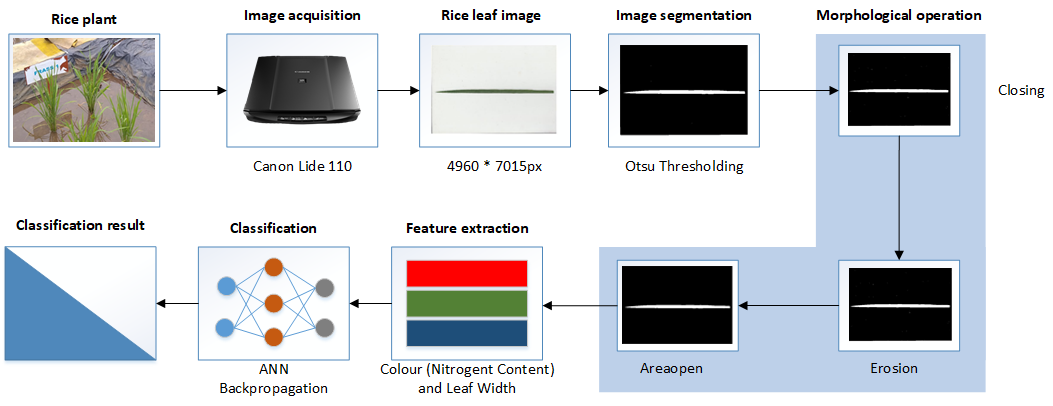
Rice farming land in Indonesia has been decreasing annually, affecting rice productivity. Optimal fertilizer application is crucial to maintain rice quality and yield. Previous studies focused only on nitrogen content measured by leaf color, while rice plant growth quality is determined by more than just nitrogen content. Therefore, this study proposes a classification model of rice plant health in the vegetative phase based on nitrogen content and leaf width, using artificial neural networks. The proposed model uses digital imagery and computer vision to classify rice plants into low, medium, and high health levels. The model includes image acquisition, quality improvement, segmentation, feature extraction, and classification using backpropagation neural networks. The proposed method achieved an average accuracy of 85.9% and a Misclassification Error of 14.1%. This research can assist farmers in identifying rice plant health levels for optimal fertilizer application.
Article Details

This work is licensed under a Creative Commons Attribution-NonCommercial-NoDerivatives 4.0 International License.
References
Statistics Indonesia (Badan Pusat Statistik). Harvested area, production, and productivity of rice by province 2019–2021 [Internet]. Jakarta: Statistics Indonesia; 2021 [cited 2022 Feb 2]. Available from: [https://www.bps.go.id/indicator/53/1498/1/luas-panen-produksi-dan-produktivitas-padi-menurut-provinsi.html](https://www.bps.go.id/indicator/53/1498/1/luas-panen-produksi-dan-produktivitas-padi-menurut-provinsi.html).
Arifah D, Salman A, Yassi A, Bahsar-Demmallino E. Climate change impacts and the rice farmers’ responses at irrigated upstream and downstream in Indonesia. Heliyon. 2022;8(12):e11923.
Djawad YA, Rehman H, Jumadi O, Tufail M, Anwar S, Bourgougnon N. Discrimination of nitrogen concentration of fertilized corn with extracted algae and polymer based on its leaf color images. Ing Des Syst Inf. 2020;25:303–309.
Yang L, Deng S, Ma S, Xiao F. Estimation model of leaf nitrogen content based on GEP and leaf spectral reflectance. Comput Electr Eng. 2022;98:107648.
Reichardt K, Timm LC. How plants absorb nutrients from the soil. In: Soil, plant and atmosphere: concepts, processes, and applications. Berlin: Springer; 2020. p. 313–330.
Jinwen L, Jingping Y, Pinpin F, Junlan S, Dongsheng L, Changshui G, et al. Responses of rice leaf thickness, SPAD readings and chlorophyll a/b ratios to different nitrogen supply rates in paddy field. Field Crops Res. 2009;114:426–432.
Wang W, Wu Y, Zhang Q, Zheng H, Yao X, Zhu Y, et al. AAVI: a novel approach to estimating leaf nitrogen concentration in rice from unmanned aerial vehicle multispectral imagery at early and middle growth stages. IEEE J Sel Top Appl Earth Obs Remote Sens. 2021;14:6716–6728.
Gholizadeh A, Saberioon M, Borůvka L, Wayayok A, Mohd Soom MA. Leaf chlorophyll and nitrogen dynamics and their relationship to lowland rice yield for site-specific paddy management. Inf Process Agric. 2017;4:259–268.
Jiang W, Huang W, Liang H, Wu Y, Shi X, Fu J, et al. Is rice field a nitrogen source or sink for the environment? Environ Pollut. 2021;283:117122.
Shi S, Zhang G, Chen L, Zhang W, Wang X, Pan K, et al. Different nitrogen fertilizer application in the field affects the morphology and structure of protein and starch in rice during cooking. Food Res Int. 2023;163:112193.
Raj R, Walker JP, Pingale R, Banoth BN, Jagarlapudi A. Leaf nitrogen content estimation using top-of-canopy airborne hyperspectral data. Int J Appl Earth Obs Geoinf. 2021;104:102584.
Vashisht BB, Jalota SK, Ramteke P, Kaur R, Jayeswal DK. Impact of rice (O. sativa L.) straw incorporation induced changes in soil physical and chemical properties on yield, water and nitrogen-balance and-use efficiency of wheat (T. aestivum L.) in rice-wheat cropping system: field and simulation studies. Agric Syst. 2021;194:103279.
Hashim MM, Yusop MK, Othman R, Wahid SA. Characterization of nitrogen uptake pattern in Malaysian rice MR219 at different growth stages using 15N isotope. Rice Sci. 2015;22:250–254.
Ma P, Lan Y, Lyu T, Zhang Y, Lin D, Li F, et al. Improving rice yields and nitrogen use efficiency by optimizing nitrogen management and applications to rapeseed in rapeseed-rice rotation system. Agronomy. 2020;10:1060.
Yao Y, Miao Y, Cao Q, Wang H, Gnyp ML, Bareth G, et al. In-season estimation of rice nitrogen status with an active crop canopy sensor. IEEE J Sel Top Appl Earth Obs Remote Sens. 2014;7:4403–4413.
Onoyama H, Ryu C, Suguri M, Iida M. Integrate growing temperature to estimate the nitrogen content of rice plants at the heading stage using hyperspectral imagery. IEEE J Sel Top Appl Earth Obs Remote Sens. 2014;7:2506–2515.
Wang Y, Wang D, Shi P, Omasa K, et al. Estimating rice chlorophyll content and leaf nitrogen concentration with a digital still color camera under natural light. Field Crops Res. 1999;64:273–286.
Zhang YH, Tang L, Liu XJ, Liu LL, Cao WX, Zhu Y. Modeling dynamics of leaf color based on RGB value in rice. J Integr Agric. 2014;13:749–759.
Qiu Z, Ma F, Li Z, Xu X, Ge H, Du C. Estimation of nitrogen nutrition index in rice from UAV RGB images coupled with machine learning algorithms. Comput Electron Agric. 2021;189:106421.
Shi P, Wang Y, Xu J, Zhao Y, Yang B, Yuan Z, et al. Rice nitrogen nutrition estimation with RGB images and machine learning methods. Comput Electron Agric. 2021;180:105860.
Lu J, Cheng D, Geng C, Zhang Z, Xiang Y, Hu T. Combining plant height, canopy coverage and vegetation index from UAV-based RGB images to estimate leaf nitrogen concentration of summer maize. Biosyst Eng. 2021;202:42–54.
Tang R, Luo X, Li C, Zhong S. A study on nitrogen concentration detection model of rubber leaf based on spatial-spectral information with NIR hyperspectral data. Infrared Phys Technol. 2022;123:104093.
Lee K, Park C-W, Ahn H, Hong S, Jang S-Y, Na S, et al. Estimation of rice leaf nitrogen content and yield using UAV image. Korean J Soil Sci Fertil. 2020;53:335–344.
Brinkhoff J, Dunn BW, Robson AJ. Rice nitrogen status detection using commercial-scale imagery. Int J Appl Earth Obs Geoinf. 2021;105:102627.
Yuan Z, Cao Q, Zhang K, Ata-Ul-Karim ST, Tian Y, Zhu Y, et al. Optimal leaf positions for SPAD meter measurement in rice. Front Plant Sci. 2016;7:719.
Otsu N. A threshold selection method from gray-level histograms. IEEE Trans Syst Man Cybern. 1979;9:62–66.
Cheng H-Y, Lin C-L. Cloud detection in all-sky images via multi-scale neighborhood features and multiple supervised learning techniques. Atmos Meas Tech. 2017;10:199–208.
Al-Zubaidi EA, Mijwil MM, Alsaadi AS. Two-dimensional optical character recognition of mouse drawn in Turkish capital letters using multi-layer perceptron classification. J Southwest Jiaotong Univ. 2019;54:1–12.
Yamashita R, Nishio M, Do RKG, Togashi K. Convolutional neural networks: an overview and application in radiology. Insights Imaging. 2018;9:611–629.
Zhu Y, Li T, Xu J, Wang J, Wang L, Zou W, et al. Leaf width gene LW5/D1 affects plant architecture and yield in rice by regulating nitrogen utilization efficiency. Plant Physiol Biochem. 2020;157:359–369.
