
Mycochemical Composition, Antioxidant Properties, and Cytotoxic Activity of Xylaria papulis Lloyd (Xylariaceae) Mycelia Grown in Static and Shaking Indigenous Liquid Culture Conditions
Article Sidebar
Main Article Content
Abstract
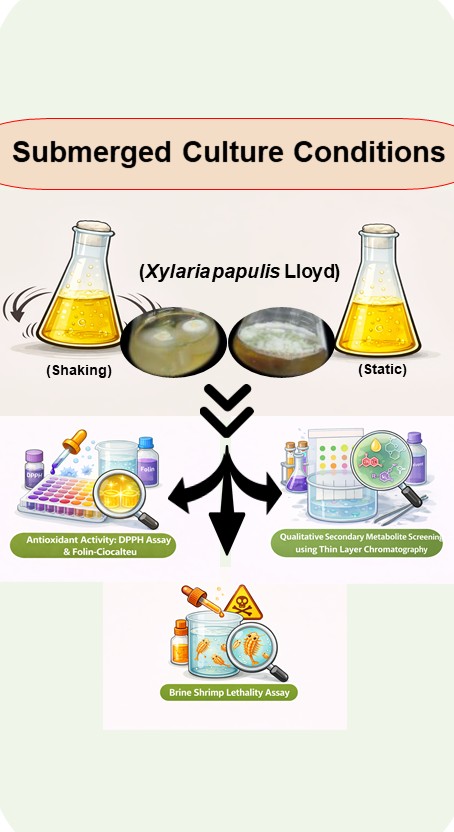
The search for promising and sustainable sources of secondary metabolites with potential biofunctional activities is important for the possible sources of drugs to treat human diseases. Hence, this study qualitatively assessed the mycochemical composition and investigated the biofunctional activities (antioxidant activity and cytotoxic activity) of Xylaria papulis Lloyd mycelia grown in static and shaking indigenous liquid culture medium. Mycochemical screening revealed the presence of several classes of secondary metabolites, such as phenolics, terpenoids, fatty acid derivatives, alkaloids, and sugar derivatives, in mycelial mat (shaking) and in culture spent (static). Mycelial mat (static) and culture spent (shaking) also contain the same classes of secondary metabolites, with the former including essential oils. Mycelial extracts have greater antioxidant property (≤ 43.19±1.63% RSA) and total phenolics (≤ 47.75±2.31 mg/GAE) compared to the culture spent. Culture spent from shaking condition exhibited cytotoxicity (LC50 = 94.39µg/mL) against brine shrimp larvae. These findings indicate that X. papulis (Lloyd) grown in liquid culture medium can be a sustainable source of diverse secondary metabolites with antioxidant properties and cytotoxic activity. Further, cytotoxicity studies against cancer cell lines can also be investigated for future studies.
Article Details

This work is licensed under a Creative Commons Attribution-NonCommercial-NoDerivatives 4.0 International License.
References
Ramesh V, Karunakaran C, Rajendran A. Evaluation of synergistic and antibacterial activity of Xylariacurta against drug-resistant Staphylococcus aureus and Pseudomonas aeruginosa. Mycology. 2012;3(4):252-257.
Karun NC, Sridhar KR. Xylaria complex in the South Western India. PPQ. 2015;5(2):83-96.
Koyani RD, Patel HR, Vasava AM, Rajput KS. Xylariaceae: Overview and addition to fungal diversity of Gujarat state. Stud Fungi. 2016;1(1):69-79.
Chien S, Wu Y, Chen Z, Yang W. Naturally Occurring Anthraquinones: Chemistry and Therapeutic Potential in Autoimmune Diabetes. Evid. Based Complement. Alternat Med. 2015;357357.
Orachaipunlap K, Suwannasai N, Whalley AJS, Phosri C, Sihanonth P. Biological Activities of Endophytic Xylaria sp. Isolated from Tropical forest in Chaiyapoom Province, Thailand. J Biol Chem Research. 2012;3:200-208.
Ramesh V, Santosh K, Pavunraj M, Karunakaran C, Rajendran A. In-vitro antifungal and anticancer potential of Xylaria curta fruiting body fractions against human fungal pathogen and cancer cell lines. Curr. Res. Environm. Appl Mycol. 2015;5(1):20-26.
Nath A, Raghunatha P, Joshi SR. Diversity and Biological Activities of Endophytic Fungi of Emblica officinalis, an Ethnomedicinal Plant of India. Mycobiology. 2012;40(1):8-13.
Nandan Patel KJ, Krishnappa M. Antimicrobial property and GC-MS Analysis of Xylaria carpophila (Pers.) Fr. Int J Pharma Bio Sci. 2017;8(4):119-126.
Sawadsitang S, Mongkolthanarukb W, Suwannasaic N, Sodngama S. Antimalarial and cytotoxic constituents of Xylaria cf. cubensis PK108. Nat Prod Res. 2015;29(21):1-4.
Peng W, Wang X, Hong Z, Zhu G, Li B, Li Z, et al. The anti-depression effect of Xylaria nigripes in patients with epilepsy: a multicentered randomized, double-blind study. Seizure. 2015;29:26-33.
Rajendran S, Robertson LP, Kosgahakumbura L, Fernando C, Göransson U, Wang H, et al. Antibacterial eremophilane sesquiterpenoids from Xylaria feejeensis, an endophytic fungi of the medicinal plant Geophila repens. Fitoterapia. 2023;167:105496.
Yan JK, Wu JY. Submerged Fermentation of Medicinal Fungus Cordyceps sinensis for Production of Biologically Active Mycelial Biomass and Exopolysaccharides. Springer. 2014.
Lopez MKS, Kalaw SP, Dulay RMR, De Leon AM, Reyes RG. Optimization of mycelial growth of Xylaria papulis Lloyd (Xylariaceae) in indigenous liquid culture conditions, Science City of Muñoz, Nueva Ecija, Philippines. Stud Fungi. 2022;7:1-7.
Singh VK, Kumar A. Secondary metabolites from endophytic fungi: Production, methods of analysis, and diverse pharmaceutical potential. Symbiosis. 2023;8:1-15.
Zhou JT, Li BC, Liang XM, Liang M, Li J, Xu W, et al. Secondary Metabolites from the Endophytic Fungus Xylaria sp. GDG-102 by Osmac Strategy and Their Antibacterial Activities. Chem Nat Compd. 2024;60:189–191.
De Leon AM, Diego EO, Domingo LKF, Kalaw SP. Mycochemical screening, antioxidant evaluation and assessment of bioactivities of Xylaria papulis: a newly reported macrofungi from Paracelis, Mountain Province, Philippines. Curr Res Environ Appl Mycol. 2020;10(1):300-318.
Kolak U, Osturk M, Ozgokce F, Ulubelen A. Norditerpene alkaloids from Delphenium linearilobum and antioxidant activity. Phytochemistry. 2006;67:2170-2175.
Sunita M, Dhananjay S. Quantitative Analysis of Total Phenolic Content in Adhatoda vasica Nees Extracts. Int J PharmTech Res. 2010;2(4):2403-2406.
Guevara B, Claustro AL, Madulid RS, Aguinaldo AM, Espeso EI, Nonato MG, et al. A guidebook to plant screening: Phytochemical and biological. University of Sto. Tomas, Manila, Philippines, UST Publishing House; 2005, p.52-54.
Aldahi EA, Khalid HS, Alhassan MS, Kabbashi AS, Noor MO. Antimicrobial and phytochemical screening of Cordia africana in Sudan. World J Pharm Res. 2015;4(3):257-269.
McLaughlin JL, Rogers LL. The use of biological assays to evaluate botanicals. Drug Inf J. 1998;32:513-524.
Rebbapragada D, Kalyanaraman R. Evaluation and Optimization of Antioxidant Potentiality of Xylaria feejeensis Hmjau22039. Asian J Pharm Clin Res. 2016;9(2):269-273.
Ko H, Song A, Lai M, Ng L. Antioxidant and Antiradical Activities of Wu Ling Shen in a Cell-Free System. Am J Chin Med. 2009;37(4):815-828.
Grbović F, Stanković MS, Ćurčić M, Đorđević N, Šeklić D, Topuzović M, et al. In Vitro Cytotoxic Activity of Origanum vulgare L. on HCT-116 and MDA-MB-231 Cell Lines. Plants. 2013;2:371-378.
Muthu N, Shanmugasundaram K. Comparative study of phytochemicals in aqueous and silver nanoparticles extracts of Agrocybe aegerita (v. Brig.) Singer black poplar mushroom. Int J Pharm Biol Sci. 2015;6(3):190-197.
Nakashima K, Tomida J, Tabata M, Hirai T, Morita Y, Kawamura Y, et al. A new chromone derivative from an endophytic fungus Xylaria sp. isolated from Ardesia crenata. Heterocycles. 2017;94(2):308-313.
Adnan M, Patel M, Reddy NM, Alshammari E. Formulation, evaluation, and bioactive potential of Xylaria primorskensis terpenoid nanoparticles from its major compound xylaranic acid. Sci Rep. 2018;8(1740):1-12.
Wang F, Han S, Hu S, Xue Y, Wang J, Xu H, et al. Two New Secondary Metabolites from Xylaria sp. cfcc 87468. Molecules. 2012;19:1250-1257.
Jang YJ, Lee I, Kim Y, Seok S, Yu SH, Yun B. Chemical Constituents of the fruiting body of Xylaria polymorpha. Mycobiology. 2009;37(3):207-210.
Van Gorkom BAP, De Vries EGE, Karrenbeldà A, Kleibeuker JH. Anthranoid laxatives and their potential carcinogenic effects. Aliment Pharmacol Ther. 1998;13:443-452.
Khanbabaee K, Ree TV. Tannins: Classification and Definition. Nat Prod Rep. 2001;18:641-649.
Tapas AR, Sakarkar DM, Kakde RB. Flavonoids as Nutraceuticals: A Review.Tropical J Pharm Res. 2008;7(3):1089-1099.
Pan F, Su T, Cai S, Wu W. Fungal endophyte-derived Fritillaria unibracteata var. wabuensis: diversity, antioxidant capacities in vitro and relations to phenolic, flavonoid or saponin compounds. Sci Rep. 2017;7:42008.
Divate RD, Wang P, Wang C, Chou S, Chang C, Chung Y. Protective effect of medicinal fungus Xylaria nigripes mycelia extracts against hydrogen peroxide-induced apoptosis in PC12 cells. Int J Immunopathol Pharmacol. 2017;30(1):105-112.
De Leon AM, Orpilla JOV, Cruz KV, Dulay RMR, Kalaw SP, Dela Cruz TEE. Optimization of mycelial growth and mycochemical screening of Lentinus sajor-caju (fr.) from Banaue, Ifugao Province, Philippines. IJAT. 2017;13(7.3):2549-2567.
Asaduzzaman MD, Rana MS, Hasan SMR, Hossain M, Das N. Cytotoxic (Brine Shrimp Lethality Bioassay) And Antioxidant Investigation of Barringtonia acutangula (L.). Biochem Pharmacol. 2015;6(8):1179-1185.
Baravalia Y, Vaghasiya Y, Chanda S. Brine Shrimp Cytotoxicity, Anti-inflammatory and Analgesic Properties of Woodfordia fruticosa Kurz Flowers. Iran J Pharm Res. 2012;11(3):851-861.
Wu JG, Peng W, Zeng PY, Wu YB, Yi J, Wu JZ. Antimicrobial activity and cytotoxicity of endophytes from Scapania verrucosa Heeg. Genet Mol Res. 2013;12(2):916-924.
Zhao ZX, Zou QY, Ma YH, Morris‐Natschke SL, Li XY, Shi LC, et al. Recent progress on triterpenoid derivatives and their anticancer potential. Phytochemistry. 2025;229:114257.
Bakrim S, El Omari N, El Hachlafi N, Bakri Y, Lee LH, Bouyahya A. Dietary Phenolic Compounds as Anticancer Natural Drugs: Recent Update on Molecular Mechanisms and Clinical Trials. Foods. 2022;11(21):3323.
Abotaleb M, Liskova A, Kubatka P, Büsselberg D. Therapeutic Potential of Plant Phenolic Acids in the Treatment of Cancer. Biomolecules. 2020;10(2):221.
Lara DFM, Hernández-Caballero ME, Terán JL, Ramírez JS, Carrasco-Carballo A. Anticancer activities of natural and synthetic steroids: A review. ACS Omega. 2025;10(8):7493-7501.
Kubrak TP, Makuch-Kocka A, Aebisher D. Coumarins in Anticancer Therapy: Mechanisms of Action, Potential Applications and Research Perspectives. Pharmaceutics. 2025;17(5):595.
Malik MS, Alsantali RI, Jassas RS, Alsimaree AA, Syed R, Alsharif MA, et al. Journey of anthraquinones as anticancer agents - a systematic review of recent literature. RSC Adv. 2021;11(57):35806-35827.
Dhyani P, Quispe C, Sharma E, Bahukhandi A, Sati P, Attri DC, et al. Anticancer potential of alkaloids: a key emphasis to colchicine, vinblastine, vincristine, vindesine, vinorelbine, and vincamine. Cancer Cell Int. 2022;22(1):206.
