
Effect of Paraffinic Oil Plasticizer Addition on Kinetics of Rubber Vulcanization Based on Kamal-Sorour and Deng-Isayev Models
Article Sidebar
Main Article Content
Abstract
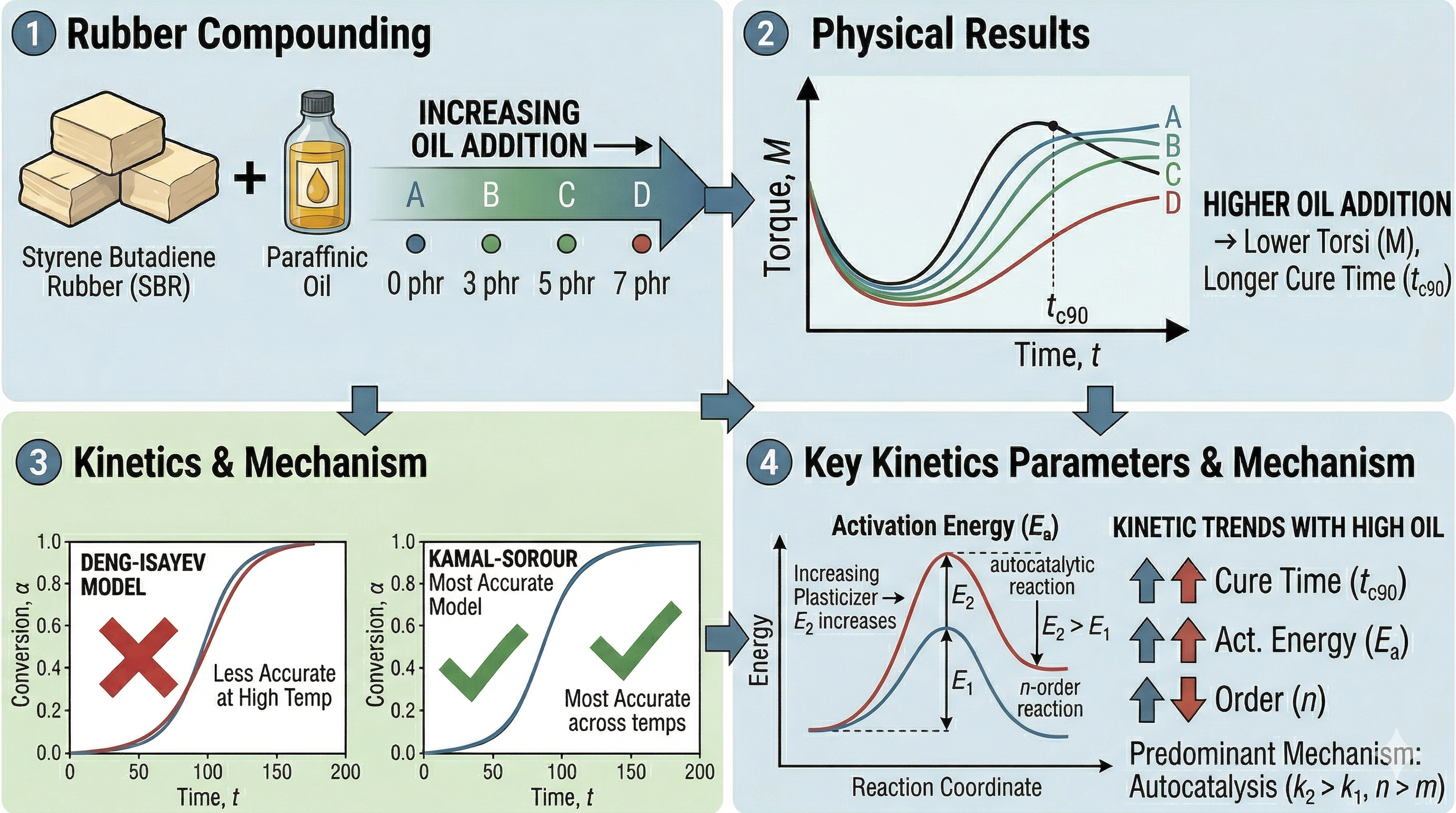
Plasticizer is an essential component in rubber compounding, characterized by the ability to reduce compound viscosity, improve the dispersion of additives, and significantly affect processing efficiency and vulcanization kinetics. Therefore, this study aimed to investigate the vulcanization kinetics of styrene butadiene rubber (SBR) with varying amounts of paraffinic oil plasticizer. The experimental procedures included mixing rubber and additives, followed by compound testing using a rheometer. The kinetic parameters of the Deng-Isayev and Kamal-Sorour models were determined using the sum of squared error (SSE) optimization of the rheological data. The results showed that increasing the vulcanization temperature and reducing plasticizer content caused a decrease in induction time (ts2) and optimum vulcanization time (tc90). Furthermore, the experimental data were accurately modeled using the Kamal-Sorour model. The vulcanization reaction occurred concurrently with the predominance of the autocatalysis mechanism (k2 > k1), while the values of m and n were inversely proportional to the amount of plasticizer. The vulcanization reaction was primarily influenced by the initial reactant compound rather than the catalytic effect on the product reaction (n > m), showing that high plasticizer content increased energy requirement (E2 > E1) for autocatalytic reactions.
Article Details

This work is licensed under a Creative Commons Attribution-NonCommercial-NoDerivatives 4.0 International License.
References
Yeoh OH. Mathematical modeling of vulcanization characteristics. Rubber Chem Technol. 2012;85(3):482–492.
Dharmaraj MM, Begum SS, Chakraborty BC. A study on nitrile rubber/polyvinyl chloride blend vulcanization kinetics with different fillers by using a single isothermal rheograph. J Elastomers Plast. 2023;55(6):896–916.
Urrego W, Guzmán Sánchez MA, Giraldo DH, Posada Correa JC, Rodríguez Ledezma CM. Comparative study of three vulcanization kinetic models for natural rubber/leather wastes composites. J Elastomers Plast. 2023;55(5):677–692.
Xiao C, Yang Q, Shao K, Li Y, Wan S, He X. Vulcanization kinetics and mechanical properties of filled ethylene-vinyl acetate copolymer rubber composites. Int Polym Process. 2023;38(4):496–504.
Milani G, Milani F. Optimal vulcanization of tires: Experimentation on idealized NR-PB natural and poly-butadiene rubber blends, phenomenological smoothed numerical kinetic model and FE implementation. Polym Test. 2018;72:63–85.
Lubura J, Kojić P, Pavličević J, Ikonić B, Balaban D, Bera O. A novel approach for simulation and optimization of rubber vulcanization. Polym. 2023;15(7):1750.
Setyorini I, Yuniari A. Determination of vulcanization rate constant, crosslink density, and free sulfur content on carbon black filled EPDM. Maj Kulit Karet Plastik. 2017;33(2):93–98.
Amiruddin MAA, Sarkawi SS. A rheological characteristics and kinetic study for sulphur accelerated vulcanisation of epoxidized natural rubber. J Rubber Res. 2023;26:363–372.
Song Y, Wu G, Peng J, Zhang C, Wang D, Zheng Q. Vulcanization kinetics of natural rubber and strain softening behaviors of gum vulcanizates tailored by deep eutectic solvents. Polym. 2022;263:125504.
Gómez-Jiménez S, Saucedo-Anaya T, López-Baltazar EA, Robles-Guerrero A. Automated identification of kinetics model in elastomer vulcanization using a rheometer MDR and Rubber-K pattern recognition software. Results Mater. 2024;21:100516.
Milani G, Milani F. Quasi-analytical kinetic model for natural rubber and polybutadiene rubber blends. React Kinet Mech Catal. 2018;123(2):351–365.
Nikolova S, Mihaylov M, Dishovsky N. Mixed peroxide/sulfur vulcanization of ethylene-propylene terpolymer based composites. Curing characteristics, curing kinetics and mechanical properties. J Chem Technol Metall. 2022;57(5):881–894.
Raef M, Hosseini SM, Nabavian Kalat M, Razzaghi‐Kashani M. Vulcanization kinetics of styrene butadiene rubber reinforced by graphenic particles. SPE Polym. 2021;2(2):122–133.
García DB, Mansilla MA, Crisnejo M, Farabollini H, Escobar MM. Effect of carbon nanotubes content on the vulcanization kinetic in styrene–butadiene rubber compounds. Polym Eng Sci. 2019;59(s2):E327–336.
Vršková J, Labaj I, Skalková P. Effect of different types of plasticizers on the properties of elastomeric blends filled with biopolymer. NanoWorld J. 2022;8(4):91–95.
Xu H, Fan T, Ye N, Wu W, Huang D, Wang D, et al. Plasticization effect of bio-based plasticizers from soybean oil for tire tread rubber. Polym. 2020;12(3):623.
Satwikanitya P, Saputra A, Wahyu Sya’bani Muh, Pambudi W, Fitra Agustian M. Effect of plasticizer of epoxidized used cooking oil on rubber vulcanization kinetics. J Penelit Karet. 2023;41(1):33–46.
Saputra A, Satwikanitya P, Fitria Puspita, Muh Wahyu Sya’bani, Mertza Fitra Agustian, Wisnu Pambudi. Synthesis of epoxy oil from Waste Cooking Oil (WCO) using acetic acid and amberlite resin IR-120 as catalyst. Eng. Appl. Sci. Res. 2023;50(4):335–342.
Kamal MR. Thermoset characterization for moldability analysis. Polym. Eng. Sci. 1974;14(3):231–9.
Kamal MR, Sourour S. Kinetics and thermal characterization of thermoset cure. Polym Eng Sci. 1973;13(1):59–64.
Isayev AI, Deng JS. Nonisothermal vulcanization of rubber compounds. Rubber Chem Technol. 1988;61(2):340–361.
Marzocca AJ, Mansilla MA. Vulcanization kinetic of styrene-butadiene rubber by sulfur/TBBS. J Appl Polym Sci. 2006;101(1):35–41.
Bergmann C, Trimbach J. Influence of plasticizers on the properties of natural rubber based compounds [Internet]. 2014 [cited 2023 Dec 10]. Available from: https://www.kgk-rubberpoint.de/wp-content/uploads/migrated/paid_content/artikel/3178.pdf.
Allahbakhsh A, Mazinani S, Kalaee MR, Sharif F. Cure kinetics and chemorheology of EPDM/graphene oxide nanocomposites. Thermochim Acta. 2013;563:22–32.
Peidayesh H, Nogellova Z, Ivan C. Effects of peroxide and sulfur curing systems on physical and mechanical properties of nitrile rubber composites: A comparative study. Mater. 2024;17(1):71.
Lee SY, Gan SN. The adhesion properties of natural rubber pressure-sensitive adhesives using palm kernel oil-based alkyd resins as a tackifier. Compos Interfaces. 2013;20(3):177–188.
Thaijaroen W. Effect of tackifiers on mechanical and dynamic properties of carbon-black-filled NR vulcanizates. Polym Eng Sci. 2011;51(12):2465–2472.
Hasan A, Rochmadi R, Sulistyo H, Honggokusumo S. The effect of ingredients mixing sequence in rubber compounding upon vulcanization kinetics of natural rubber: an autocatalytic model study. Indones. J Chem. 2018;18(4):709–717.
Akhlaghi S, Kalaee M, Mazinani S, Jowdar E, Nouri A, Sharif A, et al. Effect of zinc oxide nanoparticles on isothermal cure kinetics, morphology and mechanical properties of EPDM rubber. Thermochim Acta. 2012;527:91–98.
Kalaee M, Akhlaghi S, Nouri A, Mazinani S, Mortezaei M, Afshari M, et al. Effect of nano-sized calcium carbonate on cure kinetics and properties of polyester/epoxy blend powder coatings. Prog Org. Coat. 2011;71(2):173–180.
Wu J, Xing W, Huang G, Li H, Tang M, Wu S, et al. Vulcanization kinetics of graphene/natural rubber nanocomposites. Polym. 2013;54(13):3314–3323.
