
Exploration of Patchouli (Pogostemon cablin Benth.) Indigenous Rhizosphere Bacteria as Biofertilizer Candidates in Dissolving Phosphate and Producing Growth Regulator
Article Sidebar
Main Article Content
Abstract
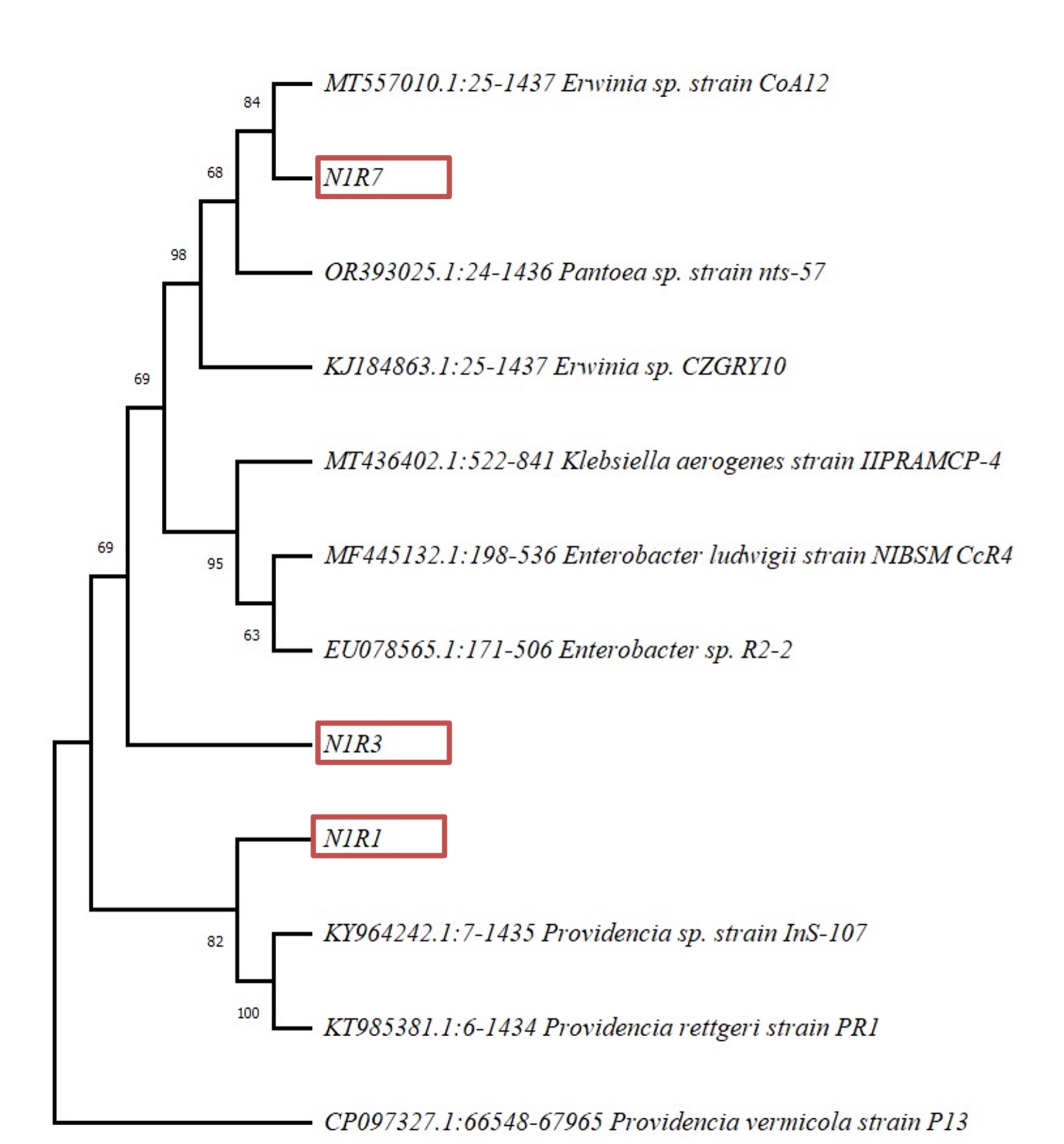
Patchouli is a plant that has high economic value due to it is extensively application in many different industries. Despite its economic importance, the production of Patchouli has struggled to meet the demands of these industries. Addressing this challenge, one potential approach involves harnessing the capabilities of indigenous rhizosphere bacteria to enhance Patchouli growth. This study aims to investigate indigenous rhizosphere bacteria associated with Patchouli, focusing on their ability to solubilize phosphate and produce indole-3-acetic acid (IAA) and gibberellins. The research commenced with the isolation of microbes, which were subsequently evaluated for their phosphate-solubilizing and growth regulator-producing capacities. The results revealed the selection of ten isolates using Pikovskaya media, characterized by morphological variations, with 60% identified as gram-negative bacteria. Notably, three isolates (N1R1, N1R3, N1R7) exhibited superior phosphate-solubilizing abilities, with the highest average clear zone diameter recorded at 10.0 mm. Moreover, isolate N1R1 demonstrated the highest IAA production at 73.03 µg/ml, while isolate N1R7 exhibited the most substantial gibberellin (GA3) production at 98.18 µg/ml. Molecular identification indicated that N1R1 resembled Providencia rettgeri, N1R3 resembled Enterobacter sp., and N1R7 resembled Erwinia sp. In conclusion, three indigenous rhizosphere bacteria associated with Patchouli exhibit promising potential for biofertilizer development, given their proficiency in phosphate solubilization and growth regulator production.
Article Details

This work is licensed under a Creative Commons Attribution-NonCommercial-NoDerivatives 4.0 International License.
References
Swamy MK & Sinniah UR. Patchouli (Pogostemon cablin Benth.): Botany, agrotechnology and biotechnological aspects. Ind Crops Prod. 2016;87:161–176.
Jain PLB, Patel SR, Desai MA. Patchouli oil: an overview on extraction method, composition and biological activities. J Essent Oil Res. 2022;34(1):1–11.
Lee HS, Lee J, Smolensky D, Lee SH. Potential benefits of Patchouli alcohol in prevention of human diseases: A mechanistic review. Int Immunopharmacol. 2020;89.
van Beek TA, Joulain D. The essential oil of Patchouli, Pogostemon cablin: A review. Flavour Fragr J. 2017;33(1):1–46.
Hariyani, Widaryanto E, & Herlina N. The Influence Of Age Harvest On Yield And An Essential Oil Quality Of Patchouli (Pogostemon cablin Benth.). JPT. 2015;3(3):205–211.
Wang J, Cui W, Che Z, Liang F, Wen Y, Zhan M, Dong X, Jin W, Dong Z, Song H. Effects of synthetic nitrogen fertilizer and manure on fungal and bacterial contributions to N2O production along a soil acidity gradient. Sci Total Environ. 2021;753.
Singh S, Tripathi A, Maji D, Awasthi A, Vajpayee P, Kalra A. Evaluating the potential of combined inoculation of Trichoderma harzianum and Brevibacterium halotolerans for increased growth and oil yield in Mentha arvensis under greenhouse and field conditions. Ind Crops Prod. 2019;131:173–181.
Xiong J, Peng S, Liu Y, Yin H, Zhou L, Zhou Z, Tan G, Gu Y, Zhang H, Huang J, Meng D. Soil properties, rhizosphere bacterial community, and plant performance respond differently to fumigation and bioagent treatment in continuous cropping fields. Front Microbiol. 2022;13.
Ashraf MA, Rasool M, Mirza MS. Nitrogen Fixation and Indole Acetic Acid Production Potential of Bacteria Isolated from Rhizosphere of Sugarcane (Saccharum officinarum L.). Adv Biol Res. 2011;5(6):348–355.
Zulkifli L, Sedijani P, Citra Rasmi DA, Amrullah LWZ. Screening and Molecular Identification of Phosphate-Solubilizing Rhizobacteria from Mangrove Ecosystem of the Lombok Island. J Biol Trop. 2020;20(3):475–484.
Verma PP, Shelake RM, Das S, Sharma P, Kim J-Y. Plant growth-promoting rhizobacteria (PGPR) and fungi (PGPF): Potential biological control agents of diseases and pests. In: Microbial Interventions in Agriculture and Environment. Singapore: Springer Singapore; 2019. p. 281–311.
Rawat P, Das S, Shankhdhar D, Shankhdhar SC. Phosphate-Solubilizing Microorganisms: Mechanism and Their Role in Phosphate Solubilization and Uptake. J Soil Sci Plant Nutr. 2021;21(1):49–68.
Vazquez P, Holguin G, Puente ME, Lopez-Cortes A, Bashan Y. Phosphate-solubilizing microorganisms associated with the rhizosphere of mangroves in a semiarid coastal lagoon. Biol Fertil Soils. 2000;30:460-468.
White L, Bruzel V, Subramanian S. Isolation of Rhizosphere Bacterial Communities from Soil. BIO-PROTOCOL. 2015;5(16).
Larasati ED, Rukmi MI, Kusdiyantini E, Ginting RCB. Isolation and identification of phosphate solubilizing bacteria from peat soil. Bioma: Berkala Ilmiah Biologi. 2018;20(1):1-8.
Rini IA, Oktaviani I, Asril M, Agustin R, Frima FK. Isolation And Characterization of Iaa (Indole Acetic Acid) Producing Bacteria from The Rhizosphere of Acacia Plant (Acacia mangium). Agro Bali: Agric J. 2020;3(2):210–219.
Rahim I, Suherman, Hakzah. Production of The Gybberellin Hormone From Cocoa Plants. Proceedings of the National Seminar. 2019;2:26–27.
Mirsam H, Suriani, Aqil M, Azrai M, Efendi R, Muliadi A, Sembiring H, Azis AI. Molecular characterization of indigenous microbes and its potential as a biological control agent of Fusarium stem rot disease (Fusarium verticillioides) on maize. Heliyon. 2022;8(12):e11960.
Sousa AM, Machado I, Nicolau A, Pereira MO. Improvements on colony morphology identification towards bacterial profiling. J Microbiol Methods. 2013;95(3):327-335.
Sadiq HM, Jahangir GZ, Nasir IA, Iqtidar M, Iqbal, M. Isolation and characterization of phosphate-solubilizing bacteria from rhizosphere soil. Biotechnol Biotechnol Equip. 2013;27(6):4248-4255.
Elhaissoufi W, Ghoulam C, Barakat A, Zeroual Y, Bargaz A. Phosphate bacterial solubilization: A key rhizosphere driving force enabling higher P use efficiency and crop productivity. J Adv Res. 2022;38:13-28.
Suliasih, Widawati S. Isolation of Indole Acetic Acid (IAA) producing Bacillus siamensis from peat and optimization of the culture conditions for maximum IAA production. IOP Conf Ser Earth Environ Sci. 2020;572:012025.
Mohite B. Isolation and characterization of indole acetic acid (IAA) producing bacteria from rhizospheric soil and its effect on plant growth. J Soil Sci Plant Nutr. 2013;13(3):638-649.
Desai SA. Isolation and characterization of gibberellic acid (GA3) producing rhizobacteria from sugarcane roots. Biosci Discov. 2017;8(3):488-494.
Vassileva M, Azcon R, Barea JM, Vassilev N. Effect of encapsulated cells of Enterobacter sp on plant growth and phosphate uptake. Bioresour Technol. 1999;67(3):229-232.
Jha CK, Aeron A, Patel BV, Maheshwari DK, Saraf M. Enterobacter: Role in Plant Growth Promotion. In: Bacteria in Agrobiology: Plant Growth Responses. Berlin, Heidelberg: Springer Berlin Heidelberg; 2011. p. 159–82.
Gupta P, Kumar V, Usmani Z, Rani R, Chandra A, Gupta VK. Implications of plant growth promoting Klebsiella sp. CPSB4 and Enterobacter sp. CPSB49 in luxuriant growth of tomato plants under chromium stress. Chemosphere. 2020;240:124944.
Saldierna GJP, Reyes-Prieto M, Hart SC. Characterization of Erwinia gerundensis A4, an almond-derived plant growth-promoting endophyte. Front Microbiol. 2021;12:687971.
Rushabh S, Kajal C, Prittesh P, Amaresan N, Krishnamurthy R. Isolation, characterization, and optimization of indole acetic acid–producing Providencia species (7MM11) and their effect on tomato (Lycopersicon esculentum) seedlings. Biocatal Agric Biotechnol. 2020;28:101732.
