
Characteristics of Red Hard Candy with Addition of Roselle (Hibiscus sabdariffa L.) Flower Extracts
Article Sidebar
Main Article Content
Abstract
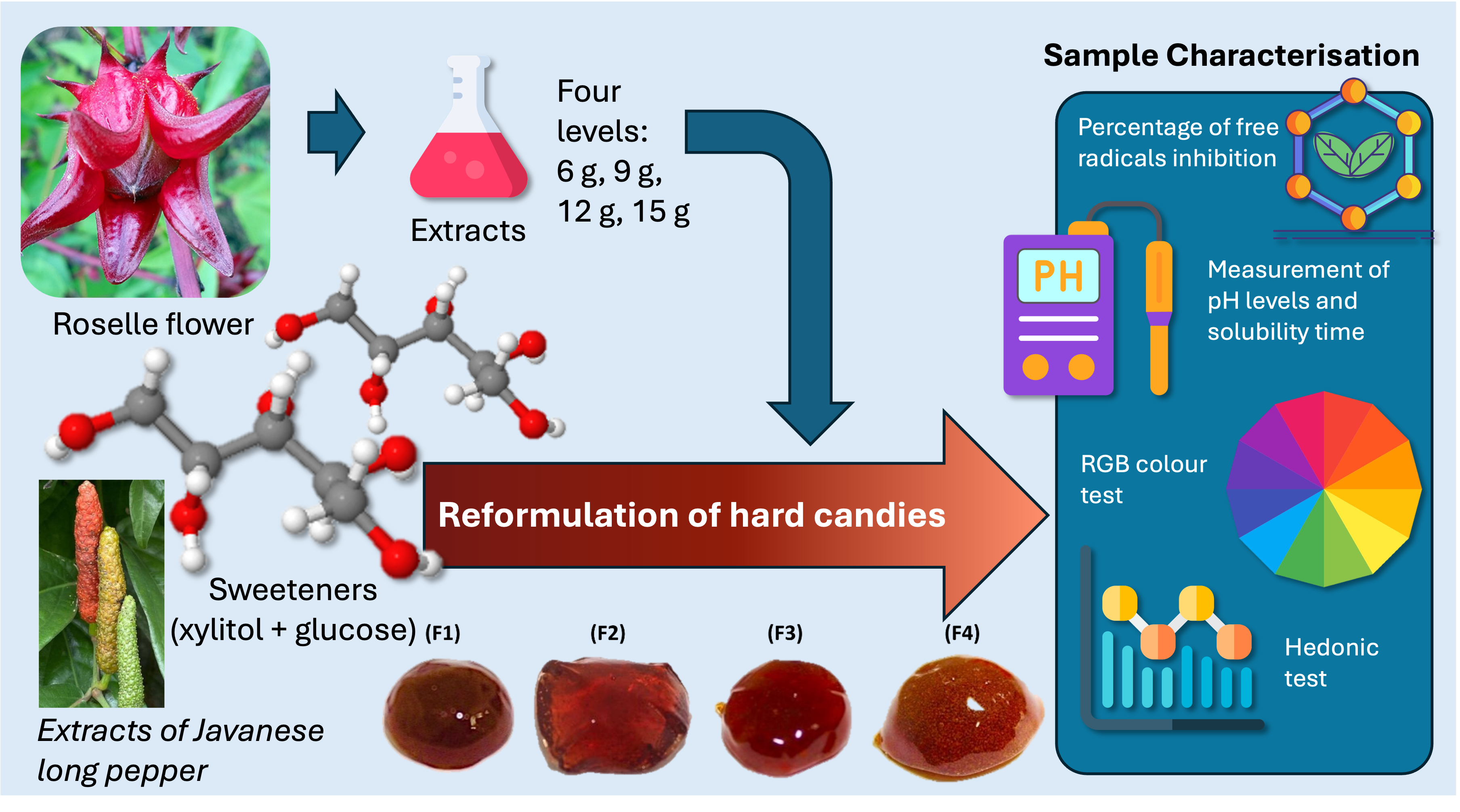
There is a growing interest in replacing synthetic dyes with natural colouring agents, primarily driven by increasing health concerns among consumers worldwide. This work aimed to reformulate hard candy products through incorporating different levels of roselle flower extracts (6-15 g) as an alternative colouring agent. The samples were also enriched with Javanese long pepper extract as a source of functional components and xylitol as an alternative sweetener. In this work, the properties of hard candy, including pH, solubility time, colour variation (expressed as Red, Green, and Blue – RGB), DPPH radical scavenging (% inhibition), and sensory acceptability, were evaluated. As a result, while pH, colour, and free radical inhibition were significantly altered, the treatments given did not affect solubility time. The pH level decreased consistently as the amount of roselle flower extract increased. Conversely, the RGB values and percentage inhibition increased with greater incorporation of roselle flower extracts into the formulation. In the case of colour, a higher proportion of the extract led to higher RGB values in hard candy, corresponding to a greater level of brightness achieved by F4. Meanwhile, F2 demonstrated the highest red intensity. Furthermore, the treatments resulted in significant effects on all sensory attributes, except aroma. F1 reached the highest sensory score for taste, texture, and overall attributes, while F2 reached the highest for colour. The work results confirm the further use of roselle flower in the formulation of red hard candy.
Article Details

This work is licensed under a Creative Commons Attribution-NonCommercial-NoDerivatives 4.0 International License.
References
Jeon Y, Oh J, Cho MS. Formulation optimization of sucrose-free hard candy fortified with cudrania tricuspidata extract. Foods. 2021;10(10):1–17.
Novais C, Molina AK, Abreu RMV, Santo-Buelga C, Ferreira ICFR, Pereira C, et al. Natural Food Colorants and Preservatives: A Review, a Demand, and a Challenge. J Agric Food Chem. 2022;70(9):2789–2805.
Wrolstad RE, Culver CA. Alternatives to those artificial FD&C food colorants. Annu Rev Food Sci Technol. 2012;3(1):59–77.
Oplatowska-Stachowiak M, Elliott CT. Food colors: Existing and emerging food safety concerns. Crit Rev Food Sci Nutr. 2017;57(3):524–548.
He SH, Jiang H. Qualitative and quantitative analysis of some co-existing colorants in some hard candies. J Food Compost Anal. 2022;109:104475.
Shruthi VH, Ramachandra CT, Nidoni U, Hiregoudar S, Naik N, Kurubar AR. Roselle (Hibiscus sabdariffa L.) as a source of natural colour: A review. Plant Arch. 2016;16(2):515–522.
Chumsri P, Sirichote A, Itharat A. Studies on the optimum conditions for the extraction and concentration of roselle (Hibiscus sabdariffa Linn.) extract. Songklanakarin J Sci Technol. 2008;30:133–139.
Halim Y, Evelyne C, Rosa D, Ramli S. Development of Roselle (Hibiscus sabdariffa L.) Calyx Jelly Candy. Caraka Tani: J Sustain Agric. 2022;37(2):357–372.
Hussein RM, Shahein YE, El AE, Awad HM. Biochemical and molecular characterization of three coloured types of Roselle (Hibiscus sabdariffa L.). J Am Sci. 2010;6(11):726–733.
Delgado Arcaño Y, Valmaña García OD, Mandelli D, Carvalho WA, Magalhães Pontes LA. Xylitol: A review on the progress and challenges of its production by chemical route. Catal Today. 2020;344:2–14.
Jadid N, Arraniry B, Hidayati D, Purwani K, Wikanta W, Hartanti S, et al. Proximate composition, nutritional values and phytochemical screening of Piper retrofractum vahl. fruits. Asian Pac J Trop Biomed. 2018;7(1):37–43.
Supriyanto S, Mojiono M. Inhibition of main protease enzyme (Mpro) by active compounds in cabya (Piper retrofractum Vahl.) for covid-19 treatment via in silico experiment. IOP Conf Ser Earth Environ Sci. 2022;1059(1).
Supriyanto S, Mojiono M, Ambarwati Y. Supplementation of Javanese Long Pepper Extracts into Sucrose-Free Hard Candy for Improving Antibacterial Activity against Streptococcus mutans. IOP Conf Ser Earth Environ Sci. 2023;1182(1):012059.
Mariod AA, Tahir HE, Mahunu GK. Composition of Hibiscus sabdariffa calyx, pigments, vitamins. In: Mariod AA, Tahir HE, Mahunu GK, editors. Roselle (Hibiscus sabdariffa) Chemistry, Production, Products, and Utilization. Academic Press; 2021. p. 69–75.
Tsai PJ, McIntosh J, Pearce P, Camden B, Jordan BR. Anthocyanin and antioxidant capacity in Roselle (Hibiscus Sabdariffa L.) extract. Food Res Int. 2002;35(4):351–356.
Souiy Z, Amri Z, Sharif H, Souiy A, Cheraief I, Hamden K, et al. The Use of D-Optimal Mixture Design in Optimizing Formulation of a Nutraceutical Hard Candy. Spigno G, editor. Int J Food Sci. 2023;2023:7510452.
Samanta S, Sarkar T, Chakraborty R, Rebezov M, Shariati MA, Thiruvengadam M, et al. Dark chocolate: An overview of its biological activity, processing, and fortification approaches. Curr Res Food Sci. 2022;5:1916–1943.
Minz PS, Saini CS. RGB camera-based image technique for color measurement of flavored milk. Measurement: Food. 2021;4.
Supriyanto S, Mojiono M, Maflahah I. Optimisation of Sucrose-Free Hard Candy Enriched with Piper retrofractum Vahl Extracts Using Response Surface Methodology (RSM). Trop J Nat Prod Res. 2025; 9(11):5565–5570.
Dhawan K, Rasane P, Singh J, Kaur S, Kaur D, Avinashe H, et al. Effect of Spice Incorporation on Sensory and Physico-chemical Properties of Matcha-Based Hard Candy. ACS Omega. 2023;8(32):29247–29252.
Spanemberg FEM, Korzenowski AL, Sellitto MA. Effects of sugar composition on shelf life of hard candy: Optimization study using D-optimal mixture design of experiments. J Food Process Eng. 2019;42(6):1–10.
