
Antibacterial activity of calamansi, Citrofortunella macrocarpa, fruit waste extract against aquaculture pathogens
Article Sidebar
Main Article Content
Abstract
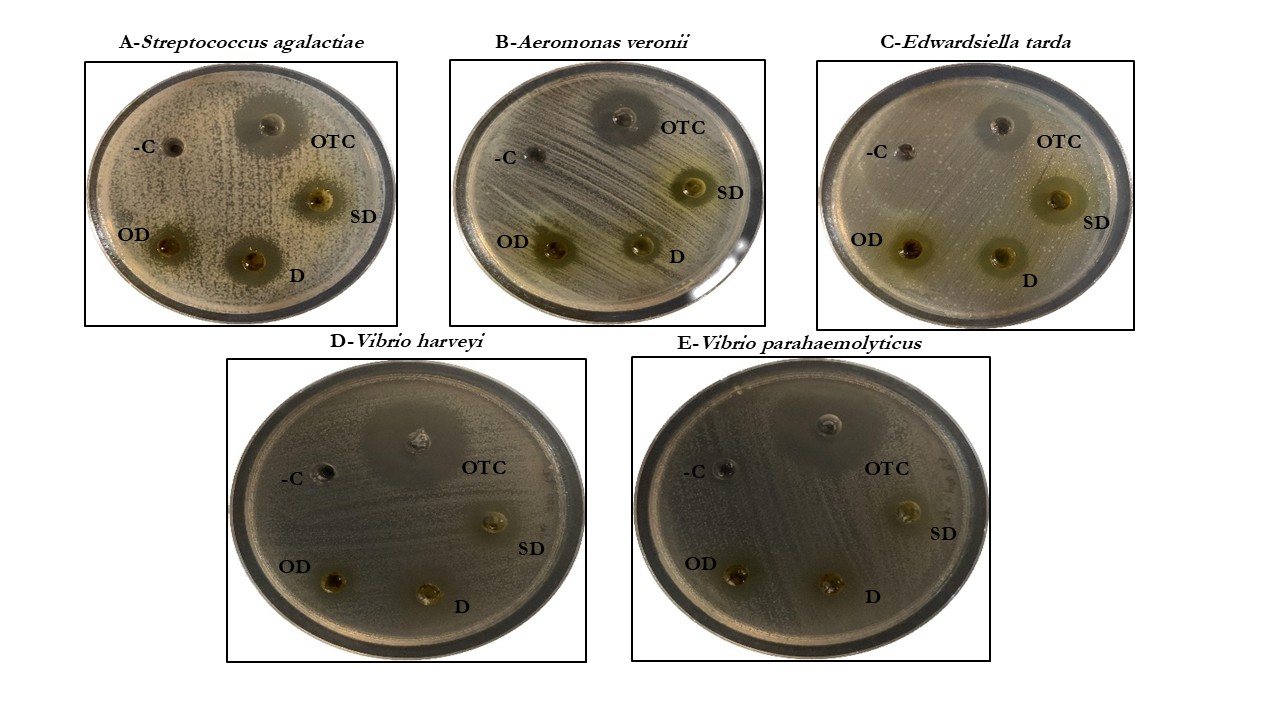
Infectious diseases and multidrug-resistant microorganisms in global aquaculture have become major challenges in the industry that necessitate innovative solutions. This study investigated the antibacterial potential of Calamansi Citrofortunella macrocarpa fruit processing waste. The extracts were evaluated for their efficacy against known aquaculture pathogens, including Streptococcus agalactiae, Aeromonas veronii, Edwardsiella tarda, Vibrio harveyi, and Vibrio parahaemolyticus. Different drying methods (sun drying, dehydrator drying, oven drying) were used to obtain dried calamansi powder. The semi-solid extract was prepared via maceration with 95% ethanol. Extraction yields varied across drying techniques, with sun-dried samples yielding the highest (7%), oven-dried extracts at 6%, and dehydrator-dried samples the lowest (3%). Antibacterial activity was assessed via agar well diffusion, and potency was further confirmed by the minimum inhibitory concentration (MIC) method. Inhibition zones across pathogens ranged from 5.7 to 9.1 mm, compared to oxytetracycline as the positive control (14.6 mm). MIC assays revealed stronger antibacterial effects in sun-dried and dehydrator-derived extracts (256–512 mg/mL), while oven-dried extracts exhibited weaker activity (1024 mg/mL). Calamansi fruit waste emerges as a promising alternative for combating aquaculture pathogens, contributing to waste management and sustainable solutions. However, we show here that antimicrobial potential is significantly influenced by drying methods. Further research is crucial for identifying specific antibacterial compounds, optimizing application methods, and ensuring safety in aquaculture practices. This investigation contributes valuable knowledge for harnessing the antibacterial properties of calamansi waste in aquaculture, addressing the pressing concerns of infectious diseases and antibiotic resistance.
Article Details

This work is licensed under a Creative Commons Attribution-NonCommercial-NoDerivatives 4.0 International License.
References
Wei LS, Goh KW, Abdul Hamid NK, Abdul Kari Z, Wee W, Van Doan H. A mini-review on co-supplementation of probiotics and medicinal herbs: application in aquaculture. Front Vet Sci. 2022; 9:869564.
Singh B, Singh JP, Kaur A, Yadav MP. Insights into the chemical composition and bioactivities of citrus peel essential oils. Food Res Int. 2021;143:110231.
Mostafa HS. Banana plant as a source of valuable antimicrobial compounds and its current applications in the food sector. J Food Sci. 2021;86(9):3778-3797.
Nik Mohamad Nek Rahimi N, Natrah I, Loh JY, Ervin Ranzil FK, Gina M, Lim SH, Lai KS, Chong CM. Phytocompounds as an alternative antimicrobial approach in aquaculture. Antibiot. 2022;11(4):469-570.
Russo C, Maugeri A, Lombardo GE, Musumeci L, Barreca D, Rapisarda A, Cirmi S, Navarra M. The second life of Citrus fruit waste: A valuable source of bioactive compounds. Mol. 2021;26(19):5991.
Palma CE, Cruz PS, Cruz DT, Bugayong AM, Castillo AL. Chemical composition and cytotoxicity of Philippine calamansi essential oil. Ind Crops Prod. 2019;128:108-114.
Maqbool Z, Khalid W, Atiq HT, Koraqi H, Javaid Z, Alhag SK, Al-Shuraym LA, Bader DM, Almarzuq M, Afifi M, Al-Farga A. Citrus waste as source of bioactive compounds: Extraction and utilization in health and food industry. Mol. 2023;28(4):1636.
Kari ZA, Sukri SA, Rusli ND, Mat K, Mahmud MB, Zakaria NN, Wee W, Hamid NK, Kabir MA, Ariff NS, Abidin SZ. Recent advances, challenges, opportunities, product development and sustainability of main agricultural wastes for the aquaculture feed industry–a review. Ann Anim Sci. 2023;23(1):25-38.
Mulat M, Pandita A, Khan F. Medicinal plant compounds for combating the multi-drug resistant pathogenic bacteria: a review. Curr Pharm Biotechnol. 2019;20(3):183-196.
Chen HC, Peng LW, Sheu MJ, Lin LY, Chiang HM, Wu CT, Wu CS, Chen YC. Effects of hot water treatment on the essential oils of calamondin. J Food Drug Analysis. 2013;21(4):363-368.
Hua K, Cobcroft JM, Cole A, Condon K, Jerry DR, Mangott A, Praeger C, Vucko MJ, Zeng C, Zenger K, Strugnell JM. The future of aquatic protein: implications for protein sources in aquaculture diets. One Earth. 2019;1(3):316-329.
Husni E, Ismed F, Afriyandi D. Standardization study of simplicia and extract of calamondin (citrus microcarpa bunge) peel, quantification of hesperidin and antibacterial assay. Phcog J. 2020;12(4):1-5.
Chan SM, Fong VY, Koo SY, Singh TR, Tang EH, Thoo LT, Sit NW. Antibacterial activity of selected medicinal plants from Malaysia. Asia Pac J Sci Technol. 2022;27(1):1-2.
Lee SW, Najiah M. Antimicrobial property of 2-hydroxypropane-1, 2,3-tricarboxylic acid isolated from Citrus microcarpa extract. Agric Sci China. 2009;8(7):880-886.
Belwal T, Cravotto C, Prieto MA, Venskutonis PR, Daglia M, Devkota HP, Baldi A, Ezzat SM, Gómez-Gómez L, Salama MM, Campone L. Effects of different drying techniques on the quality and bioactive compounds of plant-based products: A critical review on current trends. Dry Technol. 2022 ;40(8):1539-61.
Babaei Rad, S., Mumivand, H., Mollaei, S. et al. Effect of drying methods on phenolic compounds and antioxidant activity of Capparis spinosa L. fruits. BMC Plant Biol 2025;133:20-25.
Mahmoud Salama, M. Effects of different drying techniques on the quality and bioactive compounds of plant-based products: a critical review on current trends. Drying Technol. 2022;40(13):2634–2654.
ElGamal R, Song C, Rayan A, M Liu C, Rejaie SA, ElMasry G. Thermal degradation of bioactive compounds during drying process of horticultural and agronomic products: A comprehensive overview. Agron. 2023;13(6):1580.
Zaim IR, Wahab M, Ismail HF, Othman N, Hara H, Akhir FM. Extraction and determination of flavonoid compounds in citrus fruit waste. InIOP Conference Series. Earth Environ Sci. 202;1144:012005.
Matuschek E, Brown DF, Kahlmeter G. Development of the EUCAST disk diffusion antimicrobial susceptibility testing method and its implementation in routine microbiology laboratories. Clin Microbiol Infect. 2014;20(4):255-266.
Saleem M, Saeed MT. Potential application of waste fruit peels (orange, yellow lemon and banana) as wide range natural antimicrobial agent. J King Saud Univ Sci. 2020;32(1):805-810.
Wiegand I, Hilpert K, Hancock RE. Agar and broth dilution methods to determine the minimal inhibitory concentration (MIC) of antimicrobial substances. Nat Protoc. 2008;3(2):163-175.
Eucast D. Determination of minimum inhibitory concentrations (MICs) of antibacterial agents by agar dilution. Clin Microbiol Infect. 2000;6(9):509-515.
Roshni PS, Alexpandi R, Abirami G, Durgadevi R, Cai Y, Kumar P, Ravi AV. Hesperidin methyl chalcone, a citrus flavonoid, inhibits Aeromonas hydrophila infection mediated by quorum sensing. Microb Pathog. 2023;177:106029.
Addi M, Elbouzidi A, Abid M, Tungmunnithum D, Elamrani A, Hano C. An overview of bioactive flavonoids from citrus fruits. Appl Sci. 2021;12(1):2-9.
Farhadi F, Khameneh B, Iranshahi M, Iranshahy M. Antibacterial activity of flavonoids and their structure–activity relationship: An update review. Phytotherapy Research. 2019;33(1):13-40.
Harborne JB, Williams CA. Advances in flavonoid research since 1992. Phytochemistry. 2000;55(6):481-504.
Cushnie TT, Lamb AJ. Antimicrobial activity of flavonoids. Int J Antimicrob Agents. 2005;26(5):343-356.
Mbondo NN, Owino WO, Ambuko J, Sila DN. Effect of drying methods on the retention of bioactive compounds in African eggplant. Food Sci Nutr. 2018;6(4):814-823.
Rababah TM, Alhamad M, Al-Mahasneh M, Ereifej K, Andrade J, Altarifi B, Almajwal A, Yang W. Effects of drying process on total phenolics, antioxidant activity and flavonoid contents of common mediterranean herbs. Int J Agric Biol Eng. 2015;8(2):145-150.
