
Growing Miniature Waterlilies Under Different Lighting Conditions
Article Sidebar
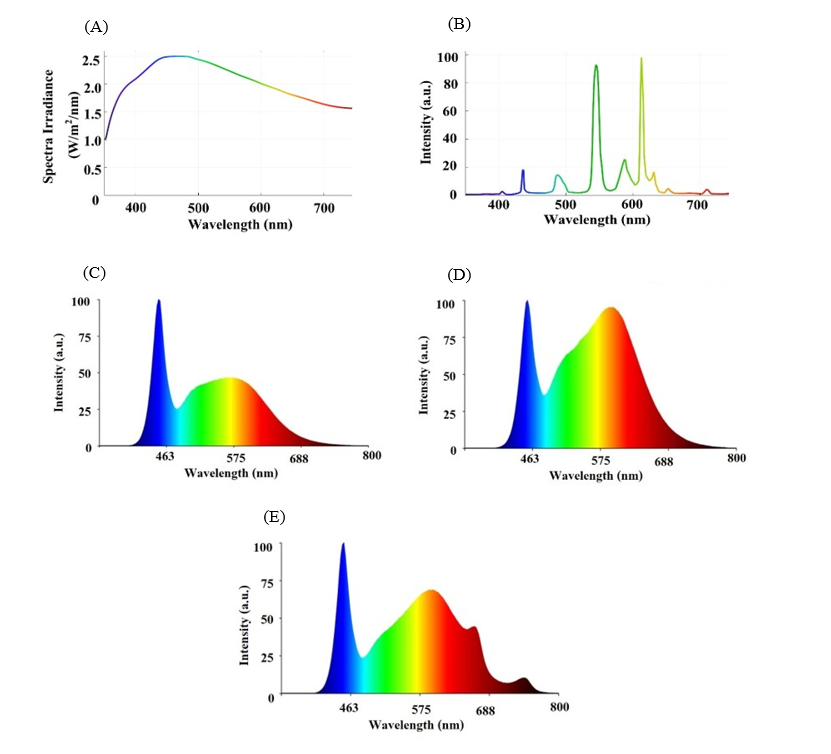
Main Article Content
Abstract
An experiment was conducted at the Faculty of Agriculture and Natural Resources, Rajamangala University of Technology Tawan–ok, Chonburi, from July to September 2023. The objective of this research was to determine the optimal growing conditions for Nymphaea minuta based solely on variations in the color temperature of the LED growth lights. This experiment used five light sources to investigate the growth of N. minuta rhizomes, including 1) 6500K-LED growth light (6500K-LED), 2) 4500K-LED growth light (4500K-LED), 3) Mixed 6500K +3500K+450 nm+660 nm+730 nm-LED growth light (Mix LED) and 4) white fluorescent (White-Flu) light sources compared to the control (sunlight). Specimens from each group were planted in a ceramic cup with a 12.7 cm top diameter and a 10.16 cm depth, which was half filled with heavy clay soil. Characterization of the samples was conducted from day 28 to day 84 post-planting to assess growth. Our findings indicate that the responses of N. minuta to different light qualities diverged from those observed in most terrestrial plants. The leaf count under artificial light treatments did not significantly differ from that under sunlight treatment after 84 days. However, the leaf length, leaf width, and petiole length under sunlight treatment were lower than those under artificial light treatments. The Mix LED treatment exhibited the shortest time to flowering (54.75 days), whereas the White-Flu treatment required the longest duration to reach flowering (75.00 days).
Article Details

This work is licensed under a Creative Commons Attribution-NonCommercial-NoDerivatives 4.0 International License.
References
Landon K, Edwards RA, Nozaic PI. A new species of waterlily (Nymphaea minuta: Nymphaeaceae) from Madagascar. SIDA, Contrib Bot. 2006; 887-893.
Zheng L, He H, Song W. Application of light-emitting diodes and the effect of light quality on horticultural crops: A review. HortScience. 2019;54(10):1656-1661.
Bantis F, Karamanoli K, Ainalidou A, Radoglou K, Constantinidou HIA. Light emitting diodes (LEDs) affect morphological, physiological and phytochemical characteristics of pomegranate seedlings. Sci Hortic. 2018;234:267-274.
Yan Z, He D, Niu G, Zhou Q, Qu Y. Growth, nutritional quality, and energy use efficiency of hydroponic lettuce as influenced by daily light integrals exposed to white versus white plus red light-emitting diodes. HortScience. 2019;54(10):1737-1744.
Li JF, Yi CY, Zhang CR, Pan F, Xie C, Zhou WZ, Zhou CF. Effects of light quality on leaf growth and photosynthetic fluorescence of Brasenia schreberi seedlings. Heliyon. 2021;7:e06082.
Xu C, Wang HJ, Yu Q, Wang HZ, Liang XM, Liu M, Jeppesen E. Effects of Artificial LED Light on the Growth of Three Submerged Macrophyte Species during the Low-Growth Winter Season: Implications for Macrophyte Restoration in Small Eutrophic Lakes. Water. 2019;11(7):1512.
Casal JJ. Photoreceptor signaling networks in plant responses to shade. Annu Rev Plant Biol. 2013;64(1):403–427.
Sasidharan R, Chinnappa CC, Staal M, Elzenga JTM, Yokoyama R, Nishitani K, Voesenek LACJ, Pierik R. Light quality-mediated petiole elongation in Arabidopsis during shade avoidance involves cell wall modification by xyloglucan endotransglucosylase/hydrolases. Plant Physiol. 2010;154(2):978-990.
Smith H. Phytochromes and light signal perception by plants-an emerging synthesis. Nature. 2000;407(6804):585-591.
Molas ML. Photomorphogenesis in Plants and Bacteria: Function and Signal Transduction Mechanisms. 2018;107:299-327.
Wei Y, Zhang J, Hu D, Zhang J, Li Z. Effects of Artificial Light at Night on Photosynthesis and Respiration of Two Urban Vascular Plants. Forests. 2024;15(4):659.
Terashima I, Fujita T, Inoue T, Chow WS, Oguchi R. Green light drives leaf photosynthesis more efficiently than red light in strong white light: revisiting the enigmatic question of why leaves are green. Plant Cell Physiol. 2009;50(4):684-697.
Smith H, Whitelam G. The shade avoidance syndrome: multiple signals and ecological consequences. Plant Cell Environ. 2017;40(2):253-261.
Duarte CM, Wu J, Xiao X, Bruhn A. Can LED light enhance seagrass growth for habitat restoration and sustainable fisheries?. Front Mar Sci. 2018;5:384.
Shelley A. Etnier, Philip J. Villani, Travis J. Ryan "Influence of Light Quality and Quantity on Heterophylly in the Aquatic Plant Nymphaea odorata subsp. tuberosa (Nymphaeaceae). Northeast Nat. 2017; 24(2):152-164.
Kim HH, Goins GD, Wheeler RM, Sager JC. Green-light supplementation for enhanced lettuce growth under red- and blue-light-emitting diodes. HortScience. 2019;44(7):1670-1674.
Xu DQ, Gao W, Ruan J. Effects of light quality on plant growth and development. Plant Physiol. J, 2015; 51.8:1217-1234.
Sharkey T D, Raschke K. Effect of Light Quality on Stomatal Opening in Leaves of Xanthium strumarium L. Plant Physiol. 1981;68(5):1170-1174.
Li Q, Kubota C. Effects of supplemental light quality on growth and phytochemicals of baby leaf lettuce. Environ Exp Bot. 2009; 67(1), 59-64.
