
Evaluating the bioremediation potential of Bacillus cereus and micrococcus iuteus consortium in soil polluted by heavy metal
Article Sidebar
Main Article Content
Abstract
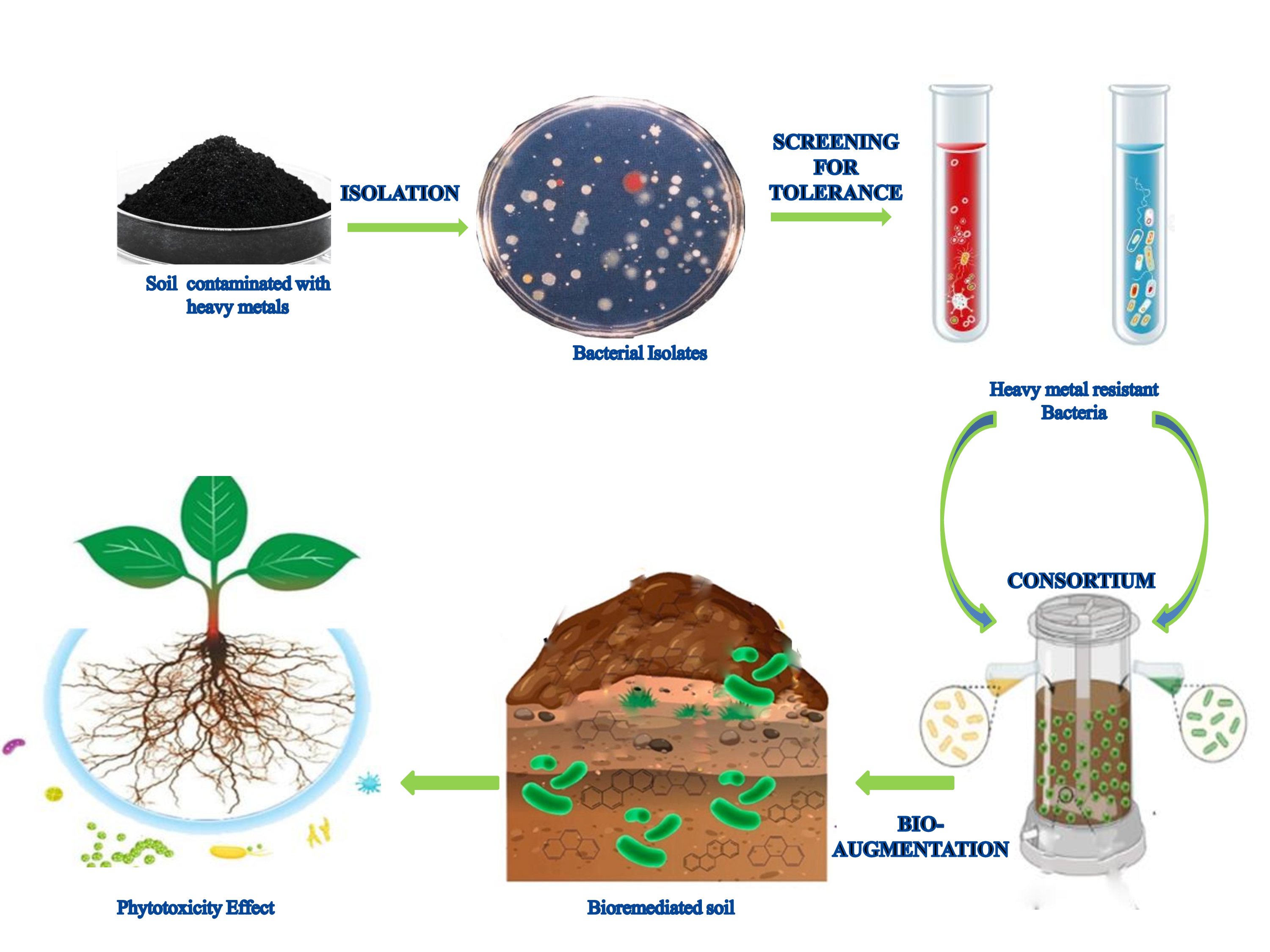
Pollution by heavy metal is an environment health threat due to their toxicity. Bioremediation through microbes is an ecofriendly method used to treat contaminated soils. Microbial consortiums are used as a natural strategy to remediate contaminated soil giving enhanced results compared with individual species. Bioremediation of heavy metals via Bacillus cereus and Micrococcus luteus were investigated. B. cereus and M. luteus were exposed to 3000 mg/L each of Lead nitrate, Mercuric Chloride and Sodium arsenate. Further, the organisms were exposed to 1000 mg/L of all three metals at 30°C for 96 hrs. Phytotoxicity of treated soil was also investigated. The microbial consortium combination of B. cereus and M. luteus has the maximum accumulation of As (1009.60 mg). Individually B. cereus and M. luteus demonstrated the highest uptake of As (729.45mg) and Hg (601.36 mg) respectively. The highest accumulation of the combined three heavy metals was observed by M. luteus. Soil phytotoxicity responses exposed that reduced heavy metal concentration correlate with decreased soil toxicity. The results indicated the efficiency of using the target organisms for the bioremediation of heavy metal and their probable agent for bioremediation.
Article Details

This work is licensed under a Creative Commons Attribution-NonCommercial-NoDerivatives 4.0 International License.
References
Garg P, Singh SS. Heavy metal accumulation pattern in soil and seedlings and in leaves of mature tree species at gevra coal mine area in chhattisgarh, India. India J Ind Pollut Control. 2017.
Yadav R, Ror P, Beniwal R, Kumar S, Ramakrishna W. Bacillus sp. and arbuscular mycorrhizal fungi consortia enhance wheat nutrient and yield in the second-year field trial: Superior performance in comparison with chemical fertilizers. J Appl Microbiol. 2022; 132(3):2203–2219.
Chowdhury S, Thakur AR, Chaudhuri SR. Novel microbial consortium for laboratory scale lead removal from city effluent. J Environ Sci Technol. 2010; 4(1):41–54.
Njoku K, Akinyede O, Obidi O. Microbial Remediation of Heavy metals Contaminated Media by Bacillus megaterium and Rhizopus stolonifer Scientific African. 2020:10: e00545.
Singh P, Kadam V, Patil Y. Isolation and development of a microbial consortium for the treatment of automobile service station wastewater. J Appl Microbiol. 2022; 132(2):1048–1061.
Tufail M A, Bejarano A, Shakoor A, Naeem A, Arif MS, Dar AA, Farooq T H, Pertot, I., Puopolo, G.,. Can bacterial endophytes be used as a promising bio-inoculant for the mitigation of salinity stress in crop plants?a global meta-analysis of the last decade. Microorganisms. 2021;9:186.
Rusnam, Neni Gusmanizar. An Acrylamide-degrading Bacterial Consortium Isolated from Volcanic Soil, J Biochem Microbiol Biotechnol. 2021; 9(2). 19-24.
Hossen, M.d.A, Chowdhury, A.I.H., Mullick, Md.R.A., Hoque, A,. Heavy metal pollution status and health risk assessment vicinity to Barapukuria coal mine area of Bangladesh. Environ Nanotechnol Monit Manag. 2021; 16: 100469.
Liu X , Mei S, Joana Falcao Salles. 2023. Inoculated microbial consortia perform better than single strains in living soil: A meta-analysis. Applied Soil Ecology.2023; 190:105011
Vaishnav VK, Chatterjee T, Agrawal M. Identification and determination of MIC value of heavy metal tolerance bacteria from coal mine of chhattisgarh and their molecularcharacterization. J Nonlinear Anal Optim. 2024; 15(2): 2.
M.S. Akhtar , B. Chali , T. Azam. Bioremediation of arsenic and lead by plants and microbes from contaminated soil. Res. Plant Sci. 2013; 1(3): 68–73.
Bodor A, Bounedjoum N, Feigl G, Laczi ADK, Agyi AS, PereiGRK,(2021). Exploitation of extracellular organic matter from Micrococcus luteus to enhance ex situ bioremediation of soils polluted with used lubricants. J Hazard Mater. 2021; 417: 125996.
Jiang, Y., Brassington, K.J., Prpich, G., Paton, G.I., Semple, K.T., Pollard, S.J.T., Coulon, F. Insights into the biodegradation of weathered hydrocarbons in contaminated soils by bioaugmentation and nutrient stimulation. Chemosphere. 2016; 161:300–307.
Mansouri A, Abbes C, Ben Mouhoub R, Ben Hassine S, Landoulsi A. Enhancement of mixture pollutant biodegradation efficiency using a bacterial consortium under static magnetic field. Das S, editor. PLOS ONE. 2019; 14: e0208431.
Imron MF, Kurniawan SB, Abdullah SRS. Resistance of bacteria isolated from leachate to heavy metals and the removal of Hg by Pseudomonas aeruginosa strain FZ-2 at different salinity levels in a batch biosorption system. Sustain Environ Res. 2021; 31: 14.
Oijagbe, I. J., Abubakar, B. Y., Edogbanya, P. R. O., Suleiman, M. O., & Olorunmola, J. B. (2019). Effects of heavy metals on soil microbial biomass carbon. MOJ Biol Med. 2019; 4:30–32.
Leung WC, Wong M-F, Chua H, Lo W, Yu PHF, Leung CK. Removal and recovery of heavy metals by bacteria isolated from activated sludge treating industrial effluents and municipal wastewater. Water Sci Technol. 2000; 41: 233–240.
Dusengemungu L, Gwanama C, Simuchimba G and Mubemba B (2022) Potential of bioaugmentation of heavy metal contaminated soils in the Zambian Copperbelt using autochthonous filamentous fungi. Front. Microbiol. 2022; 13:1045671.
Ridene S, Werfelli N, Mansouri A, Landoulsi A, Abbes C (2023) Bioremediation potential of consortium Pseudomonas stutzeri LBR and Cupriavidus metallidurans LBJ in soil polluted by lead. PLoS ONE. 2023; 18(6): e0284120.
Bodor, A., Petrovszki, P., Erdein´e Kis, ´A., Vincze, G.E., Laczi, K., Bounedjoum, N., Szil´agyi, ´A., Szalontai, B., Feigl, G., Kov´acs, K.L., R´akhely, G., Perei, K. Intensification of ex situ bioremediation of soils polluted with used lubricant oils: a comparison of biostimulation and bioaugmentation with a special focus on the type and size of the inoculum. IJERPH. 2020; 17:4106.
Ayangbenro AS, Babalola OO. Genomic analysis of Bacillus cereus NWUAB01 and its heavy metal removal from polluted soil. Sci Rep. 2020; 10(1):19660.
Yu, C., Liu, Y., Jia, Y., Su, X., Lu, L., Ding, L., Shen, C. Extracellular organic matter from Micrococcus luteus containing resuscitation-promoting factor in sequencing batch reactor for effective nutrient and phenol removal. Sci Total Environ. 2020; 727:138627.
Mrozik A, Seget ZP, Bioaugmentation as a strategy for cleaning up of soils contaminated with aromatic compounds. Microbiological Research . 2010; 363-375.
Su, X.M., Liu, Y.D., Hashmi, M.Z., Ding, L.X., Shen, C.F. Culture-dependent and culture-independent characterization of potentially functional biphenyl-degrading bacterial community in response to extracellular organic matter from Micrococcus luteus. Microb Biotechnol. 2015; 8:569–578.
