
Indian blackberry: Unveiling its health and organoleptic delights and use in beverage fermentation
Article Sidebar
Main Article Content
Abstract
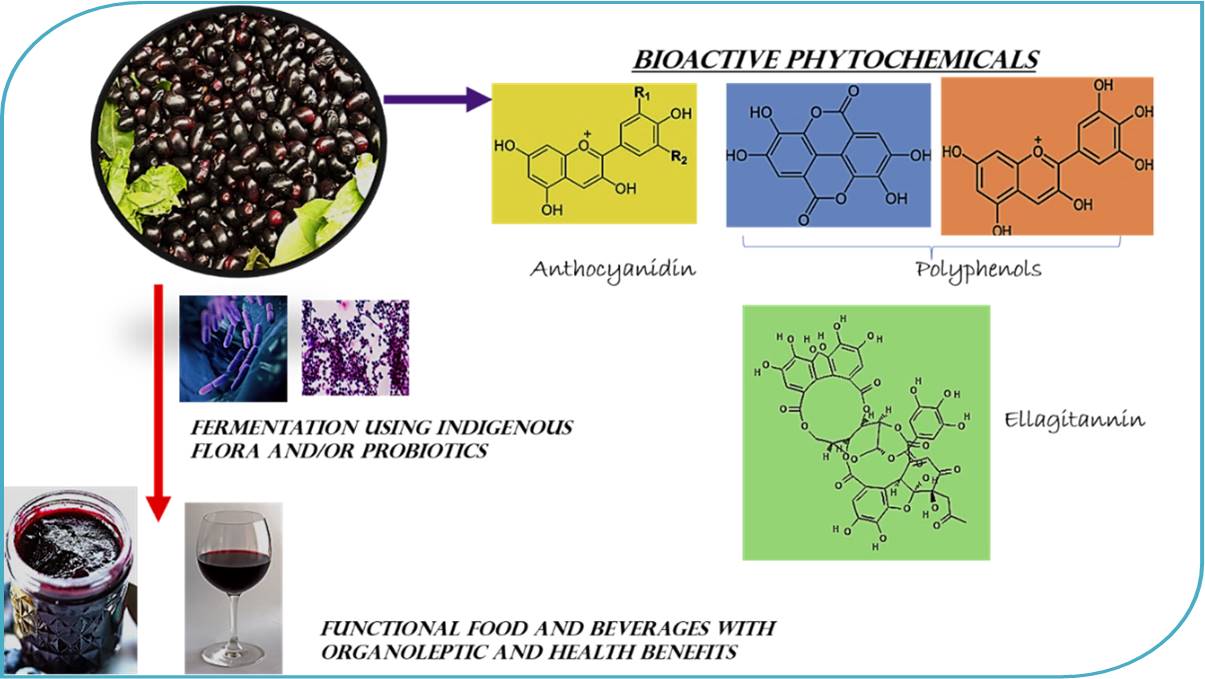
Recent years have witnessed a rise in interest in the fruit Indian blackberry, also known as Jamun or Jambu in the native language. Despite being in regular use at household levels, fruit, and other parts of the plant, have been investigated for its nutritional, biochemical and health values only recently. Several studies, spanning over the last decade, have reported various attributes of the fruit, especially the pulp, as having significant roles in combating diabetes, inflammation, reactive oxygen species (ROS), abdominal discomfort, infections and even cancer. These beneficial properties of Jamun are attributed to diverse arrays of bioactive anthocyanidins, polyphenols and ellagitannins- all of which are crucial plant secondary metabolites (PSMs). These PSMs have been correlated with the ferric reducing as well as ROS quenching activities, indicating antioxidant activity. Additionally, an important biochemical called jamboline also contributes to antioxidant activity as well as supposedly prevents solubilisation of starch in presence of sufficient glucose. Apart from being rich in important PSMs, the fruit itself is rich in carbohydrates, proteins, amino acids and vitamins that further contribute to its taste and aroma. As such, the fruit has been explored for its potential in producing functional food and beverages through microbial fermentations, especially wines. The potential for fermentation depends on the fact that jamun contains roughly 15-16 % w/w fermentable sugar. This review systematically summarizes the benefits of Jamun and its use as a fermentation substrate. Additionally, the possibility of using Jamun in fermentation of functional beverages other than wine has also been explored.
Article Details

This work is licensed under a Creative Commons Attribution-NonCommercial-NoDerivatives 4.0 International License.
References
Patil SS, Thorat RM, Rajasekaran P. Utilization of jamun fruit (Syzygium cumini) for production of red wine. J Adv Lab Res Biol 2012; 3(3):200-203.
Gajera HP, Gevariya SN, Patel SV, Golakiya BA. Nutritional profile and molecular fingerprints of indigenous black jamun (Syzygium cumini L.) landraces. J Food Sci Technol. 2018 Feb; 55:730-739.
Benherlal PS, Arumughan C. Chemical composition and in vitro antioxidant studies on Syzygium cumini fruit. J Sci Food Agric. 2007 Nov; 87(14):2560-2569.
Chaudhary C, Yadav BS, Grewal RB. Preperation of red wine by blending of grape (Vitis vinifera L.) and jamun (Syzygium cuminii L. Skeels) juices before fermentation. Int J Agric Food Sci Technol. 2014;5(4):239-348.
D'Souza P A, Naik PA, Rao SC, Vyas SVS, Palan AM, Cornelio B, Rao CV. Fermented fruit juice production using unconventional seasonal fruits through batch fermentation. J Adv Lab Res Biol. 2017;14(2):45–52.
Singh S, Singh AK, Saroj PL, Mishra S. Research status for technological development of jamun (Syzygium cumini) in India: A review. Indian J Agric Sci. 2019;89(12):1991-1998.
Paganga G, Miller N, Evans CAR. The polyphenolic content of fruit and vegetables and their antioxidant activities. What does a serving constitute. Free Radic Res. 1999;30(2):153-162.
Warrier PK. Indian medicinal plants: a compendium of 500 species. Orient Blackswan. 1993;1:3-5.
Lokesh K, Suresha GJ, Jagadeesh SL. Effect of yeast strains and must types on quality of jamun wine.
Roy G, Malla S, Chakravarty S. Integrated processing of jamun (Syzygium cumini (L.) Skeels) fruit for value addition and assessment of its impact on health and nutrition. Clin Diagn Lab Immunol. 2013;21:65-69.
Kumar M, Zhang B, Nishad J, Verma A, Sheri V, Dhumal S, Radha, Sharma N, Chandran D, Senapathy M, Dey A. Jamun (Syzygium cumini (L.) skeels) seed: A Review on Nutritional Profile, Functional food properties, health-promoting applications, and safety aspects. Processes. 2022;10(11):2169.
Noomrio MH, Dahot MU. Nutritive value of Eugenia jambosa fruit. J Islam Acad Sci. 1996;9(1):9-12.
Faria AF, Marques MC, Mercadante AZ. Identification of bioactive compounds from jambolão (Syzygium cumini) and antioxidant capacity evaluation in different pH conditions. Food chemistry. 2011 Jun 15;126(4):1571-1578.
Wathon MH, Susilowati E, Ariani SR. Anthocyanins from Java Plum Fruits (Syzygium cumini) and their Stability in Various pHs. J Biomim Biomater Biomed Eng. 2023;62:51-61.
Heim KE, Tagliaferro AR, Bobilya DJ. Flavonoid antioxidants: chemistry, metabolism and structure-activity relationships. J Nutr Biochem. 2002;13(10):572-584.
Tavares IMC, Vanzela ESL, Rebello LP, Ramos AM, Alonso SG, Romero EG, Silva RD, Gutierrez IH. Comprehensive study of the phenolic composition of the edible parts of jambolan fruit (Syzygium cumini L. skeels). Food Res Int. 2016;82:1-3.
Suradkar NG, Pawar VS, Shere DM. Physicochemical, proximate and bioactive composition of jamun (Syzygium cuminii L.) fruit. Int J Chem Stud. 2017;5(3):470-772.
Kumawat M, Damor J, Kachchhwaha J, Garg AK, Singh C. Pharmacological properties and therapeutic potential of Syzygium cumini (Jamun): A review. World J Pharm Sci. 2018; 7:312-322.
Paul DK, Shaha RK. Citrus fruits in the northern region of Bangladesh. Pakistan J Biol Sci. 2004; 7:238-242.
Baliga MS, Bhat HP, Baliga BR, Wilson R, Palatty PL. Phytochemistry, traditional uses and pharmacology of Eugenia jambolana Lam. (black plum): A review. Food Res Int. 2011;44(7):1776-1789.
Li L, Adams LS, Chen S, Killian C, Ahmed A, Seeram NP. Eugenia jambolana Lam. berry extract inhibits growth and induces apoptosis of human breast cancer but not non-tumorigenic breast cells. J Agric Food Chem. 2009;57(3):826-231.
Rastogi RP, Mehrotra BN. 7th edition. Compendium of Indian medicinal plants. 1993.
Sagrawat H, Mann AS, Kharya MD. 7th edition. Pharmacological potential of Eugenia jambolana:A review. 2006.
Veigas JM, Narayan MS, Laxman PM, Neelwarne B. Chemical nature, stability and bioefficacies of anthocyanins from fruit peel of Syzygium cumini Skeels. Food Chemistry. 2007;105(2):619-627.
Sharma SB, Nasir A, Prabhu KM, Murthy PS. Antihyperglycemic effect of the fruit-pulp of Eugenia jambolana in experimental diabetes mellitus. J Ethnopharmacol. 2006;104(3):367-373.
Sharma B, Viswanath G, Salunke R, Roy P. Effects of flavonoid-rich extract from seeds of Eugenia jambolana (L.) on carbohydrate and lipid metabolism in diabetic mice. Food chemistry. 2008;110(3):697-705.
Sharma B, Balomajumder C, Roy P. Hypoglycemic and hypolipidemic effects of flavonoid rich extract from Eugenia jambolana seeds on streptozotocin induced diabetic rats. Food Chem Toxicol. 2008;46(7):2376-2383.
Ramirez RO, Roa Jr CC. The gastroprotective effect of tannins extracted from duhat (Syzygium cumini Skeels) bark on HCl/ethanol induced gastric mucosal injury in Sprague‐Dawley rats. Clin Hemorheol Microcirc. 2003;29(3-4):253-261.
Ravi K, Ramachandran B, Subramanian S. Protective effect of Eugenia jambolana seed kernel on tissue antioxidants in streptozotocin-induced diabetic rats. Biol Pharma Bull. 2004;27(8):1212-1217.
Morton JF. Fruits of warm climates. JF Morton. 1987;6(2):60-66.
Barrett DM, Lloyd B. Advanced preservation methods and nutrient retention in fruits and vegetables. J Sci Food Agric. 2012;92(1):7-22.
Ramya S, Neethirajan K, Jayakumararaj R. Profile of bioactive compounds in Syzygium cumini-a review. J Pharm Res. 2012;5(8):4548-4553.
Indira G, Mohan RJ. National institute of nutrition Indian council of medical research. Indian J Nutr Physiol Allied Sci. 1993;1:34-37.
Boschi-Pinto C, Velebit L, Shibuya K. Estimating child mortality due to diarrhoea in developing countries. Bul World Health Organ. 2008;86(9):710-717.
Jagetia GC, Baliga MS. Syzygium cumini (Jamun) reduces the radiation-induced DNA damage in the cultured human peripheral blood lymphocytes: a preliminary study. Toxicol Lett. 2002;132(1):19-25.
Hassimotto NM, Genovese MI, Lajolo FM. Antioxidant activity of dietary fruits, vegetables, and commercial frozen fruit pulps. J Agric Food Chem. 2005;53(8):2928-2935.
do Nascimento-Silva NR, Bastos RP, da Silva FA. Jambolan (Syzygium cumini (L.) Skeels): A review on its nutrients, bioactive compounds and health benefits. J Food Compos Anal. 2022;109:104491.
Ayyanar M, Subash-Babu P. Syzygium cumini (L.) Skeels: A review of its phytochemical constituents and traditional uses. Asian Pac J Trop Biomed. 2012;2(3):240-246.
Kaneria M, Baravalia Y, Vaghasiya Y, Chanda S. Determination of antibacterial and antioxidant potential of some medicinal plants from Saurashtra region, India. Indian J Pharm Sci. 2009;71(4):406-408.
Saisrilakshmi G, Rao SK, Aishwarya A, Amulya M, Sowmya I, Reddy LR. A Systematic Review on Natural Plants Used for Hepatoprotectivity. Int J Pharm Sci Rev Res. 2018;12:65-67.
Helmstädter A. Syzygium cumini (L.) SKEELS (Myrtaceae) against diabetes–125 years of research. Die Pharm Int J Pharm Sci. 2008;63(2):91-101.
Tak Y, Kaur M, Jain MC, Samota MK, Meena NK, Kaur G, Kumar R, Sharma D, Lorenzo JM, Amarowicz R. Jamun seed: A review on bioactive constituents, nutritional value and health benefits. Pol J Food Nutr Sci. 2022;72(3):211-228.
Jagetia GC. Bioactive phytoconstituents and medicinal properties of Jamun (Syzygium cumini). J Explor Res Pharm. 2024;9(3):180-212.
Satkar K, Bharad SG, Chamroy T, Kholia A, Daberao M. Utilization of jamun (Syzygium cuminii L.) fruit for production of red wine: An overview. Curr Adv Agric Sci. 2016;8(1):8 11.
Sanwal N, Gupta A, Bareen MA, Sharma N, Sahu JK. Kombucha fermentation: Recent trends in process dynamics, functional bioactivities, toxicity management, and potential applications. Food Chem Adv. 2023;3:100421.
Anantachoke N, Duangrat R, Sutthiphatkul T, Ochaikul D, Mangmool S. Kombucha beverages produced from fruits, vegetables, and plants: A review on their pharmacological activities and health benefits. Foods. 2023;12(9):1818-1820.
Silva MM, de Souza AC, Faria ER, Molina G, de Andrade Neves N, Morais HA, Dias DR, Schwan RF, Ramos CL. Use of kombucha SCOBY and commercial yeast as inoculum for the elaboration of novel beer. Fermentation. 2022;8(12):748-750.
Melo LM, Soares MG, Bevilaqua GC, Schmidt VC, de Lima M. Historical overview and current perspectives on kombucha and SCOBY: A literature review and bibliometrics. Food Biosci. 2024;59:104081.
