
Comparison among the use of hydrocolloids to obtain texture-modified Riceberry rice porridge fortified with bio-calcium and fish protein hydrolysate from salmon (Salmo salar) frame for elderly with Dysphagia
Article Sidebar
Main Article Content
Abstract
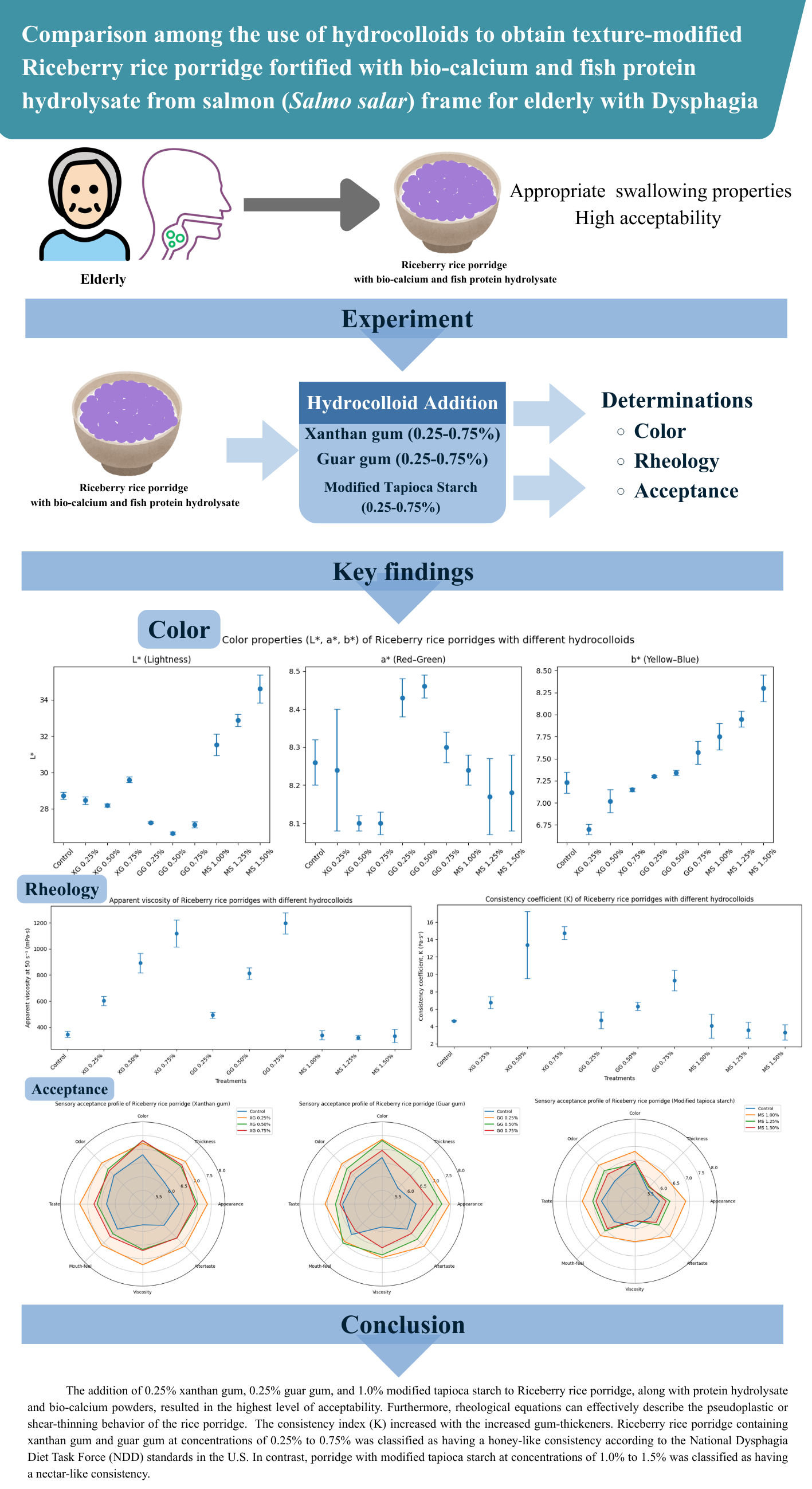
The effect of different types and concentrations of hydrocolloids (xanthan gum (XG) at 0.25, 0.50 and 0.75%, guar gum (GG) at 0.25, 0.50 and 0.75%, and modified tapioca starch (MS) at 1.0, 1.25 and 1.5%) on rheological properties of the protein hydrolysate and bio-calcium fortified Riceberry rice porridges for elderly with dysphagia was investigated. Rheological properties of porridges were as dependent on types and concentrations of the thickener, except MS. The flow behavior index (n) of all porridges was less than 1.0 which was shear thinning behavior. Increasing gum-thickener concentrations in porridges increased both apparent viscosities at a shear rate of 50 s-1 and consistency coefficient (K). Both XG and GG at the similar concentrations gave a similarly steady viscosity. Moreover, the viscosity at the shear point of these samples was obviously higher than that of the control (p<0.05). Nevertheless, the addition of MS had no effects on viscosity, K or n values of the porridges (p≥0.05). Riceberry Rice porridges with XG and GG at levels of 0.25-0.75% were classified by the National Dysphagia Diet Task Force; NDD (US standard) as having a Honey-like consistency. While those with MS at levels of 1.0-1.5% had a nectar-like consistency in the similar range of the control sample (no hydrocolloids). Acceptance tests among elderly participants (n = 50) showed that porridge containing 0.25% XG, 0.25% GG, and 1.0% MS achieved the highest scores across all attributes, with liking scores ranging from 7.12–7.86, 6.94–7.64, and 6.42–7.38, respectively, depending on the hydrocolloids.
Article Details

This work is licensed under a Creative Commons Attribution-NonCommercial-NoDerivatives 4.0 International License.
References
World Health Organization. Ageing and health [Internet]. Geneva: WHO; 2024 Sep 16 [cited 2023 May 29]. Available from: https://www.who.int/news-room/fact-sheets/detail/ageing-and-health.
Rofes L, Arreola V, Romea M, Palomera E, Almirall J, Cabré M, Serra-Prat M, Clavé P. Pathophysiology of oropharyngeal dysphagia in the frail elderly. J Neurogastroenterol Motil. 2010;22:851–858.
Martin-Martinez A, Ortega O, Viñas P, Arreola V, Nascimento W, Costa A, Riera SA, Alarcón C, Clavé P. COVID-19 is associated with oropharyngeal dysphagia and malnutrition in hospitalized patients during the spring 2020 wave of the pandemic. Clin Nutr. 2021;41:2996–3006.
Nicosia MA. A planar finite element model of bolus containment in the oral cavity. Comput Biol Med. 2007;37:1472–1478.
Idowu AT, Benjakul S, Sinthusamran S, Pongsetkul J, Sae-leaw T, Sookchoo P. Whole wheat cracker fortified with biocalcium and protein hydrolysate powders from salmon frame: characteristics and nutritional value. Food Qual Saf. 2019;3:191–199.
Benjakul S, Mad-Ali S, Senphan T, Sookchoo P. Biocalcium powder from precooked skipjack tuna bone: production and its characteristics. J Food Biochem. 2017;41:e12412.
Sharpe K, Ward L, Cichero J, Sopade P, Halley P. Thickened fluids and water absorption in rats and humans. Dysphagia. 2007;22(3):193–203.
Nishinari K, Turcanu M, Nakauma M, Fang Y. Role of fluid cohesiveness in safe swallowing. NPJ Sci Food. 2019;3:1–8.
Kim H, Hwang HI, Song KW, Lee J. Sensory and rheological characteristics of thickened liquids differing concentrations of a xanthan gum-based thickener. J Texture Stud. 2017;48:571–585.
Meilgaard M, Civille GV, Carr BT. Sensory evaluation techniques. 4th ed. Boca Raton (FL): CRC Press; 2004.
Lawless HT, Heymann H. Sensory evaluation of food: principles and practices. 2nd ed. New York (NY): Chapman & Hall; 2010.
Wongsagonsup R, Deeyai P, Chaiwat W, Horrungsiwat S, Leejariensuk K, Suphantharika M, Fuongfuchat A, Dangtip S. Modification of tapioca starch by non-chemical route using jet atmospheric argon plasma. Carbohydr Polym. 2014;102:790–798.
Liu DR, Huang WX, Cai XL. Oligomerization of rice granule-bound starch synthase 1 modulates its activity regulation. Plant Sci. 2013;210:141–150.
Duangsai P, Gawborisut S. Instrumental textural properties and sensory acceptability of rehydrated Thai fermented fish dip as affected by addition of xanthan gum and modified tapioca starch. Int J Food Prop. 2022;25:105–115.
Preichardt LD, Klaic PMA. Xanthan gum: applications and research studies. In: Butler M, editor. Food science and technology. New York (NY): Nova Science Publishers; 2016. p. 1–189.
Mudgil D, Barak S, Khatkar BS. Guar gum: processing, properties and food applications – a review. J Food Sci Technol. 2014;51:409–418.
Vuong LT. Underutilized β-carotene-rich crops of Vietnam. Food Nutr Bull. 2000;21(2):173–181.
Chan R, Lok K, Woo J. Prostate cancer and vegetable consumption. Mol Nutr Food Res. 2009;53:201–216.
Choi JG, Kang OH, Brice OO, Lee YS, Chae HS, Oh YC, et al. Antibacterial activity of Ecklonia cava against methicillin-resistant Staphylococcus aureus and Salmonella spp. Foodborne Pathog Dis. 2010;7:435–441.
Food and Agriculture Organization of the United Nations. Composition of meat [Internet]. Rome: FAO; 2019 [cited 2019 Feb 14]. Available from: https://www.fao.org/4/T0562E/T0562E05.htm
Organisation for Economic Co-operation and Development. Meat consumption (indicator) [Internet]. Paris: OECD; 2019 [cited 2019 Feb 14]. Available from: https://data.oecd.org/agroutput/meat-consumption.htm.
Eom SH, Lee DS, Jung YJ, Park JH, Choi JI, Yim MJ, Jeon JM, et al. The mechanism of antibacterial activity of phlorofucofuroeckol-A against methicillin-resistant Staphylococcus aureus. Appl Microbiol Biotechnol. 2014;98:9795–9804.
World Health Organization. A global brief on vector-borne diseases. Geneva: WHO; 2014.
