
Application of silicon improved rice productivity and reduced chalky rice
Article Sidebar
Main Article Content
Abstract
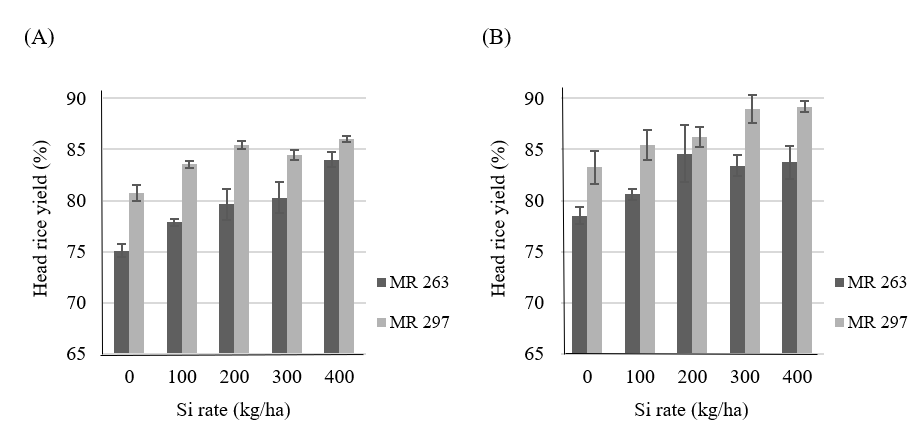
Chalkiness, together with head rice, is an important indicator of rice appearance quality. Chalky grains are more brittle than translucent grains and tend to break easily during milling. Silicon (Si) is recognized as a beneficial element that supports plant growth and enhances crop performance, particularly in rice. This study investigated the effect of Si application on rice yield, yield components and grain quality, including chalkiness. The available Si content in soil was also quantified. A pot experiment was conducted under a net-house from 2017 to 2018 across two planting cycles using Malaysian rice varieties, MR 263 and MR 297 (officially declared as MARDI Siraj 297). Five Si application rates, which were 0 (Si0), 100 (Si100), 200 (Si200), 300 (Si300), 400 (Si400) kg/ha, were arranged in a randomized complete block design (RCBD) with three replications. Results indicated that Si application significantly increased available Si in the soil, with Si300 and Si400 increased by up to 79.8% compared to the baseline. Yield components, including the number of panicles and percentage of filled grains, increased significantly, resulting in higher rice yield. The optimum Si rate for maximum rice yield (9.10 t/ha) was estimated at 247 kg/ha. Furthermore, Si application increased head rice yield, reduced the percentage of broken rice and chalkiness, and improved grain whiteness. Regardless of variety, chalkiness and broken rice decreased by 55% and 19%, respectively, from Si0 to Si400. In conclusion, Si fertilization effectively improved rice productivity and grain quality, particularly by reducing the percentages of chalkiness and broken rice.
Article Details

This work is licensed under a Creative Commons Attribution-NonCommercial-NoDerivatives 4.0 International License.
References
Redfern SK, Azzu N, Binamira J. Rice in Southeast Asia: facing risks and vulnerabilities to respond to climate change, Build Resil. Adapt Clim Change Agr Sect. 2012;23:1-14.
U.S. Department of Agriculture. 7th ed. World production volume of milled rice from 2008/2009 to 2019/2020. USDA, International Grains Council; 2021.
Ministry of Agriculture and Food Security. Malaysia Agrofood in Figure 2023. 7th ed. Putrajaya: KPKM; 2013.
Kim SS, Lee SE, Kim OW, Kim DC. Physicochemical characteristics of chalky kernels and their effects on sensory quality of cooked rice. Cereal Chem. 2000;77(3):376-379.
Lisle AJ, Martin M, Fitzgerald MA. Chalky and translucent rice grains differ in starch composition and structure and cooking properties. Cereal Chem. 2000;77(5):627-632.
Sehgal A, Sita K, Siddique KH, Kumar R, Bhogireddy S, Varshney RK, HanumanthaRao B, Nair RM, Prasad PV, Nayyar H. Drought or/and heat-stress effects on seed filling in food crops: impacts on functional biochemistry, seed yields, and nutritional quality. Front Plant Sci. 2018;9:1705.
Ma JF, Yamaji N. A cooperative system of silicon transport in plants. Trends Plant Sci. 2015;20:435-442.
Halligan JE. 7th ed. Soil Fertility and Fertilizers. Reprint. London: Forgotten Books. 1912;1:56-58.
Slater Ed. Association of American Plant Food Control Officials (AAPFCO). Official publication No. 67. In: 7th ed. West Lafayette: AAPFCO. 2014;67:95-96.
International Plant Nutrition Institute (IPNI). 7th ed. Nutri-Facts: Silicon. 2015;14:5-8.
Brown PH, Zhao FJ, Dobermann A. What is a plant nutrient Changing definitions to advance science and innovation in plant nutrition. Plant Soil. 2022;476:11-23.
Cuong TX, Ullah H, Datta A, Hanh TC. Effects of silicon-based fertilizer on growth, yield and nutrient uptake of rice in tropical zone of Vietnam. Rice Sci. 2017;24(5):283-290.
Othman O, Abu Hassan D, Alias I, Ayob AH, Azmi AR, Azmi M, Badrulhadza A, Maisarah MS, Muhamad H, Saad A, Sariam O, Siti Norsuha M, Syahrin S, Yahaya H. Manual teknologi penanaman padi lestari. 7th ed. Serdang: MARDI Press; 2008.
Korndörfer GH, Snyder GH, Ulloa M, Powell G, Datnoff LE. Calibration of soil and plant silicon for rice production. J Plant Nutr. 2001;24:1071-1084.
International Rice Research Institute (IRRI). Standard Evaluation System for Rice. 5th ed. Manila: IRRI; 2013.
Juliano BO. A simplified assay for milled rice amylose. Cereal Sci Today. 1971;16:334-338.
Cagampang GB, Perez CM, Juliano BO. A gel consistency test for eating quality of rice. J Sci Food Agric. 1973;24:1589-1594.
International Rice Research Institute (IRRI). Alkali Digestion. In: Standard Evaluation System for Rice. 2nd ed. Manila: IRRI; 1980;10:43-44.
Moore KJ, Dixon PM. Analysis of combined experiments revisited. Agron J. 2015;107:763-771.
Siregar AF, Sipahutar IA, Anggria L, Husnain H, Yufdi MP. Improving rice growth and yield with silicon addition in Oxisols. IOP Conf Ser Earth Environ Sci. 2021;648:012202.
Yanai J, Taniguchi H, Nakao A. Evaluation of available silicon content and its determining factors of agricultural soils in Japan. Soil Sci Plant Nutr. 2016;62:511-518.
Haynes RJ. A contemporary overview of silicon availability in agricultural soils. J Plant Nutr Soil Sci. 2014;177(6):831-844.
Salman KA, Hassan Z, Omar K. Effect of silicon porosity on solar cell efficiency. Int J Electrochem Sci. 2012;7:376-386.
Yoshida S, Navasero SA, Ramirez EA. Effects of silica and nitrogen supply on some leaf characters of the rice plant. Plant Soil. 1969;31:48-56.
Detmann KC, Araújo WL, Martins SC, Sanglard LM, Reis JV, Detmann E, Rodrigues FA, Nunes-Nesi A, Fernie AR, DaMatta FM. Silicon nutrition increases grain yield, which, in turn, exerts a feed-forward stimulation of photosynthetic rates via enhanced mesophyll conductance and alters primary metabolism in rice. New Phytol. 2012;196(3):752-762.
Ligaba-Osena A, Guo W, Choi SC, Limmer MA, Seyfferth AL, Hankoua BB. Silicon enhances biomass and grain yield in an ancient crop tef [Eragrostis tef (Zucc.) Trotter]. Front Plant Sci. 2020;11:608503.
Ahmad A, Afzal M, Ahmad AUH, Tahir M. Effect of foliar application of silicon on yield and quality of rice (Oryza sativa L). Cercet Agron Mold. 2013;3(155):21-28.
Jan R, Ahmad-aga F, Bahar FA, Singh T, Lone R. Effect of nitrogen and silicon on growth and yield attributes of transplanted rice (Oryza sativa L.) under Kashmir conditions. J Pharmacog Phytochem. 2018;7(1):328-332.
Hou W, Tränkner M, Lu J, Yan J, Huang S, Ren T, Cong R, Li X. Diagnosis of nitrogen nutrition in rice leaves influenced by potassium levels. Front Plant Sci. 2020;11:165.
Ma JF, Nishimura K, Takahashi E. Effect of silicon on the growth of rice plant at different growth stages. Soil Sci Plant Nutr. 1989;35(3):347-356.
Kim YH, Khan AL, Shinwari ZK, Kim DH, Waqas M, Kamran M, Lee IJ. Silicon treatment to rice (Oryza sativa L. cv.' Gopumbyeo') plants during different growth periods and its effects on growth and grain yield. Pak J Bot. 2012;44(3):891-897.
Li R, Li M, Ashraf U, Liu S, Zhang J. Exploring the relationships between yield and yield-related traits for rice varieties released in China from 1978 to 2017. Front Plant Sci. 2019;10:543-549.
Yoshida S. Effects of temperature on growth of the rice plant (Oryza sativa L.) in a controlled environment. Soil Sci Plant Nutr. 1973;19:299-310.
Gholami Y, Falah, A. Effects of two different sources of silicon on dry matter production, yield, and yield components of rice, Tarom Hashemi variety and 843 lines. Int J Agric Crop Sci. 2013;5:227-531.
Ma JF, Takahashi E. Effect of silicon on the growth and phosphorus uptake of rice. Plant Soil. 1990;126(1):115-119.
Chaiwong N, Rerkasem B, Pusadee T, Prom-U-Thai C. Silicon application improves caryopsis development and yield in rice. J Sci Foo Agric. 2020;101(1):220-228.
Savant NK, Snyder GH, Datnoff LE. Silicon management and sustainable rice production. Adv Agron. 1997;58:151-199.
Swe MM, Mar SS, Naing TT, Zar T, Ngwe K. Effect of silicon application on growth, yield and uptake of rice (Oryza sativa L.) in two different soils. Open Access Library J. 2021;8:e7937.
Ma JF, Takahashi E. Soil, fertilizer, and plant silicon research in Japan. 5th ed. Amsterdam: Elsevier. 2002.
Datnoff LE, Rodrigues FA, Seebold KW. Silicon and plant nutrition. In: Datnoff LE, Elmer WH, Huber DM, editors. Mineral nutrition and plant disease. St Paul (MN) APS Pres. 2007;15:233-246.
Meena VD, Dotaniya ML, Coumar V, Rajendiran S, Ajay, Kundu S, Subba Rao A. A case for silicon fertilization to improve crop yields in tropical soils. Proc Natl Acad Sci India Sect B Biol Sci. 2014;84(3):505-518.
Yamakawa H, Hirose T, Kuroda M, Yamaguchi T. Comprehensive expression profiling of rice grain ripening-related genes under high temperature using DNA microarray. Plant Physiol. 2007;144:258–277.
Fitzgerald MA, Resurreccion AP. Maintaining the yield of edible rice in a warming world. Funct Plant Biol 2009;36(12):1037-1045.
Nakamura S, Katsura J, Kato K, Ohtsubo K. Development of formulae for estimating amylose content and resistant starch content based on the pasting properties measured by RVA of Japonica polished rice and starch. Biosci Biotechnol Biochem. 2016;80(2):329-340.
Sultana S, Faruque M, Rafiqul Islam M. Rice grain quality parameters and determination tools: a review on the current developments and future prospects. Int J Food Prop. 2022;25(1):1063-1078.
Emam MM, Khattab EH, Helal MN, Deraz EA. Effect of selenium and silicon on yield quality of rice plant grown under drought stress. Aust J Crop Sci. 2014;8(4):596-605.
