
Bio-Based Ion Exchange Resin from Water Hyacinth for Efficient Groundwater Hardness Treatment
Article Sidebar
Main Article Content
Abstract
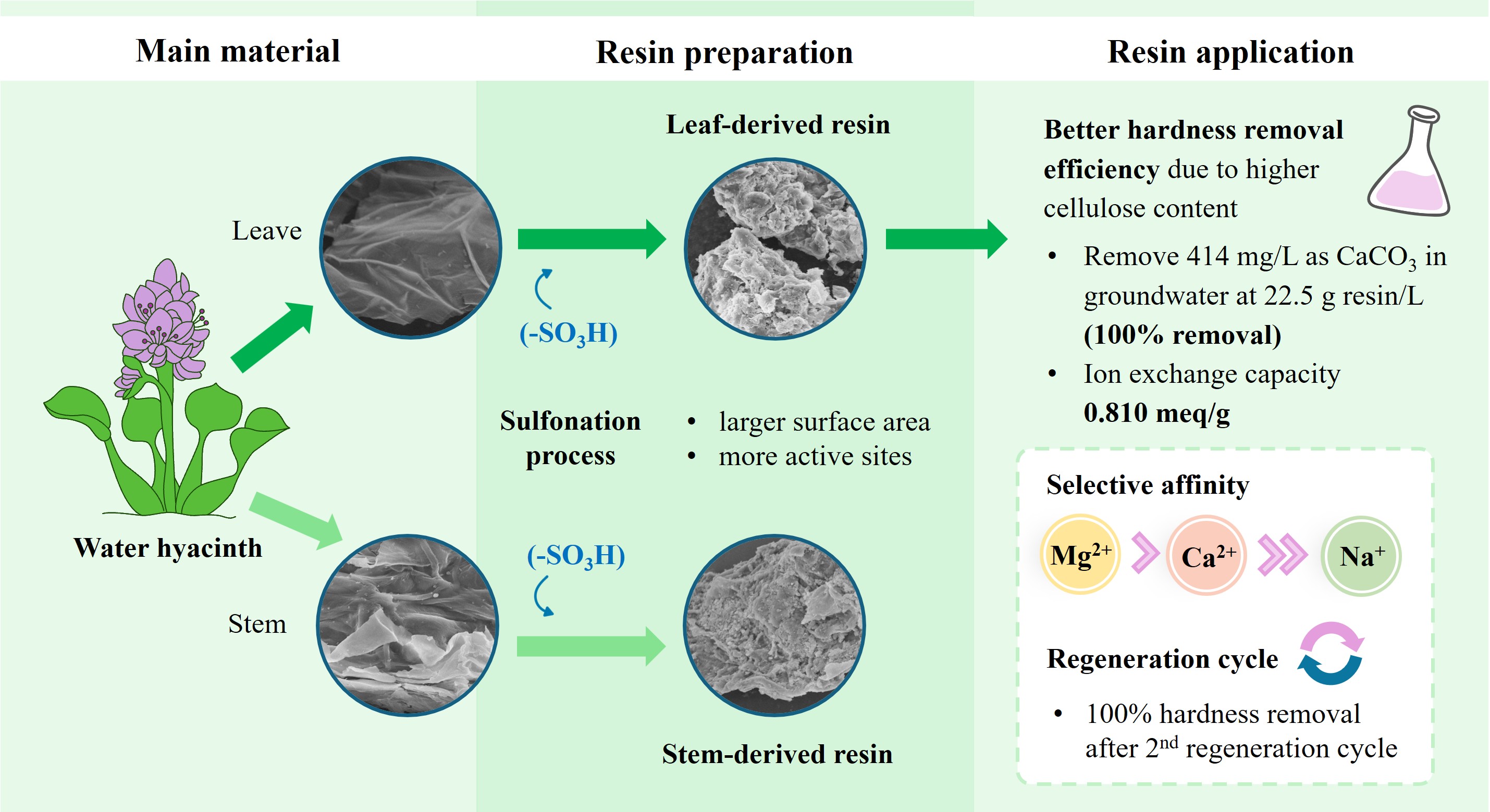
This study aims to prepare cation exchange resin from the stems and leaves of water hyacinth via the sulfonation process and to evaluate their efficiency and capacity for water softening. The water hyacinth was separated into stems and leaves and was then ground to powder. The powders were subjected to sulfuric acid treatment (sulfonation) to introduce active sulfonic acid (-SO3H) groups. Treated materials were classified as stem- and leaf-derived water hyacinth resin. The results revealed that sulfuric acid-treated water hyacinth enhanced the porosity of resin due to the incorporation of sulfonic acid groups. This improvement provided a larger surface area and more active sites for cation exchange compared to untreated samples. Sulfuric acid-treated water hyacinth leaves demonstrated greater hardness removal efficiency compared to stems, attributed to the higher cellulose content in the leaves. The optimal dosage of leaf-derived resin for complete hardness removal (414 mg·L-1 as CaCO3) was determined to be 22.5 g·L-1, equivalent to an ion exchange capacity of 0.810 meq·g-1. The resin exhibited selective affinity for ions in the order of Mg²⁺ > Ca²⁺ >> Na⁺. Additionally, the resin retained its efficiency after the first and second regeneration cycles using 0.01 M hydrochloric acid, maintaining 100% hardness removal, comparable to the performance of the new resin. These results highlight the potential of bio-based resins derived from water hyacinth leaves as a sustainable, cost-effective solution for water softening. Bio-based resins contribute to environmental conservation, promote eco-friendly materials, and support the circular economy and sustainable resource management principles.
Article Details

This work is licensed under a Creative Commons Attribution-NonCommercial-NoDerivatives 4.0 International License.
References
Nam TS, Cong NV, Thao HV. Enhancing renewable energy production from water hyacinth (Eichhornia crassipes) by a biogas-aerating recirculation system: A case study in the Vietnamese Mekong Delta. Case Stud Chem Environ Eng. 2023;7:100340.
Villamagna AM, Murphy BR. Ecological and socio-economic impacts of invasive water hyacinth (Eichhornia crassipes): A review. Freshw Biol. 2010;55:282–298.
Ayanda OI, Ajayi T, Asuwaju FP. Eichhornia crassipes (Mart.) Solms: Uses, challenges, threats, and prospects. Sci World J. 2020;2020:3452172.
Nega DT, Ancha VR, Manenti F, Adeel Z. A comprehensive policy framework for unlocking the potential of water hyacinth in Ethiopia’s circular bioeconomy. J Clean Prod. 2024;435:140509.
Ofoefule A, Uzodinma E. Biogas production from blends of cassava (Manihot utilissima) peels with some animal wastes. Int J Phys Sci. 2009;4:398–402.
Serafini LF, Arrobas M, Rodrigues MÂ, Feliciano M, Miguens F, Oliveira V, et al. The composting of water hyacinth: A life cycle assessment perspective. Waste Biomass Valor. 2025;16:507–523.
Rajan PGR, Jona Esther S, Dhinakaran S, Dinesh J, Deepika R, Aruna S, et al. Water hyacinth: A sustainable source of feed, manure and industrial products: A review. Agric Rev. 2023;44(3):389–392.
Rezania S, Ponraj M, Talaiekhozani A, Mohamad SE, Md Din MF, Taib SM, et al. Perspectives of phytoremediation using water hyacinth for removal of heavy metals, organic and inorganic pollutants in wastewater. J Environ Manage. 2015;163:125–133.
Thailand Foundation. Water hyacinth fiber products project [Internet]. 2020 [cited 2025 Jan 29]. Available from: https://www.thailand-foundation.com/projects/water-hyacint-fiber-products
Pentamwa P, Thipthara W, Nuangon S. Removal of hardness from groundwater by synthetic resin from waste plastics. Int J Environ Sci Dev. 2011;2(6):479–483.
Sengupta P. Potential health impacts of hard water. Int J Prev Med. 2013;4(8):866–875.
Fathy M, Moghny TA, Mousa MA, El-Bellihi AAA, Awadallah AE. Sulfonated ion exchange polystyrene composite resin for calcium hardness removal. Int J Emerg Technol Adv Eng. 2015;5(11):20–29.
Hailu Y, Tilahun E, Brhane A, Resky H, Sahu O. Ion exchange process for calcium, magnesium and total hardness from groundwater with natural zeolite. Groundw Sustain Dev. 2019;8:457–467.
Soliman EM, Ahmed SA, Fadl AA. Removal of calcium ions from aqueous solutions by sugar cane bagasse modified with carboxylic acids using microwave-assisted solvent-free synthesis. Desalination. 2011;278:18–25.
Dey S, Ganugula TNV, Padavala SB, Akula VPM. An experimental study on the parthenium biosorbents for removal of chlorides and hardness from contaminated water. Energy Nexus. 2024;15:100309.
Altundoğan HS, Topdemir A, Cakmak M, Bahar N. Hardness removal from waters by using citric acid modified pinecone. J Taiwan Inst Chem Eng. 2016;58:219–225.
Pawanna P. Environmental-friendly ion exchange resin from water hyacinth. Life Sci Environ J. 2023;24(2):443–455.
Tran ATK, Hoang NTT, Nguyen PT. Optimizing sulfonation process of polystyrene waste for hardness and heavy metal removal. Case Stud Chem Environ Eng. 2023;8:100396.
Chamkrom B. Bagasse resin for removal of dyes from dyeing wastewater [Master’s thesis]. Khon Kaen: Khon Kaen University; 2003.
APHA. Standard methods for the examination of water and wastewater. 23rd ed. Washington (DC): American Public Health Association; 2017.
Chawakitchareon P, Sanguanduan N. Copper removal by ion exchange resin made from corn cob, soybean hull and sunflower stalks. In: Proceedings of the 41st Kasetsart University Annual Conference; 2003 Feb 3–7; Bangkok, Thailand. Bangkok: The Thailand Research Fund; 2003, p. 346–351.
Li R, Fei J, Cai Y, Li Y, Feng J, Yao J. Cellulose whiskers extracted from mulberry: A novel biomass production. Carbohydr Polym. 2009;76(1):94–99.
Md Salim R, Asik J, Sarjadi MS. Chemical functional groups of extractives, cellulose and lignin extracted from native Leucaena leucocephala bark. Wood Sci Technol. 2021;55:295–313.
Xia Y, Li X, Zhuang J, Wang W, Abbas SC, Fu C, et al. Exploitation of functional groups in cellulose materials for lithium-ion batteries applications. Carbohydr Polym. 2024;325:121570.
Roman M, Winter WT. Effect of sulfate groups from sulfuric acid hydrolysis on the thermal degradation behavior of bacterial cellulose. Biomacromolecules. 2004;5(5):1671–1677.
Barua VB, Kalamdhad AS. Effect of various types of thermal pretreatment techniques on the hydrolysis, compositional analysis and characterization of water hyacinth. Bioresour Technol. 2017;227:147–154.
DuPont. Ion exchange resins selectivity [Internet]. 2019 [cited 2025 Jan 5]. Available from: https://www.dupont.com/content/dam/water/amer/us/en/water/public/documents/en/IER-Selectivity-TechFact-45-D01458-en.pdf
Marin NM, Lazar NM, Popa M, Galaon T, Pascu LF. Current trends in development and use of polymeric ion-exchange resins in wastewater treatment. Materials (Basel). 2024;17(23):5994.
Galizia M, Benedetti FM, Paul DR, Freeman BD. Monovalent and divalent ion sorption in a cation exchange membrane based on cross-linked poly(p-styrene sulfonate-co-divinylbenzene). J Membr Sci. 2017;535:132–142.
Tiwari U, Cummins E. Functional and physicochemical properties of legume fibers. In: Tiwari BK, Gowen A, McKenna B, editors. Pulse foods. Academic Press; 2011, p. 121–156.
Meesrisom S, Padungthon S. Regeneration efficiency of strong acid cation exchange resin using low concentration of NaCl from synthetic RO reject water. KKU Res J (Grad Stud). 2023;23(4):13–26.
de Abreu Domingos R, da Fonseca FV. Evaluation of adsorbent and ion exchange resins for removal of organic matter from petroleum refinery wastewaters aiming to increase water reuse. J Environ Manage. 2018;214:362–369.
Zheng JC, Feng HM, Lam MHW, Lam PKS, Ding YW, Yu HQ. Removal of Cu(II) in aqueous media by biosorption using water hyacinth roots as a biosorbent material. J Hazard Mater. 2009;171:780–785.
Rosidah R, Rahayu SYS, Susanti E. Removal of cadmium (II) by adsorption using water hyacinth (Eichhornia crassipes) dried biomass. J Ecol Eng. 2023;24(3):246–253.
Boonpanaid C, Piyamongkala K. Using commercial resin for ion exchange to remove hardness from domestic water supply. Mater Today Proc. 2023.
