
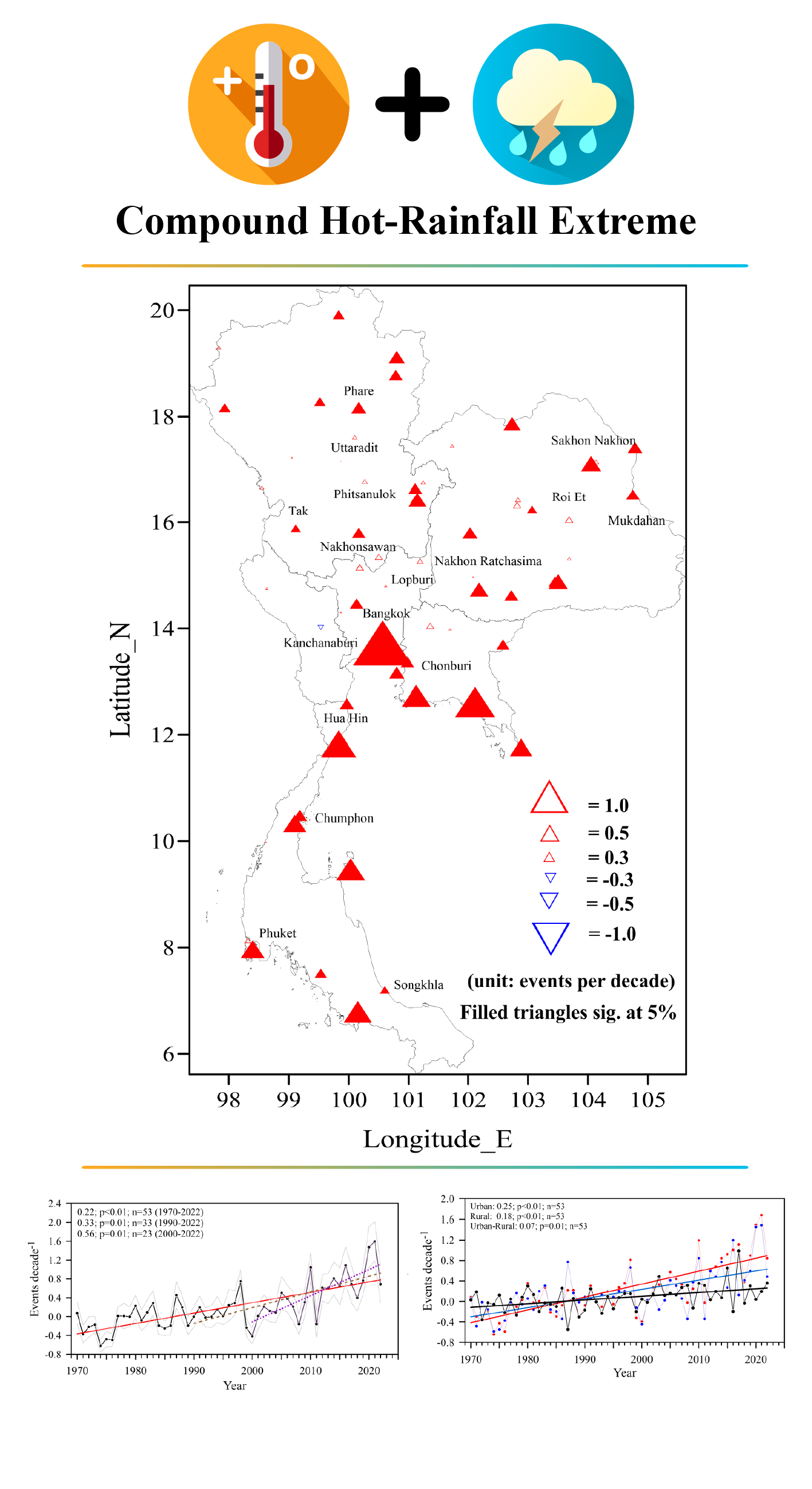
Increasing compound hot-rainfall extreme in Thailand during 1970-2022
Article Sidebar
Main Article Content
Abstract
Compound extremes often result in larger impacts than individual events and have recently received increasing attention. Based on quality-controlled observed data and commonly used empirical-based statistical method, this study examined changes in compound hot-rainfall extreme (CHRE) and their possible contributing factors in Thailand during 1970-2022. Analysis reveals that heavy rainfall preceded by extremely hot weather within three days in Thailand exhibited widespread and significant increases and acceleration in recent years. The results show that increased global mean temperature (GMT) accounted for 66% of Thailand’s CHRE changes, while short-term variations in CHRE were significantly correlated (rs =-0.40) with El Niño-Southern Oscillation (ENSO) events. Moreover, the effects of urbanisation tended to amplify occurrence of CHRE. Our findings highlight that natural-to-anthropogenic climate change and localized urbanisation processes have already expanded the range of climatic hazards in Thailand with their complex combination appearing to dynamically induce back-to-back occurrence of CHRE. Since increased frequency of weather extremes and compound events are expected under a warming world, detection and attribution studies are further required to gain insight of the physical processes and drivers of CHRE, to improve their risk assessment and to develop effective adaptation measures.
Article Details

This work is licensed under a Creative Commons Attribution-NonCommercial-NoDerivatives 4.0 International License.
References
Leonard M, Westra S, Phatak A, Lambert M, van den Hurk B, McInnes K. A compound event framework for understanding extreme impacts. Wiley Int Rev Clim Change. 2014;5:113-128.
Hao Z, Singh VP, Hao F. Compound extremes in hydroclimatology: A review. Water. 2018;10:718-719.
Zscheischler J, Martius O, Westra S, Bevacqua E, Raymond C, Horton RM. A typology of compound weather and climate events. Nat Rev Earth Environ. 2020;1:333-347.
Ridder NN, Pitman AJ, Westra S, Ukkola A, Do HX, Bador M. Global hotspots for the occurrence of compound events. Nat Commun. 2020;11:5956.
Ning G, Luo M, Zhang W, Liu Z, Wang S, Gao T. Rising risks of compound extreme heat-precipitation events in China. Int J Climatol. 2022;42:5785-5795.
Yu H, Lu N, Fu B, Zhang L, Wang M, Tian H. Hotspots, co-occurrence, and shifts of compound and cascading extreme climate events in Eurasian Drylands. Environ Int. 2022;169:107509.
Lau WKM, Kim KM. The 2010 Pakistan flood and Russian heat wave: Teleconnection of hydrometeorological extremes. J Hydrometeorol. 2012;13:392-403.
Hao Z, Hao F, Singh VP, Zhang X. Changes in the severity of compound drought and hot extremes over global land areas. Environ Res Lett. 2018;13:124022.
Wang SSY, Kim H, Coumou D, Yoon JH, Zhao L, Gillies RR. Consecutive extreme flooding and heat wave in Japan: Are they becoming a norm. Atmos Sci Lett. 2019;20(10):1-4.
Wu S, Chan TO, Zhang W, Ning G, Wang P, Tong X. Increasing compound heat and precipitation extremes elevated by urbanisation in South China. Front Earth Sci. 2021;9:636777.
United Nations Economic and Social Commission for Asia and the Pacific. Risk and Resilience Portal. Thailand country report. 2025. [cited 2025 May 29].
Earth.Org. Too hot to live: Climate change in Thailand. 2020. [cited 2025 May 30].
Department of Climate Change and Environment. Thailand’s National Adaptation Plan. 2023 [cited 2025 May 30].
Limjirakan S, Limsakul A. Observed trends in surface air temperatures and their extremes in Thailand from 1970 to 2009. J Meteorol Soc Jpn. 2012;90:647-662.
Limsakul A, Singhruck P. Long-term trends and variability of total and extreme precipitation in Thailand. Atmos Res. 2016;169:301-317.
Pimonsree S, Limsakul A, Kammuang A, Kachenchart B, Kamlangkla C. Urbanization-induced changes in extreme climate indices in Thailand during 1970-2019. Atmos Res. 2022;265:105882.
Griffiths ML, Bradley RS. Variations of twentieth-century temperature and precipitation extreme indicators in the Northeast United States. J Clim. 2007;20(21):5401-5417.
National Aeronautics and Space Administration (NASA). Goddard Institute for Space Studies (GISS) surface temperature analysis (GISTEMP). 2023. [cited 2023 Mar 20].
Hansen J, Ruedy R, Sato M, Lo K. Global surface temperature change. Rev Geophys. 2010;48:RG4004.
Lenssen N, Schmidt GA, Hendrickson M, Jacobs P, Menne MJ, Ruedy R. A NASA GISTEMPv4 Observational Uncertainty Ensemble. J Geophys Res Atmos. 2024;129(17):e2023JD040179.
National Center for Atmospheric Research. climate data guide: Southern Oscillation Indices: Signal, noise and Tahiti/Darwin SLP (SOI). National Center for Atmospheric Research Staff. 2023. [cited 2023 Jul 14].
Feng S, Hu Q, Qian W. Quality control of daily meteorological data in China, 1951-2000: A new dataset. Int J Climatol. 2004;24(7):853-870.
World Meteorological Organization. Guidelines on homogenization, WMO-No.1245. 7th edition. Geneva, Switzerland. 2020.
Wang XL. Accounting for autocorrelation in detecting mean shifts in climate data series using the Penalized Maximal t or F Test. J Appl Meteorol Climatol. 2008;47(9):2423-2444.
World Climate Research Programme. RHtestsV4 software. In: Expert Team on Climate Change Detection and Indices (ETCCDI). 2020a. [cited 2024 Nov 20].
Kachenchart B, Kamlangkla C, Puttanapong N, Limsakul A. Urbanization effects on surface air temperature trends in Thailand during 1970-2019. Environ Eng Res. 2021;26(5):200378.
World Climate Research Programme. Climate change indices. In: Expert team on climate change detection and indices (ETCCDI). 2020b. [cited 2024 Nov 25].
Zhou Z, Zhang L, Zhang Q, Hu C, Wang G, She D, Chen J. Global increase in future compound heat stress-heavy precipitation hazards and associated socio-ecosystem risks. NPJ Clim Atmos Sci. 2024;7(33):1-14.
Tang Y, Luo M, Wu S, Li X. Increasing synchrony of extreme heat and precipitation events under climate warming. Geophys Res Lett. 2025;52:e2024GL113021.
Wang F, Shao W, Yu H, Kan G, He X, Zhang D. Re-evaluation of the power of the Mann-Kendall Test for detecting monotonic trends in hydrometeorological time series. Front Earth Sci. 2020;8:1-4.
Hameed KH, Rao AR. A modified Mann-Kendall trend test for autocorrected data. J Hydrol. 2008;204:182-196.
Limsakul A. Trends in Thailand’s extreme temperature indices during 1955-2018 and their relationship with global mean temperature change. App Envi Res. 2020;42(2):94-107.
Limsakul A. Changes of daily rainfall intensity in Thailand from 1955 to 2019. Asia Pac J Sci Technol. 2022;27(01):1-3.
Paengkaew W, Limsakul A, Junggoth R, Pitaksanurat S. Variability and trend of heat index in Thailand during 1975-2017 and their relationships with some demographic-health variables. Environ Asia. 2020;13(1):26-40.
Amnuaylojaroen T, Limsakul A, Kirtsaeng S, Parasin N, Surapipith V. Effect of the near-future climate change under RCP8.5 on the heat stress and associated work performance in Thailand. Atmosphere. 2022;13:325-328.
Gu L, Chen J, Yin J, Slater LJ, Wang HM, Guo Q. Global increases in compound flood-hot extreme hazards under climate warming. Geophys Res Lett. 2022;49:e2022GL097726.
Zhang W, Villarini G. Deadly compound heat stress-flooding hazard across the Central United States. Geophys Res Lett. 2020;47:e2020GL089185.
Lin L, Chen C, Luo M. Impacts of El Niño-Southern Oscillation on heat waves in the Indochina peninsula. Atmos Sci Lett. 2018;19(11):e856.
Madolli MJ, Gade SA, Gupta V, Chakraborty A, Cha-um S, Datta A, Himanshu SK. A systematic review on rainfall patterns of Thailand: Insights into variability and its relationship with ENSO and IOD. Earth Sci Rev. 2025;264:105102.
Lin L, Gao T, Luo M, Ge E, Yang Y, Liu Z, et al. Contribution of urbanization to the changes in extreme climate events in urban agglomerations across China. Sci Total Environ. 2020;744:140264.
