
Oily Wastewater Remediation using Polyurethane Sponges Coated with an Optimised Amount of Graphene Nanoplatelets
Article Sidebar
Main Article Content
Abstract
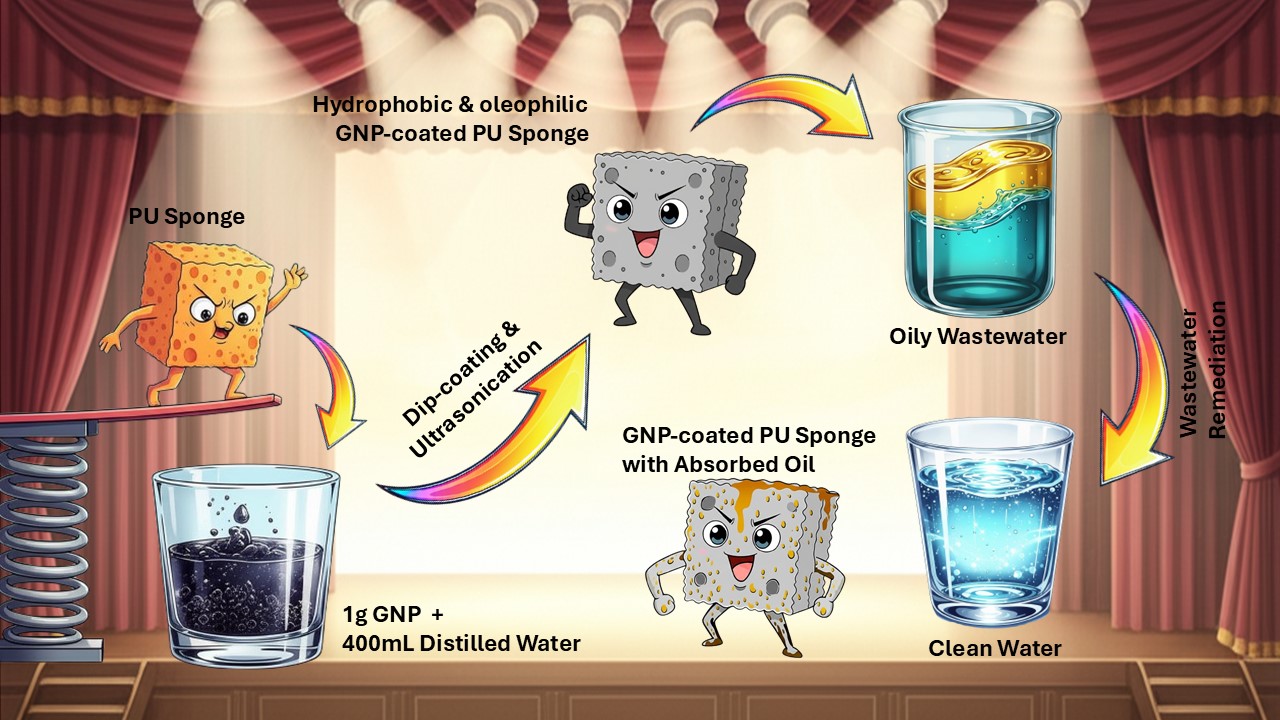
Oily wastewater discharged into water bodies without proper treatment can endanger aquatic ecosystems and human health. This study explored an alternative method for treating oily wastewater using a graphene-nanoplatelet (GNP)-coated polyurethane (PU) sponge and reported its oil absorption performance. The PU sponge surface was modified by dip-coating it with 0 g, 0.5 g, 1 g, 1.5 g, 2 g, and 2.5 g GNP aqueous suspension to prepare a GNP-coated PU sponge. Fourier-transform infrared (FTIR) spectroscopy demonstrated that the GNP successfully coated onto the PU sponge surface. The GNP coating conferred a selective absorption ability to the PU sponges, which significantly enhanced their hydrophobicity and oleophilicity. The use of 1 g GNP achieved the highest oil absorption, which was approximately 44 times the original PU sponge mass. The morphological analysis confirmed that the GNP event dispersion on the PU sponge surface was the main reason for the oil absorption being highest at 1 g GNP. The results suggested that 1 g GNP should be used for modifying PU sponge surfaces for treating oily wastewater. Furthermore, the results provided fundamental knowledge and information that can facilitate the design and development of a GNP- and PU sponge-based material for treating oily wastewater.
Article Details

This work is licensed under a Creative Commons Attribution-NonCommercial-NoDerivatives 4.0 International License.
References
Aguilera F, Méndez J, Pásaro E, Laffon B. Review on the effects of exposure to spilled oils on human health. J Appl Toxicol. 2010;30(4):291–301.
Kabiri S, Tran DNH, Altalhi T, Losic D. Outstanding adsorption performance of graphene–carbon nanotube aerogels for continuous oil removal. Carbon. 2014;80:523–533.
Diraki A, Mackey H, McKay G, Abdala AA. Removal of oil from oil–water emulsions using thermally reduced graphene and graphene nanoplatelets. Chem Eng Res Des. 2018;137:47–59.
Doshi B, Sillanpää M, Kalliola S. A review of bio-based materials for oil spill treatment. Water Res. 2018;135:262–277.
Zhang X, Liu D, Ma Y, Nie J, Sui G. Super-hydrophobic graphene coated polyurethane (GN@PU) sponge with great oil-water separation performance. Appl Surf Sci. 2017;422:116–124.
Kumar M, Sachdeva A, Garg RK, Singh S. Using RSM to optimize crystallite size of rice husk derived graphene prepared by microwave process. Asia Pac J Sci Technol. 2022;27(06):20-27.
Vaka M, Walvekar R, Khalid M, Jagadish P, Low JH. Corrosion, rheology, and thermal ageing behaviour of the eutectic salt-based graphene hybrid nanofluid for high-temperature TES applications. J Mol Liq. 2021;334:116156.
Karm Z. A comparative study of the structure and morphology of graphene oxide films on glass and aluminum supports by using dip coating. Asia Pac J Sci Technol. 2024;29(05):20-29.
Liu H, Liu Z, Yang M, He Q. Surperhydrophobic polyurethane foam modified by graphene oxide. J Appl Polym Sci. 2013;130(5):3530–3536.
Xia C, Li Y, Fei T, Gong W. Facile one-pot synthesis of superhydrophobic reduced graphene oxide-coated polyurethane sponge at the presence of ethanol for oil-water separation. Chem Eng J. 2018;345:648–658.
ACS Material LLC. 5th ed. A Detailed Overview of Graphene Nanoplatelets. 2020.
Yee K, Ghayesh MH. A review on the mechanics of graphene nanoplatelets reinforced structures. Int J Eng Sci. 2023;186:103831.
Cheong KL, Pang MM, Low JH, Tshai KY, Koay SC, Wong WY. Graphene nanoplatelets/polylactic acid conductive polymer composites: tensile, thermal and electrical properties. Chem Eng Technol. 2024;47(11):e202300592.
Ng QY, Low JH, Pang MM, Idumah CI. Properties enhancement of waterborne polyurethane bio-composite films with 3-aminopropyltriethoxy silane functionalized lignin. J Polym Environ. 2023;31(2):688–697.
LG Wade JR. Organic chemistry. 7th ed. Upper Saddle River: Pearson Education, Inc.; 2010.
Aris NF, Ghazali SK, Mohamad Z, Jamaluddin J, Adrus N, Abdul Aziz A. The effects of alkaline treatment on the oil residue, thermal properties and surface morphology of oil palm mesocarp fiber. Environ Qual Manag. 2022;32(1):405–411.
Rusman R, Majid RA, Wan Abd Rahman WA, Low JH. Carboxymethyl cassava starch/polyurethane dispersion blend as surface sizing agent. Chem Eng Trans. 2017;56:1171–1176.
