
Development of Silk Fibroin/Chitosan Sponge for Wound Dressing
Article Sidebar
Main Article Content
Abstract
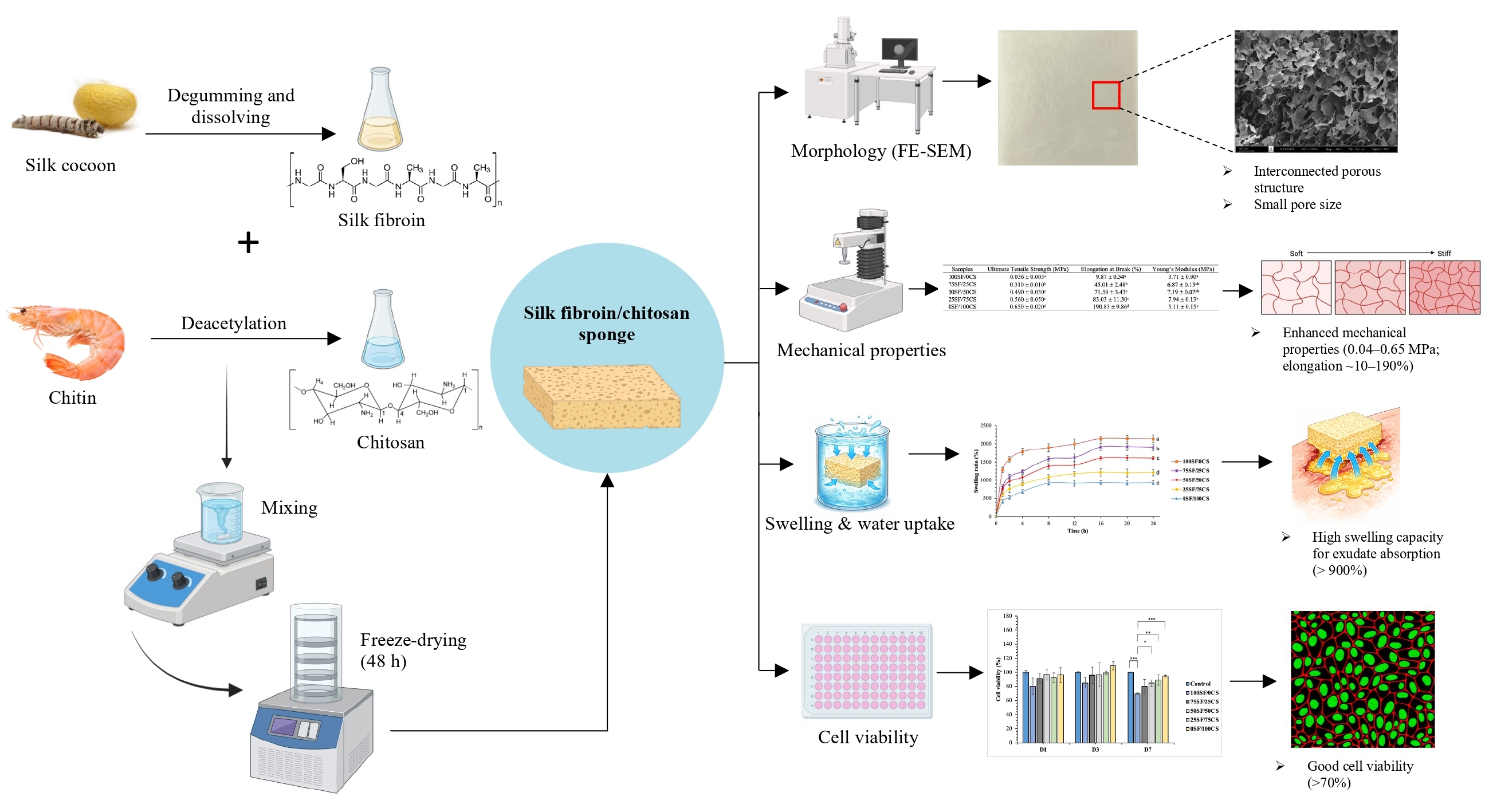
Gauze is a traditional wound dressing. However, it often adheres to the wound and is not highly absorbent. To address the limitations of traditional dressings, biopolymers are commonly considered suitable materials for wound-dressing applications. Silk fibroin (SF) is an interesting polymer known for its good water absorption, but it has poor mechanical properties. In this study, chitosan (CS) was selected to improve the mechanical properties of SF. SF/CS sponges were prepared with glycerol as a plasticizer at different ratios of SF to CS: 100/0, 75/25, 50/50, 25/75, and 0/100 (w/w of dry substances) using a freeze-drying process. Their physicochemical properties were investigated, including chemical structure, morphology, mechanical properties, swelling ratio, water uptake, and porosity, as well as cell viability. According to the results, all SF/CS sponges had suitable pore sizes (28–61 µm). The sponges exhibited high water uptake (90–96%) and swelling ratios (900–2,100%). The addition of CS greatly enhanced the mechanical properties of the sponges. Notably, SF/CS sponges at ratios of 50/50, 25/75, and 0/100 showed increases in tensile strength (0.49–0.65 MPa) and elongation at break (71–190%). However, the 0SF/100CS sponge was found to have limitations due to its low porosity (<60%). In addition, the MTT assay confirmed that none of the SF/CS sponges exhibited cytotoxicity. In summary, SF/CS sponges at 50/50 and 25/75 ratios showed potential as biomaterials for wound dressings, offering advantages in water uptake, mechanical properties, swelling ratio, porosity, and non-cytotoxicity.
Article Details

This work is licensed under a Creative Commons Attribution-NonCommercial-NoDerivatives 4.0 International License.
References
Namviriyachote N, Muangman P, Chinaroonchai K, Chuntrasakul C, Ritthidej GC. Polyurethane-biomacromolecule combined foam dressing containing asiaticoside: fabrication, characterization and clinical efficacy for traumatic dermal wound treatment. Int J Biol Macromol. 2019;131:1010–1019.
Dabiri G, Damstetter E, Phillips T. Choosing a wound dressing based on common wound characteristics. Adv Wound Care. 2016;5(1):32–41.
Yin J, Fang Y, Xu L, Ahmed A. High-throughput fabrication of silk fibroin/hydroxypropyl methylcellulose (SF/HPMC) nanofibrous scaffolds for skin tissue engineering. Int J Biol Macromol. 2021;183:1210–1221.
Rockwood DN, Preda RC, Yücel T, Wang X, Lovett ML, Kaplan DL. Materials fabrication from Bombyx mori silk fibroin. Nat Protoc. 2011;6(10):1612–1631.
Sun W, Gregory DA, Tomeh MA, Zhao X. Silk fibroin as a functional biomaterial for tissue engineering. Int J Mol Sci. 2021;22(3):1499.
Feng YF, Li XF, Zhang Q, Yan SQ, Guo Y, Li M, et al. Mechanically robust and flexible silk protein/polysaccharide composite sponges for wound dressing. Carbohydr Polym. 2019;216:17–24.
Promnil S, Ruksakulpiwat C, Numpaisal PO, Ruksakulpiwat Y. Electrospun poly(lactic acid) and silk fibroin based nanofibrous scaffold for meniscus tissue engineering. Polymers (Basel). 2022;14(12):2435.
Kweon H, Ha HC, Um IC, Park YH. Physical properties of silk fibroin/chitosan blend films. J Appl Polym Sci. 2001;80(7):928–934.
Fan Y, Lu Q, Liang W, Wang Y, Zhou Y, Lang M, et al. Preparation and characterization of antibacterial polyvinyl alcohol/chitosan sponge for wound dressing. Eur Polym J. 2021;157:110619.
Sionkowska A, Płanecka A. Preparation and characterization of silk fibroin/chitosan composite sponges for tissue engineering. J Mol Liq. 2013;178:5–14.
Tuwalska A, Grabska-Zielińska S, Sionkowska A. Chitosan/silk fibroin materials for biomedical applications—A review. Polymers (Basel). 2022;14:1343.
Patil PP, Reagan MR, Bohara RA. Silk fibroin and silk-based biomaterial derivatives for ideal wound dressings. Int J Biol Macromol. 2020;158:11–20.
Kim DW, Hwang HS, Kim DS, Sheen SH, Heo DH, Hwang GJ, et al. Effect of silk fibroin peptide derived from silkworm Bombyx mori on the anti-inflammatory effect of Tat-SOD in a mice edema model. BMB Rep. 2011;44(12):787–792.
Rodriguez-Nogales A, Lozano-Pérez AA, Aznar-Cervantes SD, Algieri F, Garrido-Mesa J, Garrido-Mesa N, et al. Effect of aqueous and particulate silk fibroin in a rat model of experimental colitis. Int J Pharm. 2016;511(1):1–9.
Khosravimelal S, Chizari M, Farhadihosseinabadi B, Moosazadeh Moghaddam M, Gholipourmalekabadi M. Fabrication and characterization of an antibacterial chitosan/silk fibroin electrospun nanofiber loaded with a cationic peptide for wound-dressing application. J Mater Sci Mater Med. 2021;32(9):104.
Mohebian Z, Tajmohammadi I, Yavari Maroufi L, Ramezani S, Ghorbani M. A novel Aloe vera-loaded ethylcellulose/hydroxypropyl methylcellulose nanofibrous mat designed for wound healing application. J Polym Environ. 2022;30(3):867–877.
Xu Z, Chen T, Zhang K, Meng K, Zhao H. Silk fibroin/chitosan hydrogel with antibacterial, hemostatic and sustained drug-release activities. Polym Int. 2021;70(10):1235–1243.
Akiyoshi A. Dissolution of silk fibroin with calcium chloride/ethanol aqueous solution. J Seric Sci Jpn. 1998;67:91–94.
Poonguzhali R, Basha SK, Kumari VS. Synthesis and characterization of chitosan-PVP-nanocellulose composites for in vitro wound dressing application. Int J Biol Macromol. 2017;105:111–120.
Li DW, Lei X, He FL, He J, Liu YL, Ye YJ, et al. Silk fibroin/chitosan scaffold with tunable properties and low inflammatory response assists the differentiation of bone marrow mesenchymal stem cells. Int J Biol Macromol. 2017;105:584–597.
Buyana B, Aderibigbe BA, Ray SS, Ndinteh DT, Fonkui YT. Development, characterization, and in vitro evaluation of water soluble poloxamer/pluronic-based wound dressing. J Appl Polym Sci. 2019;136(48):48745.
Ngece K, Aderibigbe BA, Ndinteh DT, Fonkui YT, Kumar P. Alginate-gum acacia based sponges as potential wound dressings for exuding and bleeding wounds. Int J Biol Macromol. 2021;172:350–359.
Zhang H, Li L, Dai F, Zhang H, Ni B, Zhou W, et al. Preparation and characterization of silk fibroin as a biomaterial with potential for drug delivery. J Transl Med. 2012;10:117.
Shetty GR, Rao BL, Asha S, Wang Y, Sangappa Y. Preparation and characterization of silk fibroin/hydroxypropyl methyl cellulose (HPMC) blend films. Fibers Polym. 2015;16(8):1734–1741.
Shang S, Zhu L, Fan J. Intermolecular interactions between natural polysaccharides and silk fibroin protein. Carbohydr Polym. 2013;93(2):561–573.
Jeencham R, Sutheerawattananonda M, Tiyaboonchai W. Preparation and characterization of chitosan/regenerated silk fibroin films as a biomaterial for ophthalmic drug delivery. Int J Appl Pharm. 2019;11(5):275–284.
Salem AK, Stevens R, Pearson RG, Davies MC, Tendler SJ, Roberts CJ, et al. Interactions of 3T3 fibroblasts and endothelial cells with defined pore features. J Biomed Mater Res. 2002;61(2):212–217.
Morgado PI, Aguiar-Ricardo A, Correia IJ. Asymmetric membranes as ideal wound dressings: an overview on production methods, structure, properties and performance relationship. J Membr Sci. 2015;490:139–151.
Liu L, Hu D, Xu G, Shou L, Yao J. Fabrication and evaluation of polyurethane-based asymmetric membranes. J Mater Sci. 2013;48(5):1902–1910.
Minsart M, Van Vlierberghe S, Dubruel P, Mignon A. Commercial wound dressings for the treatment of exuding wounds: an in-depth physico-chemical comparative study. Burns Trauma. 2022;10:tkac024.
Jeencham R, Tawonsawatruk T, Numpaisal PO, Ruksakulpiwat Y. Reinforcement of injectable hydrogel for meniscus tissue engineering using cellulose nanofiber from cassava pulp. Polymers (Basel). 2023;15(9):2092.
Pacheco MS, Kano GE, de Almeida Paulo L, Lopes PS, de Moraes MA. Silk fibroin/chitosan/alginate multilayer membranes as a system for controlled drug release in wound healing. Int J Biol Macromol. 2020;164:479–487.
