
Morphophysiological response of iceberg lettuce (Lactuca sativa L.) to rice hull biochar
Article Sidebar
Main Article Content
Abstract
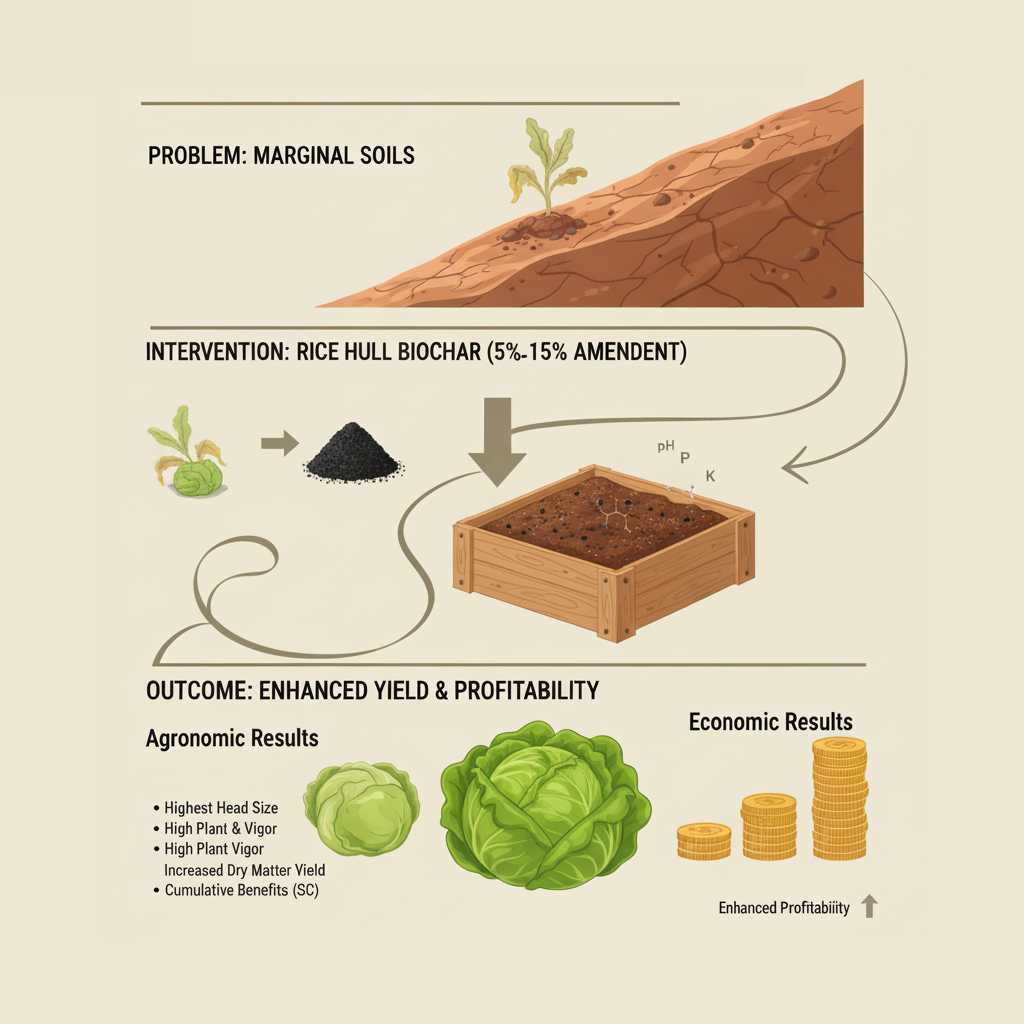
Global food insecurity necessitates innovative, localized solutions to improve agricultural resilience, particularly in sloped or marginal lands where conventional farming is limited. This study evaluated the morphophysiological response of iceberg lettuce to varying concentrations of rice hull biochar in a raised-bed system under highland agro-ecological conditions in the Philippines. A randomized complete block design with three replications was implemented, testing five treatments: conventional practice, raised-bed with growing media (RBGM), and RBGM amended with 5%, 10%, and 15% rice hull biochar. Morphological parameters, chlorophyll content, and yield components were measured across two cropping cycles. Statistical analysis revealed that biochar-amended systems significantly improved head size, plant vigor, chlorophyll content, and dry matter yield compared to the control. The 5% and 15% biochar treatments consistently outperformed the conventional and unamended systems, with the latter yielding the largest head sizes in the second cropping cycle, suggesting both immediate and residual effects. The findings underscore the potential of rice hull biochar as a cost-effective, sustainable amendment that enhances soil properties and crop productivity in household-scale gardening systems. This study contributes to the growing body of evidence supporting biochar’s role in regenerative agriculture, especially for resource-constrained settings, and offers practical recommendations for strengthening food self-sufficiency through home-based production.
Article Details

This work is licensed under a Creative Commons Attribution-NonCommercial-NoDerivatives 4.0 International License.
References
Animasaun DA, Adedibu PA, Shkryl Y, Emmanuel FO, Tekutyeva L, Balabanova L. Modern plant biotechnology: An antidote against global food insecurity. Agron. 2023;13(8):2038-2040.
Fazzino D. Global Food Security. In: Elsevier eBooks. 2019;1:177–179.
Diaz-Segura EG, Oviedo-Veas JE. Identification of topographic seismic site periods in sloping terrains. Appl Sci. 2024;14(17):7506.
Jiménez LFS, Cambronero LB. Influence of slope gradient and property size as determining factors for land cover in La Paz, San Ramón, Alajuela, Costa Rica. Perspect Rurales N Época. 2024;22(43):1–22.
Banu MRF, Rani B, Kavya SR, Jabin PPN. Biochar: A black carbon for sustainable agriculture. Int J Environ Clim Change. 2023;13(6):418–432.
Kocsis T, Ringer M, Biró B. Characteristics and applications of biochar in soil–plant systems: A short review of benefits and potential drawbacks. Appl Sci. 2022;12(8):4051.
Rouphael Y. Genotypic variation in nutritional and antioxidant profile among iceberg lettuce cultivars. Acta Sci Pol. Hortorum Cultus. 2017;16(3):37–45.
Smoleń S, Kowalska I, Kováčik P, Halka M, Sady W. Biofortification of six varieties of lettuce (Lactuca sativa L.) with iodine and selenium in combination with the application of salicylic acid. Front Plant Sci. 2019;10:1-8.
Zekkori B, Khallouki F, Bentayeb A, Fiorito S, Preziuso F, Taddeo VA. A new phytochemical and anti-oxidant and anti-inflammatory activities of different Lactuca sativa L. var. Crispa extracts. Nat Prod Commun. 2018;13(9):1934578X1801300.
Abriz SF, Golezani KG. Improving electrochemical characteristics of plant roots by biochar is an efficient mechanism in increasing cations uptake by plants. Chemosphere. 2022;313 :137365.
Yi YS, Cho HJ, Heo JY, Lee YH. Effects of wood-derived biochar application on soil chemical properties and growth of lettuce (Lactuca sativa L.). Korean J Soil Sci Fertil. 2019;52(4):457–466.
Majidi AH. 9th edition. Effect of different biochar concentration on the growth of three agricultural plants in Afghanistan. J Wastes Biomass Manag. 2022;4(1):01–07.
Villegas-Pangga G. 7th edition. Production and characterization of biochars from slow pyrolysis of different biomass materials to evaluate properties as soil amendments. Philipp J Sci.2021;150(1), 267–276.
Mon WW, Toma Y, Ueno H. 7th edition. Combined effects of rice husk biochar and organic manures on soil chemical properties and greenhouse gas emissions from two different paddy soils. Soil Syst. 2024;8(1):32-35.
Dey S, Purakayastha TJ, Sarkar B, Rinklebe J, Kumar S, Chakraborty R, et al. Enhancing cation and anion exchange capacity of rice straw biochar by chemical modification for increased plant nutrient retention. SSRN Electron J. 2023;10:163681.
Hossain MZ, Bahar MM, Sarkar B, Donne SW, Ok YS, Palansooriya KN. Biochar and its importance on nutrient dynamics in soil and plant. Biochar. 2020;2(4):379–420.
Camacho A, Rochera C, Picazo A. Effect of experimentally increased nutrient availability on the structure, metabolic activities, and potential microbial functions of a maritime Antarctic microbial mat. Front Microbiol. 2022;13:900158.
Santos SAM, Santos TRD, Furtado MSR, Henry R, Ferragut C. Periphyton nutrient content, biomass and algal community on artificial substrate: Response to experimental nutrient enrichment and the effect of its interruption in a tropical reservoir. Limnol. 2017 Nov 24;19(2):209–218.
Jabborova D, Kadirova D, Narimanov A, Wirth S. Beneficial effects of biochar application on lettuce (Lactuca sativa L.) growth, root morphological traits and physiological properties. Ann Phytomed Int J. 2021;10(2):45-52.
Trupiano D, Cocozza C, Baronti S, Amendola C, Vaccari FP, Lustrato G. The effects of biochar and its combination with compost on lettuce (Lactuca sativa L.) growth, soil properties, and soil microbial activity and abundance. Int J Agron. 2017;2017:1–12.
Elsherpiny M, Baddour A, Kaney M. Improving crisphead lettuce productivity grown under water deficit conditions through biochar and zeolite soil amendments, coupled with foliar stimulant applications under a drip irrigation system. Egypt J Soil Sci. 2024;64(2):643–660.
Premono BT, Wakhid N, Handayani D, Nurzakiah S, Tata HL. Home garden mixed cropping practice by communities living on peatland in household’s income resilience and climate adaptation. IOP Conf Ser Earth Environ Sci. 2024;1315(1):012003.
Dahal J, Pandey U, Bhandari U, Tiwari S, Shrestha S. Performance of lettuce (Lactuca sativa L.) genotypes with respect to morphological, yield and quality traits at two localities of Nepal. Nepalese Hortic. 2021;15:64–72.
Park S, Kumar P, Shi A, Mou B. Population genetics and genome‐wide association studies provide insights into the influence of selective breeding on genetic variation in lettuce. Plant Genome. 2021;14(2):e20098.
