
Macrofungi Species in Para Rubber Plantation in Kaeng Hang Maeo District, Chanthaburi Province, Thailand
Article Sidebar
Main Article Content
Abstract
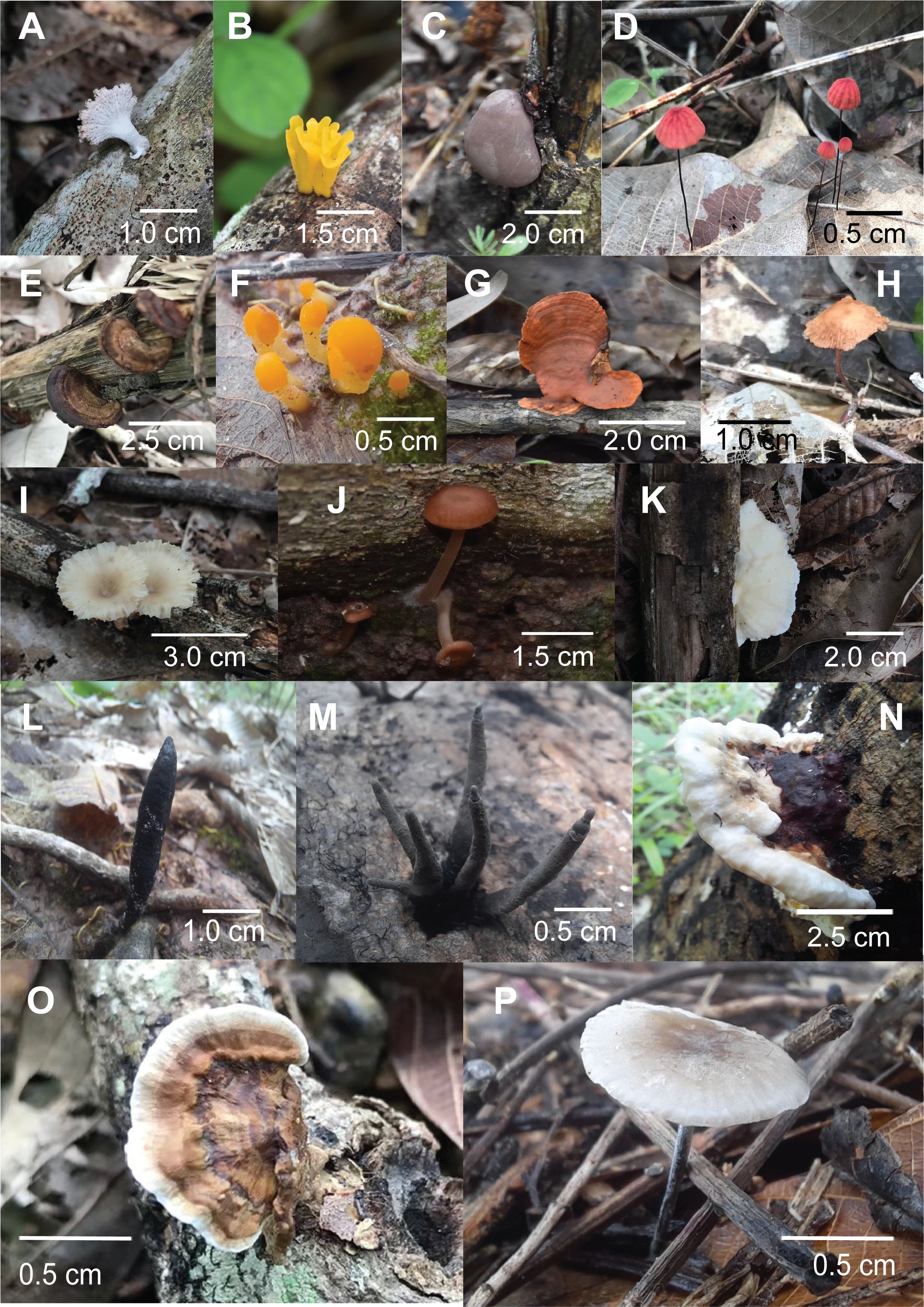
This study aimed to investigate the macrofungi species in a para rubber plantation in Kaeng Hang Maeo District, Chanthaburi Province, to identify them by a molecular method, and to evaluate their mode of life, and edibility data. Twenty-three macrofungi samples were collected, of which 16 macrofungi with different fruiting body forms were selected for identification. Based on macro-morphological characteristics, they were divided into 5 groups: (i) Cordyceps, Xylaria, and Daldinia, (ii) Earth tongues, (iii) Gilled fungi, (iv) Polypores and bracket fungi, and (v) Jelly fungi. The gilled fungi (37.5%) were mostly found in this area. Subsequently, the internal transcribed spacer (ITS) was amplified by a polymerase chain reaction (PCR), and its sequence was analyzed. The macrofungi were classified into 2 phyla, 4 classes, 5 orders, 9 families, and 15 genera. Most macrofungi were classified in the phylum Basidiomycota (75%) and the family Polyporaceae (31.25%). However, only 1 sample could not be identified at the species level, which was Gerronema sp. (KM12). Additionally, most of the macrofungi played a role as saprotrophs in the ecosystem (93.75%), and only 1 sample was found to be a pathotroph (6.25%). Although most macrofungi lacked edibility data (87.5%), edible macrofungi, including Schizophyllum commune (KM2) and Dacryopinax spathularia (KM3), were identified (12.5%). However, poisonous macrofungi were not reported in this study.
Article Details

This work is licensed under a Creative Commons Attribution-NonCommercial-NoDerivatives 4.0 International License.
References
Monkai J, Hyde KD, Xu J, Mortimer PE. Diversity and ecology of soil fungal communities in rubber plantations. Fungal Biol Rev. 2017;31(1):1-11.
Nizamani MM, Zhang Q, Zhang HL, Wang Y. Checklist of the fungi associated with the rubber tree (Hevea brasiliensis). Curr Res Environm Appl Mycol. 2023;13(1):439-488.
Seephueak P, Petcharat V, Phongpaichit S. Fungi associated with leaf litter of para rubber (Hevea brasiliensis). Mycology. 2010;1(4):213-227.
Seephueak P, Phongpaichit S, Hyde K, Petcharat V. Diversity of saprobic fungi on decaying branch litter of the rubber tree (Hevea brasiliensis). Mycosphere. 2011;2:307-330.
Surawut S, Nak-eiam S, Kunsook C, Kamhaengkul L, Kanjanavas P, Yasawong M. Diversity and the molecular identification of some ascomycetes macrofungi found in the Para Rubber plantation, Thailand. J Biochem Technol. 2021;12(4):50-56.
Meijide A, Badu CS, Moyano F, Tiralla N, Gunawan D, Knohl A. Impact of forest conversion to oil palm and rubber plantations on microclimate and the role of the 2015 ENSO event. Agric For Meteorol. 2018;252:208-219.
Nguyen TT, Do TT, Harper R, Pham TT, Linh TVK, Le TS, et al. Soil health impacts of rubber farming: The implication of conversion of degraded natural forests into monoculture plantations. Agriculture. 2020;10(8):357.
Ainusyifa F, Lestari R, Yuniati R. A review of fungal disease in Hevea brasiliensis (Willd. ex A. Juss.) Mull. Arg.: From identification to scientific investigation for control strategies. JPPIPA. 2024;10(12):977-987.
Surawut S, Kunsook C, Nak-eiam S, Khamchatra N-m, Bhudharak S, Phontharod W, et al. Biodiversity and functional distribution of macrofungi from Plant Genetic Conservation Area, Chanthaburi Province, Thailand. Curr Appl Sci Technol. 2023; 23(5): 1-19.
Nguyen NH, Song Z, Bates ST, Branco S, Tedersoo L, Menke J, et al. FUNGuild: An open annotation tool for parsing fungal community datasets by ecological guild. Fungal Ecol. 2016;20:241-248.
Lan G, Wu Z, Yang C, Sun R, Chen B, Zhang X. Tropical rainforest conversion into rubber plantations results in changes in soil fungal composition, but underlying mechanisms of community assembly remain unchanged. Geoderma. 2020;375:114505.
Li H, Guo J, Karunarathna SC, Ye L, Xu J, Hyde KD, et al. Native forests have a higher diversity of macrofungi than comparable plantation forests in the Greater Mekong Subregion Forests. 2018;9(7):402.
Chandrasrikul A, Suwanarit U, Morinaga T, Nishizawa Y, Murakami Y. Diversity of mushroom and macrofungi in Thailand. Bangkok, Thailand: Kasetsart University Publishing; 2008.
Chandrasrikul A, Suwanarit P, Sangwanit U, Lumyong S, Payapanon A, Sanoamuang N, et al. Checklist of mushrooms (Basidiomycetes) in Thailand. Bangkok, Thailand: Office of Natural Resources and Environmental Policy and Planning; 2011.
Desjardin, D.E. TFaTB. Basidiomycetes. In: EGB Jones, M Tanticharoen and KD Hyde (eds.). Thai fungal diversity. Thailand: Biotech Publishing; 2004.
Liu D, Coloe S, Baird R, Pedersen J. Rapid mini-preparation of fungal DNA for PCR. J Clin Microbiol. 2000;38(1):471.
Raja HA, Miller AN, Pearce CJ, Oberlies NH. Fungal identification using molecular tools: A primer for the natural products research community. J Nat Prod. 2017;80(3):756-770.
Saitou N, Nei M. The neighbor-joining method: a new method for reconstructing phylogenetic trees. Mol Biol Evol. 1987;4(4):406-425.
Tamura K, Nei M, Kumar S. Prospects for inferring very large phylogenies by using the neighbor-joining method. Proceedings of the National Academy of Sciences of the United States of America. 2004;101(30):11030-11035.
Kumar S, Stecher G, Li M, Knyaz C, Tamura K. MEGA X: Molecular evolutionary genetics analysis across computing platforms. Mol Biol Evol. 2018;35(6):1547-1549.
Seephueak P, Preecha C, Seephueak W. Diversity of macrofungi in oil palm (Elaeis guineensis Jacq.) plantation in Southern Thailand. Walailak J Sci & Tech (WJST). 2018;15(3):201-211.
Osemwegie O, Okhuoya J, Oghenekaro A, Evueh G. Macrofungi community in rubber plantations and a forest of Edo State, Nigeria. J Appl Sci. 2010;10:391-398.
Osemwegie O, Okhuoya J. Diversity and abundance of macrofungi in rubber agroforests in southwestern Nigeria. Nord J Bot. 2011;29(1):119-128.
Bolhassan MH, Abdullah N, Sabaratnam V, Hattori T, Abdullah S, Mohd Nor Rashid N, Musa MY. Diversity and distribution of polyporales in Peninsular Malaysia. Sains Malays. 2012;41:155-161.
Zhou L-W, Hao Z-Q, Wang Z, Wang B, Dai Y-C. Comparison of ecological patterns of polypores in three forest zones in China. Mycology. 2011;2(4):260-75.
Rosane, C. Morphological Differences in Fungi: A Comparative Study across Ecosystems. Int J Anat Var. 2024;17(8):627-628.
Na Q, Hu Y, Zeng H, Song Z, Ding H, Cheng X, et al. Updated taxonomy on Gerronema (Porotheleaceae, Agaricales) with three new taxa and one new record from China. MycoKeys. 2022;89:87.
Hawkeswood T, Sommung B, Sommung A. First record of Marasmius haematocephalus (Mont.) Fr. (1838) (Basidiomycota: Marasmiaceae) from Sisaket Province, Thailand. Calodema. 2021;940:1-3.
Kush A, Goyvaerts E, Chye ML, Chua NH. Laticifer-specific gene expression in Hevea brasiliensis (rubber tree). Proc Natl Acad Sci U S A. 1990;87(5):1787-90.
Boddy L, Watkinson SC. Wood decomposition, higher fungi, and their role in nutrient redistribution. Canad J Bot.1995;73(S1):1377-83.
Olou BA, Hègbè AD, Piepenbring M, Yorou NS. Genetic diversity and population differentiation in Earliella scabrosa, a pantropical species of Polyporales. Sci Rep. 2023;13(1):23020.
Senwanna C, Mapook A, Samarakoon M, Karunarathna A, Wang Y, Tang A, et al. Ascomycetes on Para rubber (Hevea brasiliensis). Mycosphere. 2021;12(1):1334-1512.
Dasgupta D, Basu P, Paul A, Acharya K, Chakraborty N. Schizophyllum commune, an underrated edible and medicinal mushroom: farm to industry. Stud Fungi. 2025;10: e004.
Younes M, Aquilina G, Engel KH, Fowler P, Frutos Fernandez MJ, Fürst P, et al. Safety evaluation of long-chain glycolipids from Dacryopinax spathularia. EFSA J. 2021;19(6):e06609.
Xu R-F, Karunarathna SC, Phukhamsakda C, Dai D-Q, Elgorban AM, Suwannarach N, et al. Four new species of Dothideomycetes (Ascomycota) from Para rubber (Hevea brasiliensis) in Yunnan Province, China. MycoKeys. 2024;103:71-95.
Sutjaritvorakul T, Permpoonsinsup W, Srigobue P, Koomsubsiri A. The study of seasonal and climate changes on macrofungi biodiversity in the community forest at Sai Yok District, Kanchanaburi Province, Thailand. Int J Agric Technol. 2017;13(3):425-431.
Yusran Y, Erniwati E, Wahyuni D, Ramadhanil R, Khumaidi A. Diversity of macro fungus across three altitudinal ranges in Lore Lindu National Park, Central Sulawesi, Indonesia and their utilization by local residents. Biodiversitas. 2021;22(1):199-210.
Tie L, Lang Z, Deng L, Junqiang Z. Studies on macrofungi diversity and discovery of new species of Abortiporus from Baotianman World Biosphere Reserve. Open Life Sci. 2023;18(1):20220614.
Shi L-l, Zhai D-L, Chen H-f. Converting tropical rainforest to native rubber plantations alters soil bacterial and fungal communities. Circ. Agric. Syst. 2022;2(1):1-6.
Lan G, Wei Y, Li Y, Wu Z. Diversity and assembly of root-associated microbiomes of rubber trees. Front Plant Sci. 2023;14:1136418.
Hong Z, Li X, Li D, Wu J. Rubber-based agroforestry systems modify the soil fungal composition and function in Southwest China. Soil Ecol Lett. 2024;6(3):230224.
